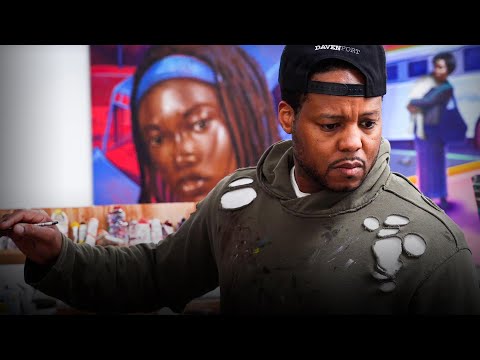
Titus Kaphar: Can beauty open our hearts to difficult conversations? | TED
The Beauty of Unheard Voices
In this section, the speaker discusses the beauty in hearing the voices of people who haven't been heard and how even difficult conversations can be beautiful if they reflect truth.
Finding Beauty in Difficult Conversations
- The speaker believes that there is beauty in hearing the voices of people who haven't been heard.
- Not all things that need to be said are lovely, but if they reflect truth, they can be fundamentally beautiful.
- Aesthetic beauty in artwork can serve as a Trojan horse, allowing for open hearts and facilitating difficult conversations.
- Sometimes, attraction to the aesthetic beauty of artwork can lead to unexpected engagement with challenging topics.
Learning from Masters and Struggles with Representation
The speaker reflects on their journey of learning how to paint by studying master artists and highlights the challenges faced when it comes to representing dark skin tones.
Challenges with Representing Dark Skin Tones
- The speaker learned how to paint by spending time at museums and studying master artists like Rembrandt, Renoir, and Manet.
- Traditional painting techniques have formulas for painting white skin but lack guidance for dark skin tones.
- Historical paintings do not represent individuals like the speaker or reflect their values, creating a conflict between technique and personal identity.
Amending History through Artistic Expression
The speaker discusses how many artists are amending history through their work to ensure representation and visibility for marginalized communities.
Amending History through Artistic Expression
- Despite being influenced by Western training and technique, the speaker's eye is drawn towards representing individuals who look like them.
- Some strategies used in their work include whiting out parts of compositions or cutting out figures to emphasize the presence or absence of certain characters.
- Many artists are amending history by creating art that reinforces the idea that marginalized communities have always been present and deserve recognition.
Exploring the Criminal Justice System through Art
The speaker shares their personal experience of reconnecting with their father after years of separation and how it inspired a body of work exploring the criminal justice system.
Exploring the Criminal Justice System
- After reconnecting with their father, the speaker started creating portraits of mug shots as a way to understand what had happened during his absence.
- Discovering 97 other Black men with the same name and mug shots led to a deeper exploration of incarceration and its impact on individuals' lives.
- The use of tar in early paintings symbolized lost time due to incarceration, highlighting the long-lasting effects beyond just time served.
Seeking Recognition and Remembering
The speaker discusses how their artwork aims to recognize and remember those who have been incarcerated, emphasizing the importance of seeing and acknowledging individuals who have been marginalized.
Recognizing Incarcerated Individuals
- Art can be a way to say "I see you" to incarcerated individuals who want to be remembered and seen.
- By putting people away for one worst thing they've done, society often overlooks their humanity.
- The speaker's artwork aims to acknowledge and give visibility to those who have been marginalized by society.
Unveiling Hidden Stories in History
The speaker explores hidden stories in history through their artwork, using symbolism and contrasting elements to shed light on race relations in America.
Unveiling Hidden Stories
- Artwork like "Behind the Myth of Benevolence" reveals hidden stories by pulling back the curtain on historical figures like Thomas Jefferson to expose the experiences of Black women.
- The speaker uses contrasting elements and forced compositions to emphasize the tumultuous relationship between Black and white communities.
- Artwork like "Another Fight for Remembrance" addresses ongoing violence against Black people by the police, highlighting the repetition of such incidents.
Editorializing Current Events through Art
The speaker discusses how their artwork serves as a commentary on current events, particularly incidents of violence against Black individuals by the police.
Commentary on Current Events
- Artwork like "Another Fight for Remembrance" is editorialized as a painting about Ferguson but also represents similar incidents in other cities like Detroit and Minneapolis.
Experience of Racial Profiling
The speaker recounts an incident where they were stopped by police officers who accused them of stealing art. They question the differential treatment based on their citizenship and learn that they had been followed for two hours.
Racial Profiling Incident
- The speaker and a companion were stopped by police officers in the street.
- The officers accused them of stealing art from a gallery space, despite the speaker actually exhibiting art there.
- They were put up against a wall with the officers' hands on their guns.
- The speaker questions why their citizenship was treated differently from others not being disturbed at that moment.
- The officer explains that they had been following them for two hours due to complaints about Black men walking in and out of galleries.
"From a Tropical Space" Art Series
The speaker introduces their recent body of work called "From a Tropical Space," which focuses on Black mothers. The paintings depict a world where the children of these women are disappearing, highlighting the struggles faced by Black women and women of color in society.
"From a Tropical Space" Art Series
- The series portrays Black mothers in a supersaturated, surrealist world similar to our own.
- It explores the trauma experienced by Black women and women of color in our community as they strive to provide opportunities for their children.
- Working with young people in the community has given the speaker hope for finding solutions to these challenges.
NXTHVN Arts Incubator
The speaker discusses NXTHVN, a 40,000-square-foot arts incubator located in the Dixwell neighborhood of New Haven, Connecticut. The project aims to support creativity and provide opportunities for young artists from the predominantly Black and Brown neighborhood.
NXTHVN Arts Incubator
- NXTHVN is an arts incubator situated in the Dixwell neighborhood.
- The neighborhood has a rich history of jazz but has been disinvested in many ways.
- Schools struggle to prepare the population for their future, emphasizing the importance of creativity.
- Each artist in the program works with a high school studio assistant from New Haven, fostering learning and skill development.
- The power of creativity has been observed to positively impact individuals.
Beauty and Truth
The speaker reflects on the complexity of beauty and its connection to truth. They express that beauty and truth are intertwined concepts.
Beauty and Truth
- Beauty is complicated due to its subjective definition.
Turn any video into a summary like this
YouTube links, meetings, lectures. With transcripts, search, and chat.