Genetic Recombination and Gene Mapping
Genetic Recombination and Gene Mapping
Introduction to Genetic Recombination
- Mr. Andersen introduces the topic of genetic recombination and gene mapping, highlighting Thomas Hunt Morgan's work with fruit flies.
- Morgan demonstrated that genes do not travel independently; they are located on chromosomes and can swap positions during crossing over.
Fruit Fly Genetics Overview
- The wild type fruit fly is contrasted with a mutant variant exhibiting black coloration and vestigial wings, indicating different genotypes.
- The wild type genotype is represented as "+" while the mutant is denoted as "little b little b," showcasing dominance in traits like wing structure.
Morgan's Puzzling Cross Experiment
- Morgan conducts a test cross using a hybrid wild type fly (F1 generation) crossed with a homozygous recessive mutant.
- He sets up a Punnett square to predict offspring phenotypes, expecting 50% parental types and 50% recombinants based on Mendelian genetics.
Unexpected Results from the Cross
- Contrary to expectations, results show 83% parental phenotypes versus only 17% recombinant types, raising questions about Mendel’s model.
- This discrepancy leads to further investigation into the nature of gene linkage and chromosome behavior during meiosis.
Alfred Sturtevant's Contribution
- Alfred Sturtevant, one of Morgan's students, proposes an explanation for the observed recombination frequency by analyzing gamete production during meiosis.
- Sturtevant concludes that since recombination frequency is less than 50%, it indicates that the two genes are located on the same chromosome.
Understanding Meiosis and Crossing Over
- During meiosis, DNA replication occurs followed by two divisions; if genes are on the same chromosome, specific gametes will be produced.
- The concept of crossing over emerges as crucial; if chromosomes exchange segments during meiosis, new combinations of alleles can form.
Visualizing Chromosomal Behavior
- Under microscopic observation, crossing over can be seen where segments of chromosomes swap places leading to recombinant chromosomes with mixed traits.
Genetic Recombination and Gene Mapping
Understanding Genetic Recombination
- The concept of genetic recombination arises when crossing over occurs between different genes on a chromosome, leading to variations in gene combinations.
- A frequency of recombination can be used to determine the distance between genes; closer genes result in higher frequencies of recombination, while farther genes yield lower frequencies.
- If the frequency of recombination is 50%, it indicates that the two genes are likely located on different chromosomes, suggesting independent assortment.
Building a Gene Map
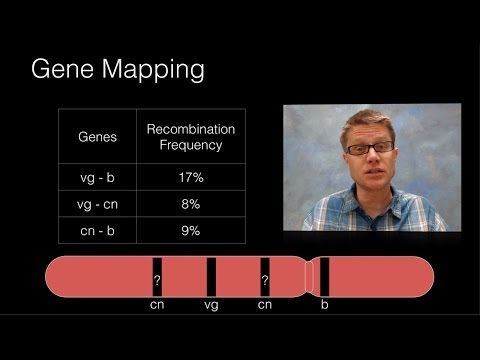
- Data collected showed that the vestigial gene and black coloration gene have a 17% frequency of recombination, indicating they are approximately 17 map units apart.
- When mapping out other genes like cinnabar (related to eye color), starting with the highest frequency helps establish their relative positions on the chromosome effectively.
Practical Application in Gene Mapping
- To determine where multiple genes are located based on their frequencies, one must consider all possible arrangements and eliminate those that do not fit observed recombination data.
- An exercise was suggested for viewers to practice mapping four given genes based on their respective frequencies of recombination.
Historical Context and Modern Techniques
- Sturtevant and Morgan's work laid foundational principles for gene mapping through recombination frequencies; however, modern techniques now rely primarily on DNA sequencing for precise gene location identification.