Organizacion Social: Concepto, Características y Tipos
Introduction to Social Organization
The introduction provides an overview of social organization, discussing its components, characteristics, types, and relevance in today's context.
Understanding Social Organization
- Social organization is divided into two main aspects: as a social entity and as an administrative function.
- As a social entity, it comprises individuals intentionally gathered to achieve specific objectives.
- Entities are formed by groups with common purposes or goals to accomplish collectively.
Administrative and Social Structure
- Administrative organization is categorized into formal (backed by the company structure) and informal (based on interpersonal relationships).
- Social structure within organizations interacts with broader societal systems, influencing each other reciprocally.
Characteristics of Social Organizations
This section delves into the key characteristics that define social organizations and their significance within larger societal frameworks.
Key Characteristics
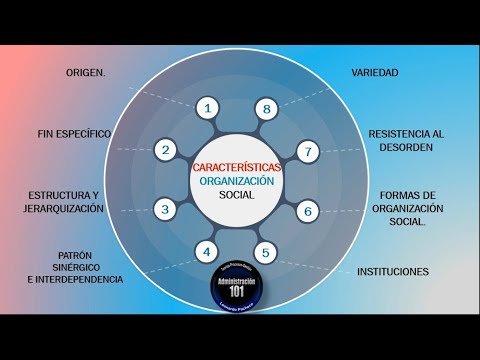
- Originating from human groupings seeking security and operating towards shared objectives.
- Families serve as fundamental units within social organizations, exhibiting specialized roles and common goals.
Purpose and Structuring
- Social structures revolve around specific aims such as survival or resource management.
Organizational Characteristics and Types of Social Organizations
This section discusses the characteristics and types of social organizations, emphasizing interdependence, synergy, institutions, resistance to disorder, and variety within social systems.
Interdependence and Synergy
- Social organizations exhibit interdependence as individuals specialize in specific functions necessary for group goals.
- Interdependency leads to a synergistic pattern where disruption can cause system breakdown and increased entropy.
Institutions and Complexity
- Institutions like the state exemplify complex social organizations with diverse objectives working towards common goals.
- Various institution types such as political, religious, educational, economic, professional, legal contribute to societal dynamics.
Forms of Social Organization
- Social organization forms are tailored to address specific societal needs or problems within distinct social contexts.
- Ranging from environmental conservation to governance structures like states or large financial corporations.
Resistance to Disorder
- Social organizations resist disorder by maintaining objectives and foundational structures against entropy increase.
- Anarchy represents extreme disorder resulting from the dissolution of hierarchical structures within society.
Variety and Control Mechanisms
- Variety in a system reflects its complexity based on diverse possible behaviors among members.
Organizational Structures in Social Organizations
The transcript discusses various types of social organizations and their functions within communities.
Functional Organizations
- Functional organizations address specific problems and needs while showing interest in affecting certain population sectors.
- Territorial organizations focus on improving the quality of life in a specific area where people reside, such as self-construction committees and regional corporations.
- Local social organizations, like communal contracting and health posts, operate at a smaller scale than territorial ones, often considered a subset or subsystem of territorial organizations.
Solidarity Economy Organizations
- Solidarity economy organizations can be integral, combining multiple activities like consumption, production, and services. Specialized organizations focus on distinct economic or service activities to benefit members or the community.
- Multi-active solidarity economy groups engage in various similar activities simultaneously, such as consumption, savings, credit, and commercialization. Production-oriented entities accelerate non-renewable resource exploitation or transformation for final product attainment.
Conclusion