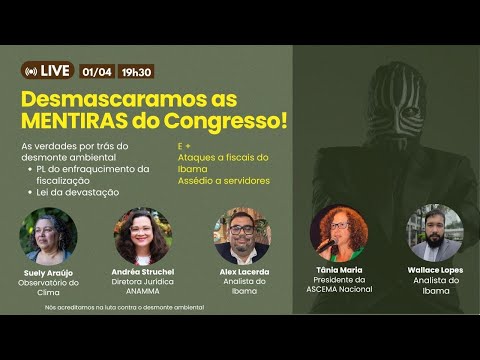
Desmascaramos as MENTIRAS do Congresso! As verdades por trás do desmonte ambiental
Introduction to the Live Session
Welcome and Engagement
- The host welcomes viewers and encourages sharing the live session on WhatsApp to increase engagement.
- Acknowledgment of the expert panel, including Sueli Araújo, André Estrúcha, and Alex Lacerda, who will discuss legislative changes affecting environmental policies.
Panel Introductions
Expert Panel Overview
- Sueli Araújo is introduced as a former president of IBAMA and current member of the Climate Observatory, focusing on legislative gaps in environmental laws.
- André Estrúcha serves as the legal director at Nama, providing insights into municipal realities regarding new legislation.
- Alex Lacerda represents IBAMA in Pará, highlighting his frontline experience with environmental conflicts.
Contextualizing Legislative Changes
Current Environmental Challenges
- The host reflects on ongoing challenges faced by environmental servers amidst changing government narratives about environmental protection.
- Discussion about how recent legislative changes have created a sense of urgency for vigilance among environmental advocates.
New Licensing Law Discussion
Implications of the New Licensing Law
- The new general licensing law has been approved but faces criticism for potentially undermining existing protections through expedited processes that lack thorough assessments.
- Concerns are raised about how this "modernization" may actually dismantle decades of regulatory progress rather than improve it.
Violence Against Environmental Servants
Risks Faced by Environmental Workers
- Increased violence against environmental workers is noted as a troubling consequence of aggressive legislative changes that embolden anti-environmental sentiments among certain political factions.
Initial Insights from Sueli Araújo
Critique of Legislative Intentions
- Sueli argues that the new licensing law represents one of the worst setbacks in Brazil's environmental legislation since its inception in 1981, prioritizing expediency over ecological safeguards.
- She highlights specific provisions like self-declaration licenses that bypass essential studies required for significant projects, raising alarms about potential ecological harm.
Judicial Response to Legislative Changes
Legal Challenges Ahead
- Three direct actions of unconstitutionality (ADIs) have been filed against aspects of the new law by various political parties and organizations concerned about its implications for public health and safety standards in licensing processes.
Specific Case: BR319 Project
Controversial Infrastructure Developments
- The discussion includes concerns over plans to use exemptions from licensing requirements for infrastructure improvements along BR319, which could lead to significant ecological damage without proper oversight or assessment procedures being followed.
Public Participation Issues
Virtual Audiences vs In-Person Engagement
- There are serious concerns regarding virtual public hearings replacing traditional formats; this shift could disenfranchise local communities who rely on face-to-face interactions to voice their opinions effectively during critical project discussions.
Impact on Local Communities
Disempowerment Through Legislation
- The panel discusses how these legislative changes disproportionately affect marginalized communities who often lack access to digital platforms necessary for participating in virtual hearings.
Municipal Autonomy Under Threat
Diminished Local Governance
- Andréia emphasizes that municipalities are losing autonomy under the new law due to reduced roles in local decision-making processes related to land use and environmental management.
Conclusion: Erosion of Environmental Protections
Summary Reflection
- Tânia compares current licensing practices to "chocolate-flavored" versions lacking real substance or protective measures; she stresses that genuine community involvement is crucial for effective governance.
Challenges in Environmental Licensing and Monitoring
Inefficiencies in Licensing Oversight
- The current licensing process struggles with effective monitoring due to overwhelming demands for new licenses, leading to insufficient oversight until renewal periods, which can be 4-5 years apart.
State and Federal Oversight Limitations
- There are concerns about how state and federal agencies like IBAMA will meet the increased expectations for effective monitoring amidst a more rigorous licensing process.
Staffing Shortages at IBAMA
- Alex expresses skepticism regarding the effectiveness of IBAMA's oversight, citing significant personnel shortages that hinder their ability to combat deforestation and illegal activities such as biopiracy and wildlife trafficking.
Political Constraints on Local Inspectors
- Local inspectors often face political pressures that limit their ability to enforce regulations effectively, making it difficult for them to act against illegal activities within their jurisdictions. This creates a dangerous environment for those trying to uphold environmental laws.
Challenges in Enforcing Environmental Regulations
- The possibility of local inspectors enforcing regulations against public entities is seen as very low due to political constraints, complicating efforts in states like Pará where strict licensing exemptions have been misapplied.
Misuse of Environmental Licenses
Irregularities in Aquaculture Licensing
- Instances of aquaculture licenses being misused were reported, where individuals falsely claimed smaller water surface areas than they actually had, highlighting issues with enforcement capabilities.
Inadequate Oversight by State Agencies
- The inability of state agencies to monitor compliance effectively leads to further irregularities in environmental licensing practices across various sectors.
Political Influence on Licensing Decisions
- A case was noted where a municipal secretary issued a pasture cleaning license outside their jurisdiction, demonstrating the extent of political influence over environmental regulation processes.
Legislative Failures in Environmental Protection
Critique of New Licensing Legislation
- There is strong criticism regarding new legislation that fails to enhance monitoring or enforcement capabilities despite increasing regulatory burdens on environmental oversight bodies like IBAMA.
Temporary Staff Limitations
- Many environmental inspectors are temporary employees lacking job security or autonomy necessary for enforcing regulations against politically connected individuals or entities. This undermines effective governance and accountability within the system.
Insufficient Legislative Support for Enforcement
- The recent legislative changes do not address the need for stronger enforcement mechanisms; instead, they perpetuate existing weaknesses within the regulatory framework without providing additional resources or support for monitoring efforts.
Technological Advancements vs Legislative Restrictions
Potential of Technology in Monitoring
- Advances in technology could significantly improve monitoring capabilities; however, recent proposals restrict remote surveillance methods that could aid enforcement actions against illegal activities such as deforestation and land use violations.
Historical Context of Monitoring Technologies
- A comparison was made between past limitations (e.g., reliance on infrequent satellite images) versus today's access to daily high-resolution imagery that enhances real-time monitoring capabilities significantly but faces legislative hurdles preventing its use effectively.
Contradictions Within Legislative Proposals
Restrictions on Remote Monitoring Tools
- Recent congressional proposals prevent using advanced technologies for remote inspections while emphasizing rights such as due process—this contradicting established principles aimed at efficient environmental protection measures through timely interventions before damage occurs.
Ethical Obligations vs Practical Limitations
- Public servants are ethically obligated to utilize available technologies; however, legislative restrictions create contradictions with these ethical standards by limiting tools essential for effective service delivery within environmental management frameworks.
Implications of Proposed Changes
Impact on Cautionary Measures
- Proposed changes threaten cautionary measures critical for immediate intervention during potential ecological harm events; this could lead directly into exacerbated damages requiring later remediation rather than prevention strategies being prioritized upfront through proactive measures like embargoes based upon satellite data analysis etc..
Conclusion: Need For Comprehensive Reform
The discussions highlight an urgent need for comprehensive reform addressing both staffing inadequacies at regulatory bodies alongside ensuring technological advancements can be leveraged appropriately without undue legislative hindrances impeding progress towards sustainable development goals while safeguarding natural resources effectively moving forward .
Discussion on Environmental Legislation and Monitoring in the Amazon
The Impact of Legislative Measures on Environmental Monitoring
- The speaker describes the recent legislative attempts to prohibit remote monitoring tools for environmental oversight as a significant deception, indicating that these measures are part of a larger agenda against effective environmental regulation.
- There is a stark contrast between the number of available environmental inspectors (around 700-800) and the vastness of the area they need to monitor, highlighting systemic inadequacies in enforcement. This discrepancy raises concerns about the effectiveness of current regulations.
- Following an embargo on deforestation activities, there was a reported 55% decrease in deforestation rates during the second half of last year, demonstrating that such measures can be effective when implemented correctly. This success has led to political backlash against these regulatory efforts.
Political Pressure and Its Consequences
- The discussion reveals intense political pressure against environmental agencies like IBAMA, with aggressive questioning from local politicians aimed at undermining their authority and effectiveness during public hearings. Such actions create a politically charged atmosphere that complicates enforcement efforts.
- The speaker recounts personal experiences with early satellite monitoring technology, illustrating how advancements have significantly improved enforcement capabilities compared to past methods reliant on manual inspections without technological support.
Economic Implications of Illegal Deforestation
- A correlation is drawn between illegal deforestation practices and increased poverty levels in affected regions; areas with high rates of illegal logging often experience higher poverty due to corruption and lack of legitimate economic opportunities. This cycle perpetuates both environmental degradation and social issues.
- The narrative emphasizes that illegal economies thrive by corrupting local officials, which further entrenches poverty among communities dependent on unsustainable practices for survival while also endangering law enforcement personnel involved in regulatory activities.
Threats Faced by Environmental Inspectors
- Recent legislative opposition has emboldened criminal elements within local communities, leading to increased threats against environmental inspectors who enforce laws against illegal activities; this situation mirrors previous governmental attitudes towards regulatory bodies under different administrations.
- Specific instances are cited where inspectors faced direct threats from organized crime groups, raising serious concerns about their safety and ability to perform their duties effectively amidst escalating violence linked to anti-regulatory sentiments fostered by political leaders.
Broader Context: Legislative Attacks on Environmental Protections
- The conversation highlights ongoing attacks on Brazil's environmental legislation as part of broader political strategies aimed at dismantling protections for natural resources; this includes attempts to undermine established laws governing land use and indigenous territories through various proposed amendments and bills in Congress.
- Participants express concern over how these legislative changes not only threaten ecological integrity but also jeopardize public trust in government institutions tasked with protecting the environment amid rising populism and anti-establishment rhetoric prevalent in contemporary politics.
Strategies for Resistance Against Legislative Changes
- Activists emphasize the importance of mobilizing public opinion against harmful legislation while maintaining vigilance over congressional proceedings related to environmental policies; grassroots movements play a crucial role in counteracting negative trends affecting conservation efforts across Brazil's diverse ecosystems.
- There is recognition that despite challenges posed by fragmented legislative attacks—where multiple small bills collectively weaken protections—there remains potential for advocacy groups to unite around common goals focused on preserving critical legal frameworks essential for sustainable development practices moving forward into future electoral cycles.
Licenciamento Ambiental e Seus Desafios
Importância do Licenciamento Ambiental
- A questão do licenciamento ambiental é crítica, pois envolve compromissos que desafiam princípios fundamentais do direito ambiental, como prevenção e precaução.
- O conceito de licenciamento ambiental deve ser centrado na prevenção; o artigo 225 da Constituição Brasileira destaca a necessidade de um meio ambiente ecologicamente equilibrado.
Críticas à LAC (Lei de Licenciamento Ambiental)
- A LAC não oferece proteção ambiental adequada, conforme evidenciado por problemas enfrentados na Bahia, onde a lei foi implementada sem sucesso.
- A LAC é vista como uma quase dispensa de licenciamento ambiental, eliminando o caráter preventivo necessário para proteger o meio ambiente.
Mobilização e Voz da Sociedade Civil
- Há uma falta de voz para os municípios e a sociedade civil preocupados com a gestão ambiental no Brasil; isso resulta em brutalidades contra o licenciamento e fiscalização ambientais.
- É crucial que eleitores considerem as consequências das suas escolhas políticas nas próximas eleições, evitando candidatos que promovam retrocessos na gestão ambiental.
Reflexões sobre Motivação e Resistência
- Comparações são feitas entre desrespeitos sociais em programas populares e a necessidade urgente de mobilização social contra retrocessos legislativos no meio ambiente.
- Um apelo é feito para que a sociedade se una em defesa do meio ambiente, destacando que todos têm um papel na preservação coletiva.
Conclusão sobre Atuação dos Servidores Públicos
- Os servidores públicos dedicados ao meio ambiente enfrentam desafios significativos devido à má gestão e desrespeito às leis ambientais.
- A motivação dos servidores vem da defesa do bem comum; eles trabalham para garantir um meio ambiente saudável, apesar das dificuldades enfrentadas diariamente.