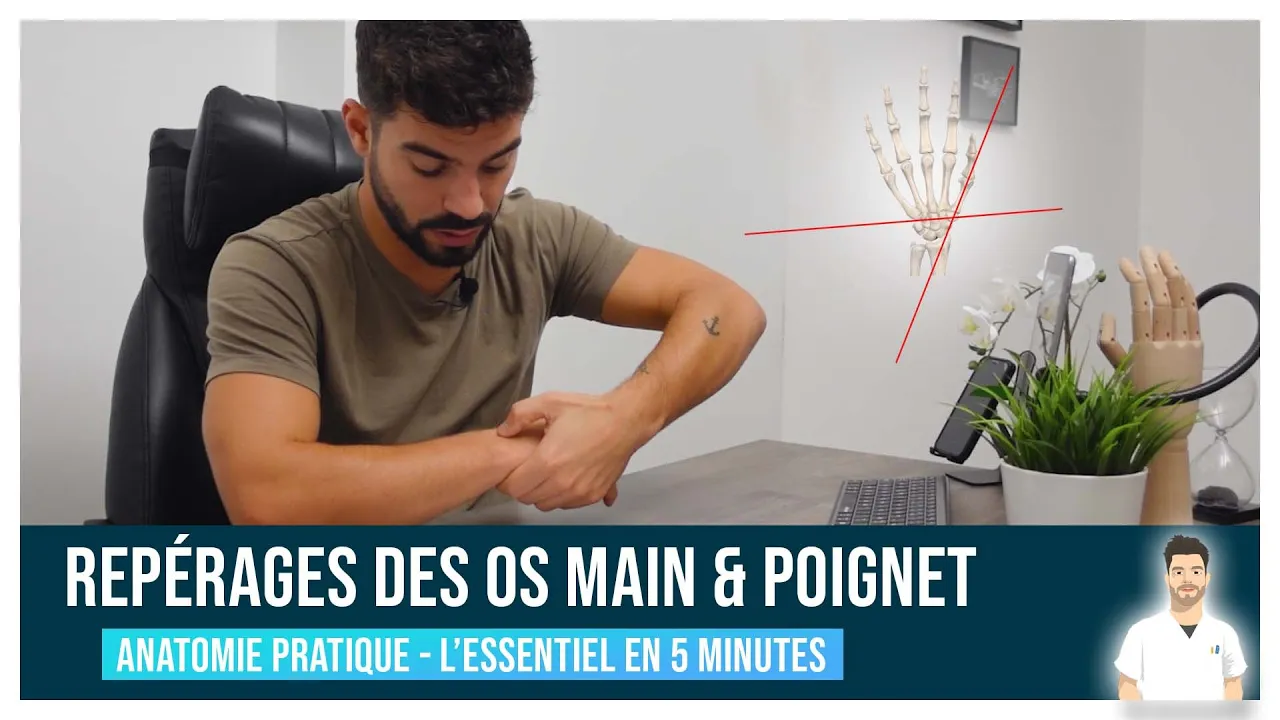
🖐 Anatomie Main & Poignet - Repérages palpatoires (3/4)
Anatomy: Identifying Bones of the Hand and Wrist
In this video, the presenter demonstrates how to precisely locate various bones of the hand and wrist based on audience preference. The focus is on identifying structures such as phalanges, metacarpals, scaphoid, lunate, trapezium, trapezoid, hamate, capitate, and pisiform.
Locating Phalanges and Metacarpals
- Phalanges are easily identified by distinct boundaries when flexing fingers.
- Palpate along the length of the finger to delineate distal and proximal interphalangeal joints.
- Metacarpals are palpable on the dorsal side of the hand due to tendon and muscle presence.
- Analyze structures in alignment with arm direction for easier identification.
Identifying Scaphoid and Lunate Bones
- Locate the scaphoid by aligning with the radius extension or feeling a depression.
- To find the lunate bone, follow from the third metacarpal or identify posterior radius tubercle.
Recognizing Trapezium and Trapezoid Bones
- The trapezium is challenging to palpate anteriorly but easier dorsally by following the second metacarpal.
- For locating the trapezoid, project from ulnar side while ensuring slight mobility confirmation.
Pinpointing Hamate and Capitate Bones
- Identify hamate below styloid process through ulnar projection near Luna.
- Capitate's distinctive feature is its sesamoid nature without direct articulation with other bones.