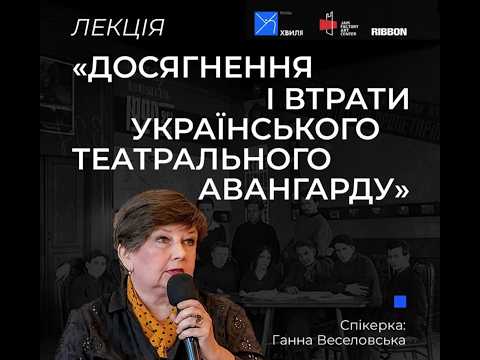
«Досягнення і втрати українського театрального авангарду» | Лекція Ганни Веселовської
Introduction to Ukrainian Theatrical Avant-Garde
Context and Background
- The speaker reflects on the unusual title of their dissertation, which was written 20 years ago when discussing avant-garde in Ukraine was not permitted.
- After gaining more freedom, the speaker authored a book titled "Ukrainian Theatrical Avant-Garde," indicating an ongoing fascination with the topic.
Lecture Overview
- The lecture is titled "Achievements and Losses of Ukrainian Theatrical Avant-Garde," focusing primarily on achievements with a brief discussion on losses later.
- Acknowledges the difficulty in discussing losses but emphasizes its necessity for a comprehensive understanding.
Fundamentals of Avant-Garde
Defining Avant-Garde
- Discusses the political implications surrounding avant-garde movements, particularly how they are often viewed through a Soviet lens.
- Highlights that while Ukrainian theatrical avant-garde coincided with Soviet times, it also requires deeper analysis beyond mere association with propaganda.
Social Critique as Core Element
- Emphasizes social criticism as a fundamental aspect of avant-garde art, influencing both neo-avant-gardists and contemporary artists.
- Notes that political movements at the end of the 20th century intersected with artistic protest initiatives led by avant-garde artists.
The Role of Popular Culture
Influence on Theatre
- Describes how popular culture served as fertile ground for avant-garde movements, making them accessible to wider audiences.
- Mentions that during the early 20th century, many people were captivated by theatrical avant-garde performances.
Marinette's Contributions
- Introduces Marinetti as a key figure who theorized about open-form theatre that engaged audiences interactively.
- Explains Marinetti's concept of "Serata," a traveling theatre designed to provoke and challenge bourgeois sensibilities through aggressive performance styles.
This structured approach provides clarity and facilitates easy navigation through key concepts discussed in the transcript.
Aesthetic Evolution in Avant-Garde Theatre
Introduction to Avant-Garde Theatre
- The speaker discusses the preparation for a lecture on avant-garde theatre, referencing Tis Leman's book on post-dramatic theatre, which introduces concepts of theatricalization and re-theatricalization.
Key Texts Influencing Discussion
- Mentioned texts include Leman's work, Dixon's "Digital Performance," and Walter Benjamin's essay on the reproduction of art. These texts serve as foundational references for understanding contemporary discussions in theatre.
Historical Context of Avant-Garde
- The evolution of avant-garde theatre is linked to its modest beginnings, contrasting with Marinetti’s more resourceful initiatives. It highlights how the movement gained momentum over ten years through systematic engagement with bourgeois audiences.
Social and Political Influences
- The rise of avant-garde coincided with significant social and political upheavals in Europe during World War I and various revolutions, particularly in Hungary, Germany, Slovenia, and Russia. This context fueled the movement’s critical stance against societal norms.
Intersection of Culture and Politics
- A discussion emerges about the convergence between popular culture and political activism within avant-garde movements. By the early 1920s, cinema began overshadowing other forms of art as a dominant medium due to its accessibility to broader audiences.
The Role of Cinema in Avant-Garde Theatre
Early Perceptions of Cinema
- In the early 20th century, cinema was perceived as lowbrow entertainment aimed at less discerning audiences. It primarily featured melodramas that lacked intellectual depth compared to other artistic expressions.
Actors' Status in Early Cinema
- Notable actors avoided film roles; instead, lesser-known performers filled these positions. This trend reflects a historical parallel where physical appearance often took precedence over acting skill.
Integration of Film into Theatre
- Avant-garde theatre began incorporating cinematic elements to engage wider audiences effectively. This strategic move aimed at reaching those who might not appreciate traditional theatrical performances.
Technological Innovations
- The speaker emphasizes that early 20th-century cinema represented one of the few technological advancements available to avant-garde artists. Despite its rudimentary nature—like flickering images projected onto screens—it became crucial for expanding audience reach.
Contrasting Modernism with Avant-Garde
Defining Characteristics
- A distinction is made between modernism and avant-garde movements: modernism respects tradition while seeking innovation; conversely, avant-garde artists reject tradition outright as part of their protest against established norms.
Impact on Ukrainian Art Scene
- The discussion transitions towards Ukraine’s artistic landscape during the 1910s, noting that modernism dominated rather than avant-garde principles. This divergence illustrates a cultural gap where traditional values were upheld amidst calls for radical change by some artists.
The Transition from Modernism to Avant-Garde in Ukrainian Culture
The Conflict of Traditions
- The transition from modernism to avant-garde is not a linear process; it involves complex cultural shifts and conflicts, particularly in Ukraine.
- Modernists played a crucial role in establishing Ukrainian culture as modern and national, but their respect for traditions clashed with the avant-garde's radical approach.
Key Figures in the Avant-Garde Movement
- Mykhailo Semenko emerges as a pivotal figure in the Ukrainian futurist movement, influenced directly by Italian futurists during his studies in St. Petersburg.
- Semenko's provocative actions, such as the burning of "Kobzar," symbolize a clear break from past traditions and an assertion of new identity.
Emergence of New Aesthetic Forms
- The late 1910s marked a significant aesthetic shift towards avant-garde expressions coinciding with social and political upheaval.
- Les Kurbas moved to Kyiv in 1916, seeking to escape conservative theater practices that adhered strictly to bourgeois culture.
Establishing Innovative Theater Practices
- Kurbas's early work did not fully embrace avant-garde principles; instead, it reflected theatrical modernism focused on rapid adaptation of global theatrical trends.
- The establishment of the Berezil artistic association in 1922 represents Kurbas’s commitment to innovative theater practices beyond traditional formats.
Redefining Audience Engagement
- Berezil was not merely a theater but a conglomerate of studios aimed at redefining audience interaction through education rather than entertainment.
- Kurbas emphasized personal development for both audiences and performers, aiming for deeper engagement with theatrical art.
Utopian Ideals within Avant-Garde Movements
- The concept of "life-building" emerged as an important utopian idea within the avant-garde, promoting conscious life construction through self-improvement.
- This notion suggests that engaging with theater can be part of broader self-enhancement efforts, reflecting individual aspirations toward meaningful existence.
The Role of Community in Individual Growth
Importance of Understanding and Support
- Building a life individually can lead to challenges due to lack of understanding from others.
- The concept behind Kurbas's studio emphasizes the necessity of community support for personal development.
- Personal growth involves working through aspects related to one's identity, which ultimately benefits the collective.
Historical Context of Artistic Movements
- The artistic union "Brezil" operated until 1926, reflecting complex structures within its framework.
- After the Kyiv and Kharkiv periods, theatrical productions became more aligned with state interests as they were funded by authorities.
Early Productions and Their Impact
Revolutionary Themes in Theatre
- Kurbas's early works included overtly revolutionary themes, such as "October" and "Rur," produced in 1922.
- These performances utilized minimal text and relied heavily on symbolic actions, diverging from traditional Ukrainian theatre norms.
Notable Productions
- One significant production was "Jimmy Higgins," staged in November 1923, marking a new season for the theatre.
- This production is well-documented compared to earlier works, providing insights into avant-garde practices.
Integration of Popular Culture in Theatre
Use of Film as a Narrative Device
- In "Jimmy Higgins," film was used innovatively to enhance storytelling by juxtaposing live action with cinematic imagery.
- The narrative follows Jimmy's journey through World War I, showcasing his struggles after losing his family in an explosion.
Fragmentation vs. Continuity
- Unlike classical theatre that seeks continuity, Kurbas’s approach involved fragmented scenes that challenge traditional narrative flow.
- This fragmentation reflects avant-garde experimentation where audience comprehension is not prioritized.
Cinematic Techniques in Avant-Garde Theatre
Innovative Stagecraft
- Kurbas integrated cinema into live performances as a means to expand visual storytelling dimensions.
- His use of film provided scale and depth; for instance, depicting ocean scenes where characters transition between realities.
Legacy and Recognition
- Despite being pioneering in combining live performance with film in 1923, this innovation is often overshadowed by later figures like Erwin Piscator.
- Piscator’s work from 1927 shows similar techniques but lacks acknowledgment of Kurbas's earlier contributions.
The Role of Cinema in Ukrainian Avant-Garde Theatre
Understanding the Influence of Les Kurbas
- Les Kurbas was one of the first to recognize cinema's potential as a popular culture medium, expanding theatrical space and symbolizing deeper meanings.
- This approach became a mechanism for creating avant-garde performances not only in Ukraine but globally, re-emerging during the neo-avant-garde movement of the 1960s.
Technological Innovations in Theatre
- The introduction of new lighting technologies in the early 2000s parallels earlier innovations that influenced theatrical presentations, showcasing how technology continually revitalizes performance art.
- Kurbas’s vision for integrating film and projections is evident in his 1920 production "Haydamaky," which featured minimalist staging yet impactful shadow projections.
Projection Techniques and Their Significance
- In "Haydamaky," character shadows were projected onto a white screen, enhancing character depth and doubling their presence on stage.
- Similar projection techniques were utilized in Kurbas's later work "Maklena Grasa," where characters' images were projected to create complex visual narratives.
Historical Context: MOB vs. MOP
- The confusion between MOB (an artistic collective name) and MOP (a term meaning crowd), highlights historical misunderstandings about theatrical productions from this era.
- Director Boris Hlaholin employed live action combined with virtual elements, using screens to depict significant scenes like Jesus Christ descending to Earth.
Notable Productions and Their Impact
- Glaholin's adaptation of "Viy" also showcased innovative scenography by Petrytskyi, emphasizing elaborate costumes while underplaying intricate set designs that included multi-level structures.
- The Mars scene from this production illustrated imaginative storytelling through advanced stagecraft, reflecting societal aspirations towards exploration beyond Earth.
Legacy of Ukrainian Avant-Garde Theatre
- The use of screens as integral components within performances marked a significant achievement for Ukrainian avant-garde theatre, demonstrating its forward-thinking nature.
- Observations from contemporaries like Berez Kudrytskyi reveal how these technical advancements left lasting impressions on audiences and practitioners alike.
Exploration of Avant-Garde Theatre Techniques
The Role of Light and Space in Theatre
- Discussion on experiments with light, referencing historical works like those from Ganda and MacLeagras, highlighting their innovative use of light to create space and atmosphere.
- Introduction to the play "Napередодні," which focuses on the 1905 Russian bourgeois revolution, showcasing significant transformations in character portrayal through lighting techniques.
- Emphasis on the remarkable achievements of contemporary theatre in utilizing light and shadow to solve spatial challenges, contrasting with less impactful representations found in Dixon's book.
Characteristics of Ukrainian Avant-Garde Art
- Overview of how Ukrainian avant-garde art advanced beyond popular art forms by appealing to symbolic imagery rather than everyday experiences.
- Notable characteristics include a focus on abstraction and avoidance of familiar daily experiences, aiming for deeper engagement with higher ideals and concepts.
Audience Engagement and Artistic Intent
- Explanation of how familiar experiences can limit audience engagement; avant-garde seeks to challenge this by introducing abstract ideas that provoke thought.
- Acknowledgment that while familiar themes may attract audiences easily, they do not foster deep intellectual or emotional connections as effectively as abstract concepts do.
Theoretical Foundations: Disobjectification in Art
- Discussion on the concept of disobjectification within German avant-garde movements, emphasizing a shift from traditional life forms to abstract representations.
- Mention of Bauhaus influences compared with Kurbas’s work; although some parallels exist, they are deemed irrelevant due to differing contexts and objectives.
Creative Theatre Phenomenon
- Exploration of Oscar Schlemmer's contributions from Bauhaus regarding optical techniques aimed at removing human familiarity from performance art.
- Analysis of Schlemmer's geometric figures representing characters, illustrating a departure from naturalistic portrayals towards more abstract forms that enhance theatrical expression.
Actor Representation in Avant-Garde Theatre
- Reflection on Kurbas’s approach focusing on abstraction over realism; his goal was to move away from emotionally charged performances typical in Ukrainian theatre traditions.
- Insight into Kurbas’s methods derived from student notes emphasizing the importance of form over emotional display for achieving expressive performances.
The Influence of Geometry in Theatre
The Uniformity of Female Performers
- Discussion on how female performers from various countries, including Belgium and France, appeared similar in their roles.
- Noted that theatre critics primarily focus on the genius of individual performers like Gakebush, while overlooking the collective uniformity required by the ensemble.
Geometric Movement in Performance
- Introduction to the concept of "triadic ballet," where individuals are transformed into geometric figures that move rhythmically.
- Mention of Kurbas's exploration of kinetic movement within acting, emphasizing a lack of time to delve deeper into practical applications.
Kurbas's Productions and Their Impact
- Reflection on Kurbas’s productions, highlighting less attention given to certain actors compared to others like Buchma.
- Emphasis on geometric forms in Kurbas's work, particularly in his production "Hello on Wave 477," which was popular in Kharkiv during 1929.
Symbolism and Functionality in Acting
- Analysis of how actors were shaped into symbolic geometric figures serving specific functions within performances.
- Description of the visual elements such as poses, costumes, and set design contributing to this geometric aesthetic.
Audience Interaction and Conceptual Framework
- Insight into audience dynamics during performances; two groups engaged differently with live characters versus visual elements.
- Clarification that "Hello on Wave 477" consisted of segments directed by different authors rather than solely by Kurbas himself.
Popular Culture and Social Commentary
- Examination of how Kurbas’s works incorporated elements from popular culture while also addressing social issues through humor and satire.
- Recognition that these theatrical pieces served as a platform for protest against societal norms while remaining accessible to audiences.
This structured summary captures key insights from the transcript regarding geometry's influence on theatre performance under Kurbas's direction. Each point is linked back to its respective timestamp for easy reference.
The Role of Avant-Garde in Ukrainian Theatre
Comparison with Other Theatrical Cultures
- The speaker reflects on the uniqueness of Ukrainian theatre compared to other theatrical cultures, noting a lack of parallels elsewhere.
- They mention Czech theatre figures like Bereh and Voskovez, who engaged in critical dialogues through their performances, positioning themselves against the bourgeois Czech government.
Aesthetic Innovations and Mechanical Theatre
- Key theses revolve around new aesthetic approaches in theatre that redefine elements of performance.
- The concept of "mechanical theatre," originating from Bauhaus projects, is introduced as a form devoid of human actors but rich in mechanical movement.
- This idea re-emerges in 1960s American pop art, showcasing toys and dolls powered by electricity, linking back to earlier 20th-century concepts.
Integration of Mechanisms in Performance
- The discussion includes a comparison between the mechanical theatre project and Kurbas's play "October," highlighting how both utilize large moving parts within their scenography.
- Emphasis is placed on the necessity for human involvement to operate these mechanisms, suggesting a blend between technology and live performance.
Critique of Boris Groys' Conceptual Framework
- The speaker critiques Boris Groys' popular avant-garde concept which centers around Meyerhold’s utopian vision for theatre as an apex achievement. They argue for a decolonization approach that moves away from Groys’ framework towards understanding unique Ukrainian avant-garde contributions.
- They assert that while Groys’ ideas are influential, they do not fully encapsulate the distinct achievements within Ukrainian avant-garde movements.
Life-Building Ideology and National Identity Formation
- A fundamental idea discussed is "life-building," which although abstract, had concrete implications for Kurbas and his contemporaries regarding the formation of modern Ukrainian identity. This was seen as an essential achievement despite its propagandistic overtones later on.
- The speaker emphasizes that this cultural movement laid foundations for future generations (like the Sixtiers) while engaging with popular culture effectively before totalitarian control shifted it towards mass propaganda culture post-repression in 1933.
Cultural Identity and Loss in the Context of Ukrainian Avant-Garde
The Shift Towards Mass Culture
- The discussion begins with a recognition of recognizable faces and masks in photographs, indicating a shift towards mass culture and propaganda.
- The speaker emphasizes the importance of examining losses from multiple perspectives, particularly the physical loss of generations of artists involved in the avant-garde movement.
Cultural Identity Crisis
- A critical insight is presented regarding the loss of cultural identity, which began as propaganda mass culture emerged, built on internationalism that denied national ideas.
- The conversation highlights how political figures who supported national ideas were replaced by those indifferent to them, leading to a transition into mass propagandistic ideology.
Unification and Control Mechanisms
- As political actors changed, there was an immediate shift towards a unified ideological framework that suppressed individual thought and expression.
- This unification resulted in identical theatrical productions across different regions (e.g., Ukraine and Georgia), showcasing a lack of diversity in artistic expression.
Totalitarian Influence on Art
- The speaker notes that totalitarian regimes controlled art by enforcing uniformity in theater repertoires and production styles across Soviet territories.
- An example is given where plays like "Bogdan Khmelnytsky" were staged identically throughout various locations, illustrating this homogenization.
Return to Avant-Garde Ideals
- Despite earlier suppression, there was a resurgence of avant-garde ideals during the 1960s among Ukrainian artists who sought to reconnect with local folklore rather than mass propaganda.
- This revival involved exploring archaic forms linked to Ukrainian culture through abstraction and symbolism while navigating challenges unique to live performance.
Folk Culture vs. Mass Propaganda
- The 1960s artists recognized folk culture as popular culture; they aimed for accessibility without sacrificing depth through symbolic representation.
- There’s an important distinction made between working with genuine folk traditions versus diluted versions turned into mere commercialized artifacts under totalitarian influence.
Conclusion: Resilience of Avant-Garde
- Ultimately, it is suggested that avant-garde movements did not vanish but transformed over time, adapting to new contexts while maintaining their core principles rooted in cultural authenticity.
- However, even as folk elements re-emerged within popular culture during later decades (1970s), they risked being commodified into superficial representations devoid of their original significance.
Cultural Recovery and the Role of Avant-Garde
Understanding the Impact of Avant-Garde Movements
- The discussion revolves around the significance of avant-garde and neo-avant-garde movements in cultural recovery, identity formation, and decolonization processes.
- The term "neo-avant-garde" was coined by Americans in the 1960s to describe their engagement with European avant-garde art, which they had previously lacked.
- A critical observation is made about how advanced artistic formats can be co-opted for propaganda purposes, transforming their original intent into something contrary to their essence.
Historical Context and Key Figures
- The conversation highlights Les Kurbas as a central figure in theatrical avant-garde, whose unique ideas predated those of contemporaries like Bertolt Brecht.
- Kurbas's work faced limitations due to technological constraints and socio-political conditions that hindered the development of his innovative concepts.
Influence of Walter Benjamin
- Walter Benjamin's writings are referenced as foundational for understanding Kurbas's ideas on art reproduction and its implications for future generations.
- Kurbas emphasized not only his contributions but also the importance of how art would be reproduced and disseminated by his students.
Legacy and Challenges
- The influence of other figures such as Berezil’s Kudrytskyi is acknowledged for preserving Kurbas's legacy while adapting it within Soviet ideological frameworks.
- Discussion includes various artists who experimented with cinematic techniques that were integral to advancing theatrical practices during this period.
Questions on Folklore and Cultural Appropriation
- A question arises regarding folklore's role in shaping cultural narratives within Soviet systems, highlighting how these elements were manipulated for state agendas.
Funding Challenges in Early Theatre
Financial Support for Artistic Initiatives
- Inquiry into funding sources reveals that early initiatives like Berezil operated largely without financial backing, relying instead on community support.
Systemic Limitations
- It is noted that despite potential information availability regarding traditional costumes or folklore, systemic constraints led to a superficial representation used by authorities.
The Evolution of State Funding in Ukrainian Theatre
Historical Context and Transition to State Support
- Discussion on the concept of "subvention" as a modern term that was also relevant during earlier periods, with minimal subventions starting from 1922.
- The move to Kharkiv was motivated by a desire to escape poverty and hunger, leading to increased financial support for the theatre.
- Unlike contemporary theatres, such as Zankovetska's, which have autonomy over their repertoire, early Soviet theatres faced pressure regarding their programming due to state funding.
Early Soviet Theatre Dynamics
- In the early Soviet period, state funding dictated certain aspects of repertoire policy, particularly around significant events like October Revolution.
- Notably, director Les Kurbas attempted to navigate these constraints creatively; his work often diverged from direct propaganda themes despite state expectations.
Shift from Avant-Garde to Propaganda
- A critical turning point occurred when theatres were forced into a binary choice: conforming to state demands for funding or risking closure.
- Despite avant-garde art being complex and ideationally rich, productions like "Alona Khvylia" could still generate profit due to their appeal.
Influence of Avant-Garde Ideals
- The notion of "life-building" is discussed as a broader avant-garde idea rather than an exclusively Ukrainian achievement; it connects with various avant-garde movements globally.
- Comparisons are drawn between historical avant-gardism and contemporary cultural movements like hippies, emphasizing shared ideals in life construction.
Contemporary Relevance of Avant-Garde Ideas
- The discussion touches on how concepts from classical avant-garde continue influencing modern artistic expressions and practices.
- Pop-art's critique of mainstream American culture parallels earlier avant-garde critiques but reflects different traditions relevant in the 1920s.
Challenges Facing Modern Interpretations
- Questions arise about whether the essence of Ukrainian avant-garde theatre can be replicated today given its unique historical context and ideas surrounding freedom.
- An example is provided where modern performances incorporate elements reminiscent of Bauhaus principles while addressing contemporary social issues through innovative staging techniques.
Discussion on Performance and Artistic Expression
The Use of Props in Performance
- The discussion begins with the importance of visual elements in performance, specifically mentioning the use of sticks as paddles to symbolize overcoming obstacles like the sea.
- Sticks are not only illustrative but also serve to enhance the physical representation of characters, particularly those associated with cyborg-like qualities or prosthetics.
- The concept of extending limbs through props is explored, emphasizing a departure from physicality towards an idea of enhancement and improvement in human form.
Reflections on Ukrainian Avant-Garde Theatre
- A question arises about personal connections to current performances, leading to reflections on the perceived losses within Ukrainian avant-garde theatre.
- The speaker expresses concern over a limited understanding of avant-garde values, attributing this misunderstanding to educational shortcomings in actor training systems.
- It is noted that while there was a system in place under Kurbas, it existed primarily in his mind rather than being formally documented, making it difficult for future generations to connect with his vision.
Cultural Continuity and Losses
- The conversation shifts towards significant cultural losses due to interruptions in artistic continuity; experiences from past generations have not been effectively passed down.
- There is a recognition that reviving past performances isn't necessary; instead, maintaining a continuous cultural continuum is crucial for development without starting anew each time.