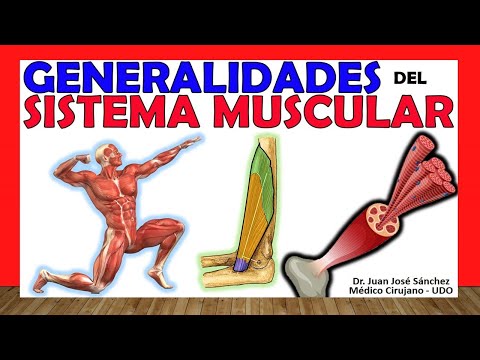
🥇 SISTEMA MUSCULAR. Clasificación, Tipos y Generalidades.
Introduction to the Muscular System
In this section, Juan José Sánchez introduces the topic of the muscular system and provides an overview of its generalities.
Understanding Muscles
- A muscle is a structure that has the ability to contract and generate movement.
- Not all muscles have the function of moving structures; some may have other functions such as fixation or prevention of movement.
- The word "músculo" (muscle) comes from Latin roots, with "mus" meaning "mouse" and "culus" meaning "small." This is believed to be because contracted muscles resemble a small mouse in shape.
- Muscles are considered the most important unit of the muscular system.
Properties of Muscles
- Excitability: Muscles have the ability to receive information from the nervous system and respond by contracting and generating movement.
- Contractility: Muscles can shorten their fibers and contract, allowing for movement. This property is particularly important in skeletal muscles.
- Extensibility: Muscles can extend or stretch without damage. This property is not limited to visible muscles but also applies to smooth muscles found in organs like the gastrointestinal system.
- Elasticity: After contraction and extension, muscles can return to their original shape without undergoing any permanent changes.
Classification of Muscles
In this section, Juan José Sánchez discusses the classification of muscles into two main groups: striated (skeletal) muscles and smooth muscles.
Striated (Skeletal) Muscles
- Striated muscles are characterized by their reddish color due to visible striations when observed under a microscope.
- These muscles are typically found in limbs, chest, abdomen, and neck regions.
Smooth Muscles
- Smooth muscles are characteristic of organs such as the gastrointestinal system, arteries, lymphatic system, sweat glands, and ducts.
- Smooth muscles have a whiter appearance compared to striated muscles and lack the visible striations.
Conclusion
Juan José Sánchez concludes the video by inviting viewers to subscribe to his channel and providing information on how to access more anatomical videos.
- Viewers are encouraged to subscribe to the channel for access to over 170 anatomical videos.
- The classification of muscles includes striated (skeletal) muscles and smooth muscles.
- Striated muscles are reddish in color with visible striations, while smooth muscles are whiter in appearance and lack visible striations.
Introduction to the Muscular System
In this section, the speaker introduces the study of the muscular system and explains that different muscles have distinct names and functions. The focus of the video will be on skeletal muscles.
Skeletal Muscles
- Skeletal muscles are found in various parts of the body, including the extremities, thoracic wall, abdominal wall, neck, face, and skull.
- Each skeletal muscle has a unique name and function.
- Skeletal muscles are voluntary muscles that can be moved at will.
- They are innervated by the peripheral nervous system.
- Examples of skeletal muscles include those involved in walking, moving arms, facial expressions, neck movements, and breathing.
Cardiac Muscle
- Cardiac muscle is unique to the heart.
- It differs from skeletal muscle in terms of innervation.
- Unlike skeletal muscle, cardiac muscle is involuntary and cannot be consciously controlled.
- It is innervated by the autonomic nervous system.
Smooth Muscle
- Smooth muscle is found in organs such as the digestive tract and uterus.
- Like cardiac muscle, smooth muscle is involuntary and controlled by the autonomic nervous system.
- Smooth muscle is not extensively studied in anatomy compared to skeletal and cardiac muscles.
Structure of Skeletal Muscle
This section focuses on understanding the structure of skeletal muscles at different levels.
Muscle Fiber
- The basic unit of a muscle is a fiber or cell called a myocyte or myofiber.
- Each myocyte is surrounded by connective tissue called endomysium.
Fascicle
- A group of myocytes forms a fascicle or bundle within a muscle.
- Fascicles are surrounded by another layer of connective tissue called perimysium.
Muscle
- Multiple fascicles together form a whole muscle.
- The entire muscle is enveloped by a layer of connective tissue called epimysium.
- The aponeurosis, a fibrous structure, can be found outside the muscle and is sometimes used for muscle insertions.
Origin and Insertion of Skeletal Muscles
This section explains the concepts of origin and insertion in skeletal muscles.
Origin
- The origin refers to the fixed attachment point of a muscle.
- It is generally considered the less contractile part of the muscle.
- The origin does not typically generate movement.
Insertion
- The insertion refers to the movable attachment point of a muscle.
- It is also known as the mobile insertion.
- Contractions at the insertion site result in movement.
- Tendons are often involved in connecting muscles to their insertions.
Belly
- The belly is the portion between the origin and insertion.
- It has greater contractility compared to the origin but less than the tendon near the insertion.
Conclusion
The transcript provides an introduction to studying the muscular system, focusing on skeletal muscles. It explains how skeletal muscles differ from cardiac and smooth muscles in terms of innervation and control. Additionally, it discusses the structure of skeletal muscles at different levels, including muscle fibers, fascicles, and whole muscles. Finally, it covers concepts related to origin, insertion, and belly in skeletal muscles.
Understanding Muscle Origins, Insertions, and Functions
In this section, the speaker discusses the importance of understanding muscle origins, insertions, and functions in studying skeletal muscles. They explain that most muscles have a fixed origin and a more mobile insertion. The speaker also mentions that while many skeletal muscles insert into bones, there are exceptions such as facial expression muscles that insert into the skin.
Muscle Origins and Insertions
- Muscles can have a fixed origin and a more mobile insertion.
- Skeletal muscles usually insert into bones but can also insert into other structures like the skin or mucosa.
- Some muscles even reach aponeurosis or synovial capsules of joints.
- Understanding muscle origins and insertions helps determine their function.
Inervación (Innervation)
- Innervation refers to the nerve supply of a muscle.
- Skeletal muscles require nerve fibers from the peripheral nervous system to receive information for movement.
- Nerves like those from the cervical plexus play a role in moving skeletal muscles.
Function of Muscles
- The function of a muscle is determined by its origin and insertion points.
- Knowing the origin and insertion allows us to understand which part of the body will be moved by contraction.
- For example, the biceps brachii originates at the shoulder and inserts on the forearm, causing flexion of the forearm.
- Conversely, the triceps brachii originates at the shoulder but inserts on the forearm from behind, resulting in extension of the forearm.
Muscle Morphology
- Muscles can have various shapes such as fusiform (like mouse), two-headed (biceps brachii), or multi-bellied (oblique abdominal muscle).
- Some muscles have tendons central to multiple muscle fibers (e.g., tibialis posterior) while others have tendons on both sides (e.g., rectus femoris).
- Muscle nomenclature often reflects their morphology, location, or action.
Nomenclature of Muscles
- Muscle names can indicate their shape (e.g., rhomboid), origin and insertion points (e.g., sternocleidomastoid), or location (e.g., brachialis anterior).
- Some muscles are named based on the number of bellies they have (e.g., biceps brachii) or have mixed names indicating both characteristics.
- Other muscles are named after their actions (e.g., levator scapulae) or location and action combined (e.g., extensor digitorum).
Different Forms of Skeletal Muscles
In this section, the speaker discusses the various forms that skeletal muscles can take. They explain that muscles can be fusiform, two-headed, multi-bellied, semi-pennate, uni-pennate, bi-pennate, or have other unique shapes. The speaker emphasizes that understanding muscle forms helps in identifying and studying them.
Muscle Forms
- Skeletal muscles can have different forms:
- Fusiform: Mouse-like shape.
- Two-headed: Two origins with a common insertion point.
- Multi-bellied: Multiple muscle bellies connected by tendons.
- Semi-pennate: Fibers radiating from one side of a central tendon.
- Uni-pennate: Fibers on one side of a central tendon.
- Bi-pennate: Fibers on both sides of a central tendon.
Examples of Muscle Forms
- Examples include:
- Biceps brachii: Two-headed muscle in the arm.
- Rectus abdominis: Multi-bellied muscle in the abdomen.
- Tibialis posterior: Semi-pennate muscle in the leg.
- Rectus femoris: Bi-pennate muscle in the thigh.
Muscle Nomenclature and Naming Conventions
In this section, the speaker discusses muscle nomenclature and naming conventions. They explain that muscle names can indicate characteristics such as shape, origin and insertion points, location, or action. The speaker emphasizes that understanding muscle names makes it easier to study anatomy.
Nomenclature Based on Characteristics
- Muscle names can reflect various characteristics:
- Shape: Some muscles are named after their shape, like "romboides" for a rhombus-shaped muscle.
- Origin and Insertion: Names like "esternocleidomastoideo" indicate both origin (sternum and clavicle) and insertion (mastoid process).
- Location: Muscles may be named based on their location, such as "cubital anterior" for a muscle located anterior to the ulna bone.
- Action: Some muscles are named after their action, like "elevador de la escápula" for a muscle that elevates the scapula.
Simplifying Anatomy Study
- Muscle names help make anatomy study easier by providing information about the muscle's characteristics or function.
- Understanding the meaning behind muscle names aids in memorization and comprehension of anatomical structures.
Timestamps have been associated with relevant bullet points to facilitate studying the transcript.
Turn any video into a summary like this
YouTube links, meetings, lectures. With transcripts, search, and chat.