Computer System Architecture
Overview of Computer System Architecture
Introduction to Operating Systems
- The lecture begins with a recap of previous topics, including computer system operation and storage/input/output structures.
- The focus shifts to categorizing computer systems based on the number of general-purpose processors.
Types of Computer Systems
Single Processor System
- A single processor system contains only one main CPU capable of executing general-purpose instruction sets and user process instructions.
- Special purpose processors may exist in this system for device-specific tasks, such as converting keystrokes from a keyboard into binary code.
- Despite having special purpose processors, the classification remains as a single processor system due to the presence of only one general-purpose processor.
Multiprocessor System
- A multiprocessor system consists of two or more processors that work closely together, also referred to as parallel or tightly coupled systems.
- These processors share resources like the computer bus, memory, and peripheral devices for efficient task execution.
Advantages of Multiprocessor Systems
Increased Throughput
- Multiprocessor systems offer increased throughput by allowing multiple processors to perform tasks in parallel, enhancing overall performance.
Economy of Scale
Advantages and Types of Multiprocessor Systems
Economic Efficiency of Multiprocessor Systems
- Multiprocessor systems are more economical than single processor systems, as having multiple processors can replace the need for several individual single processor systems.
Increased Reliability in Multiprocessor Systems
- The reliability of multiprocessor systems is higher because if one processor fails, others can continue to operate, preventing total system failure. This contrasts with single processor systems where a failure results in complete breakdown.
- For example, in a ten-processor multiprocessor system, if one fails, the remaining nine can share its workload without causing a total system failure.
- Thus, multiprocessor systems provide increased reliability compared to single processor setups.
Types of Multiprocessor Systems
Symmetric vs Asymmetric Multiprocessing
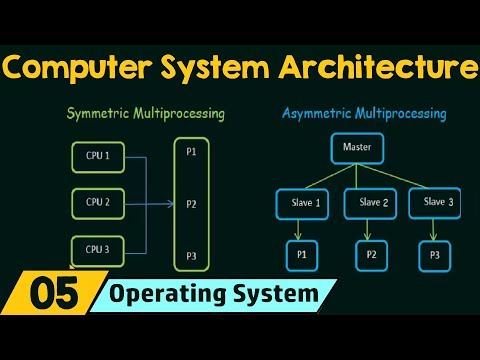
- There are two main types of multiprocessor systems: symmetric multiprocessing (SMP) and asymmetric multiprocessing (AMP). Each has distinct characteristics and operational structures.
Symmetric Multiprocessing (SMP)
- In SMP, all processors are identical and work collaboratively on tasks or processes (e.g., P1, P2, P3), sharing workloads equally among themselves.
Asymmetric Multiprocessing (AMP)
- AMP employs a master-slave architecture where one CPU acts as the master that monitors and assigns tasks to slave CPUs. Each slave handles specific processes independently from each other. For instance, Slave1 manages process P1 exclusively while Slave2 and Slave3 handle P2 and P3 respectively.
Clustered Systems: A Step Beyond Multiprocessing
Definition and Structure
- Clustered systems consist of multiple individual computer systems working together to perform computational tasks; they differ from traditional multiprocessors by coupling entire systems rather than just processors.
High Availability Features
- These clustered configurations enhance availability since if one system fails, others can take over its responsibilities without leading to complete system failure—thus minimizing downtime risks.
Clustering Modes: Asymmetric vs Symmetric
- Similar to multiprocessors, clustered systems can also be structured asymmetrically or symmetrically:
- Asymmetrical Mode: One machine remains in hot standby mode while others run applications; this standby machine monitors operations and takes over if any active machine fails.
Clustered Systems vs. Asymmetric Structures
Understanding Symmetric Monitoring in Clustered Systems
- In clustered systems, all hosts monitor each other rather than relying on a single system for oversight, promoting a more collaborative environment.
- The symmetric structure of monitoring is deemed superior to asymmetric structures due to its efficiency and resource-sharing capabilities.
Types of Computer Systems Based on Processors
- The discussion covers various types of computer systems categorized by the number of general-purpose processors: single processor systems, multiprocessor systems, and clustered systems.
Turn any video into a summary like this
YouTube links, meetings, lectures. With transcripts, search, and chat.