Photosynthesis: The Calvin Cycle
What is the Calvin Cycle?
Overview of the Calvin Cycle
- The Calvin cycle is the second set of reactions in photosynthesis, occurring after light-dependent reactions. It is sometimes referred to as light-independent or dark reactions since it does not directly require light for its process.
- Two key products from the light reactions, ATP and NADPH, are essential for the Calvin cycle to function effectively. These are produced during the light reactions at the thylakoids.
Phases of the Calvin Cycle
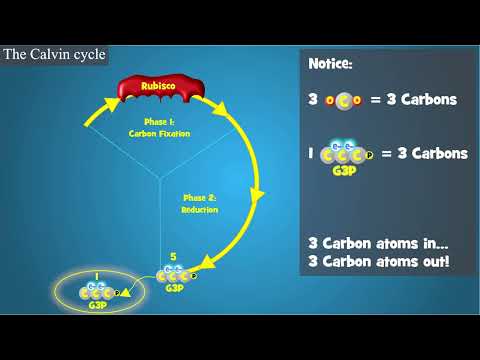
Phase One: Carbon Fixation
- An enzyme called Rubisco catalyzes the addition of CO2 from the air to a five-carbon compound known as RuBP (ribulose bisphosphate), resulting in carbon fixation. This creates a six-carbon compound that splits into two molecules of 3-phosphoglycerate (3-PGA). For every three CO2 molecules fixed, this process occurs simultaneously.
Phase Two: Reduction
- In this phase, ATP provides energy to convert an intermediate compound into glyceraldehyde 3-phosphate (G3P) through reduction, where electrons and hydrogen from NADPH are utilized. G3P is crucial as it can be used to synthesize sugars. For every three CO2 molecules entering, there’s a net gain of one G3P molecule produced.
Phase Three: Regeneration
- Out of six G3P molecules produced, only one exits the cycle while five remain to regenerate RuBP, ensuring continuity in the cycle's operation. Each G3P contains three carbons; thus five G3Ps yield enough carbon atoms to reform three RuBP molecules with energy supplied by ATP.
Producing Glucose
- To produce glucose (which consists of six carbon atoms), two G3P molecules are required from the Calvin cycle processes—highlighting how interconnected these biochemical pathways are within photosynthesis and their role in supporting plant growth and life on Earth overall.