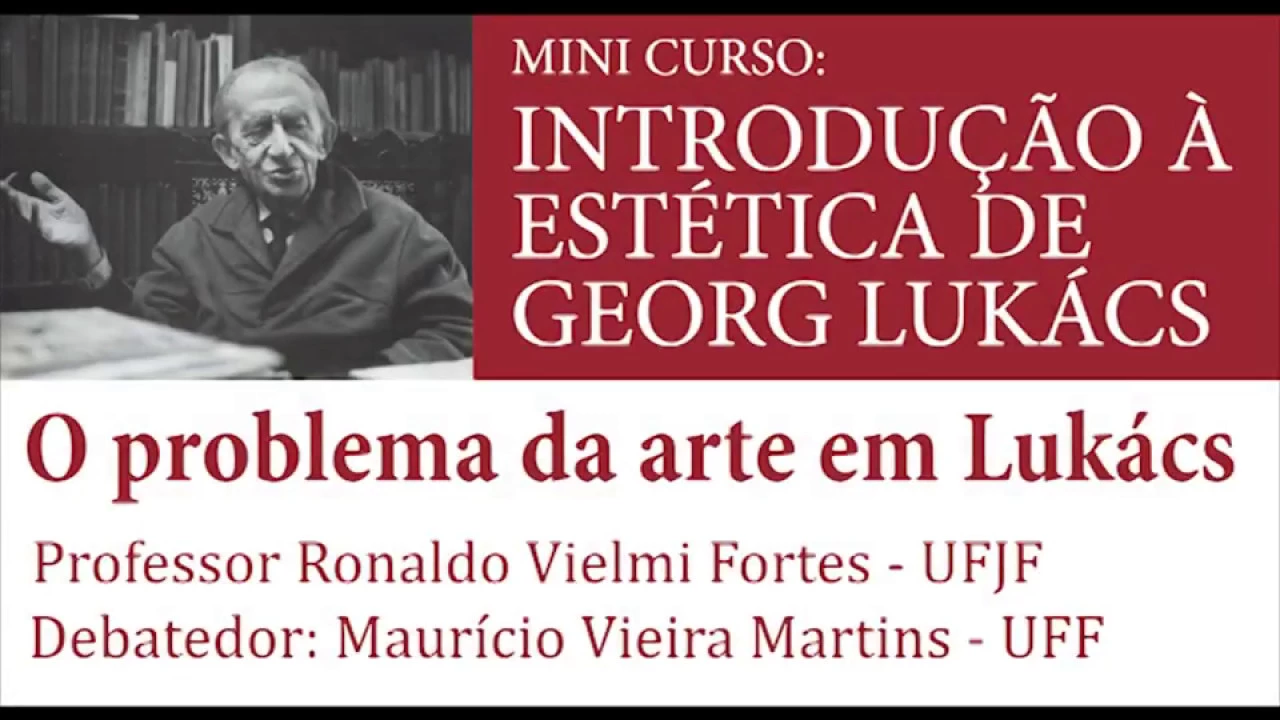
MiniCurso: Introdução à Estética de Georg Lukács - 07 12 - Ronaldo Vielmi e Maurício Martins
New Section
The introduction to an event featuring Professor Maurício Diniz and the development of a new research axis at the School of Architecture and Urbanism at the Federal Fluminense University.
Introduction to Event
- The event is about to start, led by Professor Maurício Diniz, focusing on a test application related to ongoing work.
- A new research axis is being established in the School of Architecture and Urbanism, building upon previous efforts with scholars dedicated to deepening knowledge of Lukács' work across various disciplines.
- Acknowledgment of support from the events department for bringing colleagues from other cities and gratitude towards various groups involved in the initiative.
Professor Introductions
Brief introductions of Professor Ronaldo Viera Me Forte and Professor Maurício Diniz highlighting their academic backgrounds.
Professor Introductions
- Introduction of Professor Ronaldo Viera Me Forte, outlining his role as an associate professor at the Federal University of Juiz de Fora in Social Services, Psychology, and his research focus on Marxism and ontology.
- Description of Professor Maurício Diniz's background as an associate professor at the Federal Fluminense University with expertise in philosophy and sociology, emphasizing his contributions to philosophical assumptions in social sciences.
Discussion on Esthetics Work
Discussion on the significance of studying Lukács' esthetics work within Brazil's intellectual landscape.
Significance of Studying Esthetics Work
- Acknowledgment of Lukács' significant presence in Brazilian intellectual circles with a focus on esthetics work that remains relatively unknown outside Brazil.
- Mentioning Brazilian scholars like Leandro Konder and Carlos Nelson Coutinho who engaged with Lukács' earlier esthetic texts before delving into critiques based on realism within his later works.
New Section
In this section, the speaker discusses the density and complexity of a particular work in German, emphasizing its significant length and transition from an aesthetic to an ethical focus.
Complexity of the Work
- The original German work spans over 1600 pages, showcasing its depth and intricacy.
- Initially planned as a multi-volume exploration of aesthetics, it shifted towards ethics after the first 1600 pages.
- The transition from aesthetics to ethics led to a profound engagement with communist theory in art, diverging from propaganda-driven approaches seen in socialist realism.
New Section
This part delves into Lukács' approach to Marxist aesthetics, highlighting his deep philosophical engagement beyond a mere Marxist interpretation of art.
Philosophical Engagement
- Lukács engages deeply with the philosophy of aesthetics within Marxism, moving beyond a simplistic communist theory of art.
- His reflections are influenced by Marx's philosophy, leading to a nuanced exploration of aesthetic thought.
- Lukács' work involves dialogues with prominent philosophers such as Kant and Spinoza, showcasing his rigorous intellectual engagement.
New Section
The speaker outlines Lukács' ambitious project divided into three volumes focusing on different aspects of art and aesthetics.
Ambitious Project Structure
- Lukács divides his project into three volumes: the first volume explores general categories in aesthetics.
- The subsequent volumes were intended to delve deeper into specific analyses of literary works, paintings, and architecture.
Realistic Work of Art and Historical-Social Phenomenon
In this section, the speaker discusses the concept of a realistic work of art as an artistic creation and a historical-social phenomenon. The analysis delves into how art reflects significant individuality issues within specific historical contexts.
Realism in Art and Historical Context
- The speaker outlines a project where artworks are studied in light of historical events, tracing the evolution of art from ancient Greek tragedies to contemporary pieces.
- Emphasizes the shift from aesthetics to a deeper exploration of social being, highlighting the importance of understanding the philosophical-historical moment for meaningful insights.
- Transition from aesthetics signifies a move towards urgent reflections that underpin aesthetic elaborations, setting the stage for a unique perspective on aesthetic thought.
Debate on Aesthetics and Marxian Influence
This segment focuses on engaging with prominent aesthetic thinkers while simultaneously introducing ruptures in traditional aesthetic discourse. The discussion highlights Marx's influence on shaping critical perspectives within aesthetics.
Aesthetic Debate and Marxist Influence
- The speaker emphasizes Cat's engagement with major aesthetic philosophers while also establishing ruptures in conventional thought, presenting a blend of continuity and discontinuity in his work.
- Cat's divergence from communist art theories prevalent in Soviet Union underscores his unique approach to philosophical debates within aesthetics.
- Draws distinctions between Cat's views and Kantian philosophy, showcasing direct critiques against idealism prevalent in aesthetic conceptions.
Critique of Idealism and Development of Aesthetic Perception
This part delves into Cat's critique against idealism concerning aesthetic production, emphasizing the role of historical processes in shaping human qualities and perceptions within art.
Critique Against Idealism
- Challenges idealistic views regarding innate artistic faculties by asserting that human capacities evolve through historical constructions rather than inherent traits.
- Aligning with Marxist principles, Cat rejects notions of eternal human essence, highlighting how qualities, even spiritual ones, are products of historical development rather than intrinsic attributes.
New Section
In this section, the speaker delves into the concept of rhythm as a category that exists within nature before becoming a human-imposed aesthetic category.
Rhythm as a Natural Category
- The speaker explains that rhythm initially exists within nature, such as in the rising and setting of the sun, before being perceived in human activities like dance.
- Examples like heartbeats and walking demonstrate how rhythm is inherent in nature, not just a human construct.
Transformation of Rhythm
- Rhythm transitions from a natural category to a social one through human activities like work, where rhythmic actions are necessary for productivity.
- Work activities requiring rhythmic coordination, like pounding grains or pulling heavy objects collectively, highlight how rhythm becomes imposed by humans for transformative purposes.
Next New Section
This section explores how rhythm shifts from a natural phenomenon to an imposed category by humans through work activities.
Evolution of Rhythm in Work
- Rhythm transitions from a natural occurrence to an imposed category by humans during work activities aimed at transforming nature.
- Successful execution of rhythmic tasks leads to satisfaction and self-perception changes, emphasizing the role of rhythm beyond utility.
Rhythm's Aesthetic Dimension
- Rhythm detaches from utilitarian functions and evolves into an activity that evokes emotions and self-reflection among individuals.
New Section
In this section, the discussion revolves around a fierce debate between two German playwrights in the 1930s, highlighting their differing perspectives and critical engagements with each other's work.
Debate Between Playwrights
- A notable German playwright engaged in a fierce debate during the 1930s, leading to intense criticism from both sides towards each other.
- Despite initial animosity, one playwright was honored with an award while the other was invited to speak but faced refusal from the former. Towards the end of their lives, they reached a significant agreement.
- The debate between these playwrights focused on fundamental categories of aesthetics and ethics, showcasing distinct ideologies that did not align with Marxist thought.
Exploring Catarsis in Theater
This segment delves into the concept of catharsis in theater, contrasting viewpoints on its impact on individuals' emotions and passivity.
Views on Catharsis
- One playwright critiques catharsis as potentially rendering individuals passive by appealing to sentimental emotions rather than engaging them intellectually.
- Catharsis is depicted as dominating individuals through emotional manipulation within artistic works, fostering passivity instead of active engagement with reality.
- Proposals are made to eliminate catharsis to encourage intellectual discourse and transformative action among audiences rather than soothing them into complacency.
The Role of Art in Society
This part emphasizes the transformative power of art in society by challenging traditional notions of entertainment and advocating for messages that provoke critical thinking.
Transformative Power of Art
- Art is portrayed as a medium for delivering transformative messages that awaken audiences to societal issues rather than lulling them into indifference.
- The debate underscores the necessity for art to engage all facets of human experience, rejecting approaches that limit art's impact solely to intellectual critique.
- By exploring unique artistic categories and critiquing mainstream entertainment forms like Disney films, artists aim to preserve art's specificity and transformative potential.
The Concept of Catharsis Revisited
Revisiting catharsis within theater, this section highlights its nuanced role in evoking emotions without subjugating individuals but rather empowering them towards self-realization.
Redefining Catharsis
- Catharsis is redefined as a means not to dominate or enslave individuals through emotions but as a tool for holistic transformation by touching upon emotional depths.
- Emphasizing how catharsis can emancipate individuals by engaging their entire being—body, spirit, psychology—it serves as an educational force beyond mere intellectual discourse.
Art and Emotions in Artistic Expression
In this section, the speaker delves into the intersection of art and emotions, highlighting how art serves as a medium for exploring individual identity within historical contexts.
Exploring Identity Through Art
- The author emphasizes that art is not merely a discussion or reception but has the power to prompt individuals to change their lives.
- Art leads individuals to introspection, moving them away from mundane life towards profound questions within specific historical settings.
- Through engaging with art, individuals transcend themselves to ponder significant societal and historical issues, prompting self-awareness and reflection.
The Role of Art in Human Spirituality
This segment delves into the intrinsic role of art in human spirituality, emphasizing its function in awakening self-consciousness and elevating individuals beyond self-absorption.
Significance of Art in Human Spirituality
- While some may view art as useless or mere entertainment, it plays a crucial role in human spirituality by fostering self-awareness and addressing existential questions within specific historical contexts.
- The speaker asserts that only art can fulfill the vital role of elevating individuals to contemplate broader societal issues compared to other dimensions like philosophy or politics.
Emotional Evocation through Art
This part underscores the importance of emotional evocation in art, emphasizing how it resonates with individuals on an emotional level beyond rationality.
Importance of Emotional Resonance
- The speaker highlights the significance of evoking emotions and feelings in individuals' entirety rather than solely relying on rational arguments for personal transformation.
- Drawing from Spinoza's concept, it is emphasized that appealing solely to one facet of human faculties is insufficient; true impact arises from stirring intense emotions against existing convictions.
Artistic Catharsis: A Liberating Experience
This section explores artistic catharsis as a transformative experience that liberates individuals by eliciting deep emotions and challenging preconceived notions.
Transformative Power of Catharsis
- Art has the potential to profoundly touch individuals by triggering intense emotions that surpass preconceptions, fostering personal growth through emotive engagement.
Objective of Art and Role in Individual Emancipation
The discussion delves into the role of art in fostering self-awareness among individuals and aiming for their emancipation.
Art as a Tool for Self-Consciousness and Emancipation
- Art serves as a means for individuals to attain self-awareness, with the artist acting as a significant interlocutor and inspirer within the aesthetic realm.
- While Max is acknowledged as influential, it is Guy Debord who emerges as the primary thinker shaping aesthetics, emphasizing individual contributions despite Kant's and Hegel's occasional appearances.
- Guy Debord's philosophy significantly influences aesthetic thought, positioning him as a key figure in understanding artistic debates and individual perspectives.
Debate on Art Engagement and Politics
The discourse explores the debate between two authors regarding whether art should be politically engaged or maintain autonomy from political influence.
Art Engagement vs. Autonomy
- A compelling debate arises between Bret and Sartre concerning the necessity of art being politically engaged, prompting reflections on the nature of art's relationship with politics.
- The distinction between political messaging in art and its intrinsic essence is highlighted, questioning whether politicized art loses its artistic value.
- The assertion that art transcends politics by touching individuals at a deeper level than political ideologies underscores its unique role in spiritual construction compared to politics' more external impact.
Symbolism vs. Allegory in Art
This segment focuses on distinguishing symbolism from allegory within artworks, drawing on historical perspectives to elucidate these concepts.
Symbolism versus Allegory
- Through an exploration of symbolism versus allegory dating back to ancient times, Walter Benjamin's theories are contrasted with Guy Debord's views on these categories.
- Poets' approaches to capturing generalities through particularities or vice versa are discussed, shedding light on how allegories differ from symbols in conveying meanings.
New Section
In this section, the speaker discusses the concept of art as allegory and its role in conveying deeper meanings within artistic creations.
Understanding Art as Allegory
- The distinction between concept, idea, and symbol is highlighted. A symbol does not reduce to the universal but rather reveals universality through particularity.
- Art does not confine itself to a single concept but illuminates various determinations present in life, allowing for a broad reflection on reality.
- Art as a symbol opens up perspectives and does not limit itself to one idea, encouraging a broader contemplation of life and reality.
- The transformation of appearance into concept and concept into image is discussed, emphasizing the infinite activity and indescribable nature of images in art.
- Authentic artworks possess a wide spiritual dimension that transcends time periods, enabling diverse interpretations based on the viewer's context and understanding.
Another New Section
This section delves into the historical evolution of art from its rudimentary forms intertwined with rituals to its autonomy as a complex autonomous entity.
Evolution of Art Through History
- Early forms of art were intertwined with rituals in primitive societies like dance and music before evolving into autonomous expressions over time.
- The transition from symbolic elements mixed with religious concepts towards autonomous complexity is traced through different historical periods such as the Middle Ages.
- The struggle for artistic autonomy against religious allegories is exemplified during the Renaissance period when artists began challenging dogmatic principles through their compositions.
- Artists gradually shifted from mere representations of dogmas towards authentic artistic expressions that defied traditional constraints, leading to a more profound exploration of artistic composition.
A New Form of Allegory
The discussion delves into the concept of allegory in contemporary times, moving away from its traditional religious connotations to a new form that explores emptiness and meaninglessness in art.
Allegory Evolving
- The evolution of allegory is highlighted, shifting from a religious idea to a representation of absence and senselessness in art.
- Literature, such as Joyce's "Ulysses," and games are used to demonstrate this shift towards an absence of meaning and sense in art.
Art Critique
- Art is critiqued for portraying pathological individuals as exemplary models, challenging traditional norms of representation.
- Surrealist paintings are discussed as presenting a new form of allegory - one that is fragmented and devoid of logical order.
The Shift in Art's Purpose
The conversation explores how contemporary art has moved towards subjective expression rather than objective representation, emphasizing the artist's individuality over societal commentary.
Subjectivity Over Objectivity
- Modern art prioritizes subjective expression over objective depiction, focusing on the artist's personal perspective rather than reflecting the world.
- Critiques are made regarding contemporary art's emphasis on subjectivity, contrasting it with historical literary works like those of Thomas Mann.
Symbolism vs. Allegory
Distinguishing between symbolism and allegory within art, highlighting their roles in conveying deeper meanings and societal reflections.
Artistic Interpretation
- Goya's artworks are discussed as examples where deformity does not detract from artistic value but instead serves to reflect human conditions and societal challenges.
Realization of Human Existence
In this section, the speaker discusses the concept of human existence and its reflection in art during the Renaissance period.
Reflection of Individuality in Art
- The artwork reflects individuals within a specific historical context, going beyond religious representation to showcase human potential.
- The speaker explores the subversion of Christian dogma through artistic representations, emphasizing the role and significance of women in creation.
- There is an emphasis on expressing human confidence and emerging capabilities within a rich historical context during the Renaissance.
Art as a Reflection of Humanity
This part delves into how art serves as a mirror reflecting human qualities and aspirations during significant historical periods.
Liberation Through Art
- Artistic expressions liberate individuals from mundane life, allowing them to contemplate their own potentials within a given historical setting.
- Art enables viewers to transcend daily routines and contemplate human individualities within their historical contexts, fostering introspection and growth.
The Significance of Artistic Sensitivity
Here, the importance of artistic sensitivity in perceiving and appreciating artworks is highlighted.
Development Through Art
- Viewing art prompts reflections on individual potentials, hopes, and abilities within specific historical contexts, leading to personal growth and enlightenment.
- Art serves as a historical memory that encapsulates major issues surrounding individuality at different points in time.
Impact of Art on Personal Growth
This segment explores how art elevates individuals beyond immediate concerns towards broader existential questions.
Elevating Individuality
- Engaging with art elevates individuals from self-absorption towards profound existential inquiries, fostering a deeper understanding of personal identity.
New Section
In this section, the speaker discusses the unfolding of a social scenario involving education and family dynamics, leading to a pivotal moment of realization and decision-making.
Social Scenario Unfolding
- The speaker describes a situation where access to education for their children is at stake, leading to a social charade.
- Unexpected events disrupt the unfolding plot, bringing about a resolution and return to normalcy.
Moment of Realization
- The woman in the scenario faces clarity about her life and decides to leave immediately.
- Dialogue between the characters reveals underlying tensions and responsibilities within the family dynamic.
Societal Critique
- Questions arise regarding sacred duties and individual obligations within relationships.
- The portrayal of a housewife challenges traditional gender roles and societal expectations.
New Section
This segment delves into the construction of female identity within societal norms, highlighting themes of subjugation and self-realization.
Female Identity Construction
- The character reflects on being raised as a "doll" within societal confines, symbolizing domesticity.
- Artifice is used to depict experiences beyond everyday life, emphasizing societal constraints on women's roles.
Artistic Representation
- The drama unfolds around a woman's struggle for autonomy, revealing inner conflicts and personal growth.
- A pivotal moment showcases the protagonist's choice to prioritize self-realization over maternal duties.
New Section
This part explores themes of self-discovery, reeducation, and personal transformation amidst familial responsibilities.
Self-Discovery Journey
- The character abandons her role as a mother to embark on a journey of self-renewal in her hometown.
- Art challenges individuals' perceptions by presenting alternative realities that prompt introspection.
Ethical Reflection
- Emphasis is placed on ethical responsibility towards personal growth rather than abandoning familial roles.
New Section
In this section, the speaker discusses the relationship between objectivity and subjectivity in art, highlighting how artists navigate these aspects in their work.
Understanding Objectivity and Subjectivity in Art
- The artist is capable of perceiving the objectivity of the world and addressing significant global issues. Sometimes, an artist's subjectivity may be overshadowed by the world's objectivity, emphasizing the need to align with this objective reality.
- Artists like Balzac exemplify how even individuals with conservative and reactionary political views are compelled to prioritize objectivity over personal beliefs in their literary works due to the demands of realism.
- Contrary to common belief, great artworks do not solely express the artist's intimate subjectivity but rather showcase their sensitivity, astuteness, and ability to capture complex worldly issues through an aesthetic representation.
- A profound artwork goes beyond self-expression; it involves capturing and representing multiple determinants of reality aesthetically. It transcends mere translation of concepts to encompass a holistic portrayal of various realities.
- Art serves as a unique form of knowledge acquisition that differs from scientific or everyday understanding. Its distinctiveness lies in its ability to fulfill essential human functions by capturing and interpreting the world uniquely.
New Section
This segment delves into the social significance of art, emphasizing its role in revealing individualities, societal dynamics, and existential dilemmas within historical contexts.
The Social Functionality of Art
- Art plays a crucial role in society by unveiling individual identities, exploring personal struggles, showcasing potentials, and addressing significant societal issues within specific historical frameworks.
- Emphasizing art's fundamental importance for humanity across time, it is highlighted as a dimension that cannot be disregarded within human conceptions. It serves as a pivotal element for social development and individual introspection.
- Despite being revolutionary at times, art elevates individuals beyond mere capitalist sustainability. Figures like Thomas Mann exemplify how even staunch capitalists can critique subjective actions within capitalist structures through their works.
New Section
This part explores how art prompts individuals towards self-reflection and societal transformation by challenging prevailing norms and fostering critical engagement with established systems.
Challenging Norms Through Art
- Even when advocating capitalism like Thomas Mann did, artists can expose internal contradictions within capitalist societies through realist portrayals. This process encourages individuals to transcend existing conditions towards self-improvement.
- Art catalyzes revolutions by urging individuals towards introspection and societal change. It challenges conventional narratives while pushing humanity towards overcoming inherent limitations through transformative processes.
New Section
Transitioning into a new discussion contextually linked with previous themes regarding Lukács' aesthetics versus other scholarly perspectives on art.
Shifting Perspectives on Aesthetics
- Introducing a shift towards discussing Lukács' aesthetics compared to other scholarly viewpoints on art forms part of ongoing dialogues surrounding Lukács' theories amidst diverse academic interpretations.
- Exploring Lukács' aesthetic theories alongside personal research trajectories offers insights into varied scholarly engagements with Lukács' ideas within broader intellectual discourses on aesthetics.
- Diverging from Ronaldo's focus on Lukács' aesthetics reveals alternative scholarly approaches rooted in distinct academic backgrounds. These variations enrich discussions on aesthetic theory diversity among scholars studying similar thematic domains.
New Section
Reflecting on contrasting perspectives between speakers regarding Lukács' analysis of James Joyce's work while acknowledging diverse reactions among audiences toward such critical evaluations.
Evaluating Literary Criticism
New Section
In this section, the speaker discusses the possibility of maintaining a relationship with local aesthetic categories without necessarily agreeing with all aesthetic judgments.
Local Aesthetic Categories
- Carlos Nelson Coutinho suggests it is possible to maintain a relationship with local aesthetic categories without needing to agree with all aesthetic judgments.
- Despite being controversial, the observation emphasizes the importance of engaging with local aesthetics while teaching students.
- Encourages individual interpretation and dialogue with aesthetic categories rather than strict agreement on specific aesthetic judgments.
Exploring Aesthetics through Literature
The speaker reflects on personal experiences with literary works and the varying interpretations within Marxist perspectives.
Literary Interpretations
- Shares appreciation for Samuel Beckett's play "Endgame," highlighting differing opinions within Marxist circles regarding Beckett's works.
- Mentions debates around Beckett's works, such as "Waiting for Godot," emphasizing diverse interpretations among Marxist authors.
- Acknowledges that some Marxist authors establish alternative relationships with Beckett's works, showcasing varied critical perspectives within literary analysis.
Interplay Between Local Reflection and Philosophy
Ronaldo Viana's lecture prompts a discussion on the intersection between local reflections and philosophical discourse.
Philosophical Discourse
- Ronaldo Viana highlights that local reflections involve not only existing debates but also engage in philosophical dialogues.
- References Lukács' engagement with aesthetics through his disciple Reale, emphasizing historical significance in understanding esthetic thought processes.
New Section
In this section, the discussion revolves around the concept of aesthetic reflection and its interpretation in relation to realism and naturalism in art.
Aesthetic Reflection and Interpretation
- Lukács emphasizes the importance of human self-awareness in artistic production.
- The debate on aesthetics involves challenging prevailing historical trends and fostering self-consciousness about humanity.
- Lukács introduces the concept of aesthetic reflection, which is critiqued by authors opposed to his ideas.
- Misinterpretations of aesthetic reflection include viewing it as a mere replication of reality, particularly criticized by naturalist perspectives like Balzac's realism.
- Naturalism's limitation lies in superficial description without delving into deeper historical contexts or subjective intervention.
Exploring Realism and Naturalism
This segment delves into Lukács' critique of prevalent naturalistic tendencies that lack substantive reflection on historical contexts.
Critique of Naturalism
- Lukács criticizes naturalism for focusing solely on immediate appearances rather than deeper societal realities.
- Naturalism's descriptive nature neglects capturing profound historical trends, contrasting with Lukács' emphasis on reflective engagement.
- Lukács highlights naturalism's failure to engage with multi-layered realities, reducing art to surface-level observations devoid of subjective influence.
Art as Political Pedagogy
The discourse shifts towards art as a form of political pedagogy, referencing debates from the 1930s.
Artistic Expression and Politics
- Ronaldo discusses transforming art into political pedagogy, a notion contested by Lukács against propagandistic distortions.
- Lukács condemns propagandistic elements within socialist realism, advocating for authentic artistic expression over ideological manipulation.
Interpreting Partisan Art
The conversation navigates through the nuances of partisan art and its broader implications beyond political affiliations.
Partisan Art Clarification
New Section
The speaker discusses the concept of art and its connection to utopia, particularly focusing on the role of artists in society.
Artistic Consciousness and Utopia
- The speaker reflects on Maringá and his unique perspective as an artist, emphasizing a consciousness that touches upon utopian ideals.
- Art is described as a form of expression detached from reality, yet still engaging with ethical dimensions and progressive tendencies within society.
- Reference is made to a historical example where progressive art faced resistance but maintained a distinct partisan quality, highlighting the peculiar nature of partisan art.
- A distinction is drawn between partisan art and other forms of literature or art that may not align with progressive values, emphasizing the importance of artistic integrity.
New Section
Lukács' political interventions and stance on art are explored, shedding light on his views regarding the quality and progressiveness of artistic works.
Lukács' Political Stance
- Lukács' engagement with politics is exemplified through his theatrical endeavors, teaching Ibsen's works to workers while challenging societal prejudices against bourgeois authors.
- The criteria for evaluating artworks are discussed, emphasizing the importance of an author's progressive stance towards reality in determining the quality of their work.
- Lukács' emphasis on the quality and progressiveness of an author's work as key criteria for assessing art is highlighted within political contexts.
New Section
The enduring relevance of Lukács' observations on art in contemporary society is examined, particularly focusing on challenges in interpreting artworks due to societal hostility towards emancipatory themes.
Contemporary Challenges in Art Interpretation
- Lukács' insights into historical contexts impacting artistic interpretation are extended to present-day challenges where societal attitudes hinder understanding emancipatory aspects in artworks.
- Reference is made to Juarez's contribution regarding contemporary artworks reflecting a disdain for humanity, exemplified by certain artistic expressions characterized by dehumanization.
New Section
In this section, the speaker discusses the portrayal of white characters in a film where a 12-year-old girl is almost coerced into marrying an older man who objectifies her. The film is critiqued for its depiction of objectification, raising questions about the repetition of the intended message.
Analysis of Objectification in Film
- The film portrays white characters where a young girl is pressured into marrying an older man who treats her as an object, highlighting themes of objectification.
- Critiques point out that the film attempts to depict objectification but may fall short in articulating it effectively, drawing parallels with discussions on human essence and generalization.
- Activists viewing the film note disparities and inequalities related to objectification present not only within the narrative but also in cinema beyond individual intentions.
- Complex questions arise regarding how realism is achieved in art and whether works inadvertently perpetuate what they aim to critique, emphasizing the nuanced nature of addressing such themes.
- The speaker reflects on a loss of innocence and naivety in our engagement with art forms, suggesting a shift towards critical analysis and investment in understanding artistic works.
New Section
This segment delves into defining aesthetics based on contrasting perspectives within specific historical contexts, referencing Pierre Bourdieu's contributions to sociology and literature studies.
Defining Aesthetics Through Contrasts
- Aesthetics are shaped by their unique terms and comparisons with existing proposals during particular historical periods, illustrating how aesthetics evolve over time.
- While Pierre Bourdieu's work significantly impacted sociology and literary studies through his distinct approach, there was minimal direct interaction between Bourdieu and Lukács due to temporal constraints.
- American researchers' quantification practices influence academic rankings based on citation metrics, highlighting Bourdieu's global influence as one of the most cited authors across humanities disciplines.
- Bourdieu's profound impact extended globally, shaping academic institutions like universities where scholars sought guidance from his theories and methodologies.
- "The Rules of Art" by Bourdieu offers insights into sociology of literature by exploring societal structures through literary analysis, providing valuable perspectives for understanding cultural production.
New Section
This part focuses on contrasting approaches to literature analysis by comparing Pierre Bourdieu's sociological lens with another author's examination of character development within a renowned French novel.
Literary Analysis Perspectives
- Comparing Pierre Bourdieu's sociological lens with other scholarly approaches reveals diverse methodologies for interpreting literary works like "The Sentimental Education."
- By examining character conflicts in "The Sentimental Education," readers explore themes related to personal desires versus societal expectations within rich narrative contexts.
- The protagonist Félicité navigates internal struggles around familial obligations versus personal aspirations in "The Sentimental Education," reflecting broader societal dilemmas.
- Gustave Flaubert's narrative choices parallel societal roles through character dynamics between Félicité and writer Frédéric Moreau in "The Sentimental Education."
New Section
In this section, the speaker discusses the concept of autonomy in aesthetics and its relation to Marxism, emphasizing the relative autonomy of art and the continuous pursuit of autonomy within artistic works.
Autonomy in Aesthetics
- Lukács refers to autonomy in aesthetics as having intrinsic value, acknowledging that this autonomy is not absolute but rather a relative independence from external influences.
- The speaker criticizes viewing literature solely through its immediate social context, highlighting the importance of avoiding a narrow sociological interpretation that diminishes the complexity and richness of literary works.
- There is a discussion on contrasting reputations of Lukács and Proust in contemporary discourse, emphasizing the need for critical examination beyond popular perceptions to truly understand an author's contribution.
- Art is portrayed as a form of humanity's self-awareness, allowing individuals to transcend their particularities and engage with broader historical contexts through artistic expression.
- The significance of perspective in art is highlighted, suggesting that true art should offer viewers a new outlook or insight rather than merely confirming existing perspectives.
New Section
This section transitions into audience engagement and reflections on personal experiences related to studying Lukács' aesthetics.
Audience Engagement and Personal Reflection
- The speaker expresses gratitude for engaging discussions and shares personal growth experiences after delving into Lukács' aesthetics alongside other scholarly works.
- Plans are made for further discussions over coffee before resuming debate sessions, indicating a desire for continued intellectual exchange among participants.
New Section
The focus shifts towards preparing for questions from attendees regarding Lukács' aesthetics and broader societal influences on contemporary art.
Questions from Attendees
- An attendee queries about significant shifts in literature post-mid 20th century that may have impacted the emergence of great art today, prompting reflections on societal changes influencing artistic expressions.
- Another attendee seeks opinions on Lukács' proposed aesthetics versus current media representations of art confined to specific spaces like streets or semi-public domains.
- Discussions touch upon the intersection between art and politics, particularly how urban art reflects public sentiments distinct from mainstream media portrayals.
New Section
Attendees continue to engage with questions surrounding the political dimensions of art and its role in society according to Lukács' aesthetic framework.
Political Dimensions of Art
- An attendee highlights urban art as a form of political expression distinct from mainstream media representations due to its grounding in local contexts and issues like violence.
- A question arises concerning instrumentalization versus philosophical exploration within art; whether it should serve political ends or delve into profound philosophical inquiries remains a point of contention.
New Section
Further exploration delves into Lukács' view on art's purpose regarding addressing contemporary issues without reducing it solely to pedagogy or propaganda.
Purpose of Art According to Lukács
Discussion on Art and Contemporary World
The discussion delves into the structures of the economic and social fields, emphasizing their interplay with superstructures. It also touches upon the emergence of a new research field focusing on the decline of Western civilization.
Structures and Superstructures
- The economic and social fields are intricately linked, reflecting a broad understanding. Superstructures deeply influence these realms in a dialectical manner.
Art in the Contemporary World
- Understanding art in the contemporary world necessitates considering profound structural determinations that significantly impact artistic landscapes.
Research Field Emergence
- A new research field is emerging in countries like the US, Canada, and Europe, focusing on studying the decline of Western civilization as a key area of interest.
Exploration of Decadence in Western Civilization Studies
This segment explores studies centered around the decadence of Western civilization, highlighting notable figures like Niall Ferguson within this thematic domain.
Focus on Decadence Studies
- Scholars engage in researching the decay of Western civilization as a prominent subject matter for academic inquiry.
Niall Ferguson's Influence
- Niall Ferguson emerges as a significant figure within this field, prompting reflections on how academia approaches themes such as societal decline without necessarily critiquing or opposing them directly.
Challenges Amidst Societal Decline
Addressing challenges posed by societal decline, including responses to political projects and paradoxes surrounding human extinction possibilities.
Paradoxes of Societal Decline
- Society faces paradoxical situations where discussions about human extinction coexist with skepticism towards transformative political projects due to perceived futility.
Contemporary Art Forms and Popular Manifestations
Delving into contemporary art forms like street art and their resonance with popular culture through technological advancements.
Street Art Appreciation
- Embracing popular manifestations such as street art intensified by new technologies signifies positive developments within cultural expressions.
Diverse Manifestations in Contemporary Context
Examining diverse manifestations within contemporary contexts, emphasizing nuanced analyses based on individual cases rather than generalizations.
Heterogeneous Expressions
Philosophical Pedagogy and the End of Art
In this section, the discussion revolves around philosophical pedagogy, the concept of the end of art, and the relationship between art and philosophy.
Philosophical Pedagogy
- The idea that art should be surpassed by philosophy due to its strong sensory aspect is highlighted.
- There is a critique regarding the inability to establish the autonomy of aesthetic facts when subordinated to philosophy.
End of Art Discussion
- Reference to Ronaldo's insights on understanding Clichy in relation to Thomas Mann's works.
- Emphasis on a text edited by Boitempo as pivotal in addressing ideological decadence within capitalism through analyzing individual artworks.
Decadence and Analysis
- Acknowledgment that not all capitalist art is inherently decadent; each piece requires individual analysis.
- Caution against simplistic denunciations of capitalism within art without nuanced examination.
Decadence in Art and Authentic Expression
This segment delves into decadence in art, authentic expression, and the necessity for thorough analysis in evaluating artistic works.
Decadence in Art
- The importance of analyzing individual authors' works to understand authentic artistic expression rather than making blanket statements about capitalist influence.
- Discussion on how Cat's second volume focuses on analyzing authors individually to reveal genuine artistic expression amidst societal influences.
Authentic Expression
- Emphasizing that rejecting capitalist art isn't merely a stance but requires detailed analysis of each artwork.
- Highlighting the need for specific analysis rather than general denunciations when evaluating artworks within societal contexts.
Role of Contemporary Art Forms
This part explores contemporary art forms' significance, their societal roles, and distinguishing them from traditional definitions of "art."
Societal Impact
- Acknowledgment that modern artistic expressions play crucial social roles even if not classified as traditional "art."
New Section
In this section, the discussion revolves around the impact of art on society, the definition of art, and its role in social contexts.
The Impact of Art on Society
- The sociological aspect of art is highlighted, emphasizing how literary works and plays influence society.
- Art plays a crucial role in the emancipation of individuals and spiritual fulfillment.
- Art serves as a medium to convey aesthetic concepts and ideologies within society.
- The significance of authentic artistic expressions in conveying societal messages is discussed.
- The debate on what constitutes art and its function as a philosophical discourse is explored.
New Section
This section delves into the intersection between philosophy, art, and ideology.
Philosophy vs. Art
- Philosophy is distinguished from art based on their roles in addressing societal issues.
- Philosophy focuses on understanding human nature through conceptual frameworks, while art views the universe through human experiences.
- The contrast between science's approach to nature and philosophy's anthropomorphic view through art is examined.
New Section
This segment explores the unique role of art in evoking emotions and individuality compared to other disciplines.
Role of Art
- Art holds primacy in eliciting emotions and reflecting individuality within societal contexts.
- Emphasizes that while philosophy deals with conceptual aspects, it cannot evoke emotions like art does.
- Discusses how art captures human essence holistically beyond intellectual faculties.
New Section
This part discusses the perpetual conflict between individualities within historical contexts and the distinct roles of philosophy and art in addressing these conflicts.
Individualities & Conflicts
- Highlights ongoing conflicts among individualities within historical contexts intersecting with broader societal issues.
- Art's focus on individual experiences sets it apart from philosophy's broader contemplations about human destiny.
New Section
The discussion delves into the historical determination of art in capitalism, emphasizing the technical construction and human dimension within architecture.
Historical Determination of Art in Capitalism
- Art is historically determined in capitalism, primarily constructed from a technical perspective and exploring technical possibilities.
- Individuality is overshadowed by movements emphasizing general characteristics of art under capitalism, requiring careful consideration on a case-by-case basis.
- Under capitalism, architecture stands out as the only art form that did not flourish significantly.
New Section
The importance of approaching studied objects with seriousness and avoiding clichés is highlighted.
Approach to Studied Objects
- Emphasizes the need for a serious approach when analyzing and studying objects to avoid falling into clichés.
- Discusses the significance of demonstrating what one speaks about with care and attention to detail.
New Section
Reference to influential figures like José Paulo Netto and Max Lukács in academia is made, acknowledging their impact despite facing challenges.
Influence of Academic Figures
- Mentions José Paulo Netto and Max Lukács as influential figures despite facing challenges within academia.
- Reflects on the success of certain academic figures like José Paulo Netto in specific academic circles.
New Section
Discussion on essential references for study, including personal experiences related to language barriers.
Essential Study References
- Highlights the importance of fundamental references for study, even amidst language barriers.
- Acknowledges significant references such as Miguel Abreu that contribute greatly to understanding various subjects.
New Section
Reflection on encounters with diverse perspectives during academic journeys is shared, emphasizing personal growth through exposure to different viewpoints.
Academic Encounters and Growth
- Recounting encounters with diverse perspectives during academic journeys leads to personal growth and expanded understanding.
New Section
In this section, the speaker discusses the importance of art and its connection to various aspects of life, drawing from personal experiences and observations.
Importance of Art in Society
- The speaker emphasizes the significance of art, reflecting on their experience at a music school and how different forms of art intersect.
- They highlight their efforts as an artist to bridge gaps between art forms and communities, aiming to make art more accessible and integrated into daily life.
- Discusses challenges faced in promoting art, such as limited spaces for artistic expression like theaters within schools or galleries in commercial settings.
New Section
This segment delves into the relationship between art and politics, contrasting perspectives on whether art should be intertwined with political ideologies.
Art vs. Politics
- Compares viewpoints on art's role in politics, referencing Walter Benjamin's stance that art transcends mere political agendas.
- Explores the engagement between art and politics, questioning how artists navigate societal structures that may influence their creative expressions.
- Reflects on personal experiences where artistic endeavors inevitably intersect with political contexts due to urban constraints and institutional influences.
New Section
This part focuses on the blurred boundaries between art and politics, examining how each domain can influence or diminish the value of the other.
Interplay of Art and Politics
- Explores a project aimed at integrating public spaces with artistic performances while contemplating the inherent politicization of artistic endeavors.
- Raises questions about how politics can shape or devalue art when they become indistinguishable entities within societal frameworks.
Desafios do Pensamento Marxista
The discussion revolves around the challenges faced by Marxist thought during a historical period marked by stagnation and the influence of Stalinism on intellectual and activist circles.
Challenges Faced by Marxist Thought
- Lukács and other intellectuals experienced a moment of reevaluation, moving away from dogmas and clichés towards a critical reflection on Marxism due to the impact of Stalinism.
- The urgency to rethink fundamental Marxist categories arises from the pressing realities that demand theoretical adjustments in response to emerging issues.
- The discussion touches upon the differences between thinkers like Lukács and Hegel, emphasizing an evolutionary aesthetic approach versus a more systemic concern present in Hegel's philosophy.
Reinterpretation of Philosophical Frameworks
- The conversation delves into how philosophical systems, including Hegel's, could sometimes constrain rather than illuminate the content they aim to analyze.
- Exploring the theological undertones in Hegel's work, particularly regarding the concept of spirit as a sophisticated translation of religious narratives into philosophical discourse.
Exploring Aesthetics in Philosophy
This segment focuses on unraveling aesthetics within philosophy, specifically examining how art encapsulates profound thoughts beyond mere sensory experiences.
Unveiling Artistic Expression
- Rather than dismissing Hegel's work entirely due to its theological inclinations, Lukács acknowledges the presence of explosive ideas within Hegelian philosophy that transcend traditional frameworks.
- Addressing criticisms labeling Hegel as a theologian disguised as a philosopher, highlighting ongoing debates surrounding his philosophical contributions.
Artistic Thought in Aesthetics
- Drawing parallels between aesthetics and philosophy through an exploration of art as not solely visual but also laden with conceptual depth.
- Reflecting on how artworks embody profound thoughts, challenging conventional perceptions that reduce art to mere sensory stimuli.
Philosophical Perspectives on Ontology
The discourse shifts towards ontology within philosophy, contemplating the essence of being and existence through different philosophical lenses.
Ontological Considerations
- Maurício introduces insights on ontology, distinguishing it from metaphysics while acknowledging its roots in speculative philosophy.
Ontology and Critique in Philosophy
In this section, the discussion revolves around the concept of ontology and its application in philosophical critique, particularly focusing on the works of various philosophers.
Leo Koff Rabelo's Usage of Ontology
- Leo Koff Rabelo mentions his use of the term "ontology" and expresses his process of familiarizing himself with it.
Hartmann's Respect for Tertuliano and Marxist Influence
- Hartmann is noted to have a deep respect for Tertuliano despite being more aligned with Marxism.
- This respect extends to engaging in critical discussions not only with friends but also with adversaries.
The Issue with Leão's Text and Tertuliano's Thesis
- Leão faces challenges in his text, particularly concerning criticism from Tertuliano.
- Tertuliano introduces a thesis regarding Hartmann's work as a catalyst, leading to significant debates within Brazilian philosophical circles.
Critique of Hartmann by Tertuliano
- Tertuliano critiques Hartmann by highlighting the latter's lack of understanding regarding certain philosophical concepts.
- This critique leads to an exploration of realism within Hartmann's philosophy.
Importance of Understanding Hartmann's Work
- Delving into the significance of Hartmann’s work, there is an emphasis on grasping its essence beyond surface interpretations.
- This involves analyzing correspondences between key figures like Cat and Hoffenheim Arish.
Understanding the Rebellion and Dialogue
The speaker discusses the importance of rebellion and dialogue in philosophical contexts.
Rebelião Bonita e Diálogo com o Cade
- The rebellion is seen as a warrior's act, emphasizing the beauty in such defiance.
- Emphasizes the need for dialogue with "Cade" to settle matters.
- Mentions a philosopher who highlights the remaining special essence in Ducati.
Significance of Authentic Ontology
Exploring the concept of authentic ontology and its relevance.
Falsa e Autêntica Ontologia de Hagan
- Discusses a chapter on false and authentic ontology by Hagan.
- Highlights the issue when these categories are subsumed into a philosophical system.
Critiques within Aesthetics
Delving into critiques within aesthetics and identity between subject and object.
Críticas na Estética e Identidade em Reggio
- Points out critiques prevailing in aesthetics, focusing on identity between subject and object in Reggio.
- Emphasizes identifying significant questions within reality while creating art.
Artistic Expression and Identity
Examining how artistic expression reflects identity between subject and object.
Identidade do Sujeito Objeto na Arte
- Artistic expression mirrors the identity between subject and object where authors invent stories reflecting reality.
- Art emphasizes that art is not mere imitation but captures fundamental aspects of reality.
Complexity of Artistic Creation
Unpacking the complexity behind artistic creation beyond mere replication of life.
Criação Artística e Vida Imitada
- Artistic creation involves more than immediate reproduction of life; it entails identifying existing contents within reality.
- Artists invent stories while recognizing profound questions embedded in reality itself.
New Section
In this section, the speaker discusses the intersection of art and literature, emphasizing the portrayal of extreme pain and artistic expression.
Artistic Expression and Extreme Pain
- The speaker mentions how art captures moments of extreme pain, where people distance themselves from the situation.
- Descriptions in literature can highlight extreme pain but also emphasize aesthetic effects.
- Artistic expression differs from traditional norms, allowing for unique interpretations and insights.
Exploring the Political Role of Art
This segment delves into the political implications of art and its role in reflecting societal struggles.
Politics in Art
- Art plays a political role by revealing societal issues and advocating for change.
- The speaker discusses how art reflects class struggles within a capitalist society.
- Art addresses significant human issues distinctively from politics but still intertwined with social conditions.
Art as a Political Tool Beyond Discourse
Here, the discussion shifts to how art transcends mere political discourse to impact individuals on a deeper level.
Art's Impact Beyond Politics
- The example of writing about women's issues showcases how art goes beyond mere political discourse to touch individuals' inner selves.
- Art symbolizes more than just political statements; it delves into personal growth and emotional exploration.
The Power of Emotions in Shaping Perspectives
This part emphasizes how emotions influence personal growth and societal change through artistic expressions.
Emotional Influence
- Strong emotions depicted in art challenge preconceived notions and pave the way for personal transformation.
Art and Individuality
The discussion delves into the role of art in reflecting individualities, touching on dentistry's connection to art and how art showcases the processes of personal constitution.
Art as a Reflection of Individuality
- Art reflects individualities and plays a crucial role in showcasing the processes of personal constitution.
- Before revolutionizing the world, individuals must first revolutionize themselves, highlighting the political aspect of art.
Music, Architecture, and Aesthetics
The conversation explores the significance of music and architecture in art, emphasizing learning new skills for artistic expression.
Importance of Music and Architecture
- Music and architecture play vital roles in art, with an emphasis on learning new skills for artistic expression.
- Discusses the banalization of images in art and the need for new artistic forms beyond superficial representations.
Graffiti vs. Street Art
Contrasts graffiti with street art, focusing on maintaining authenticity and resisting commodification.
Graffiti vs. Street Art
- Differentiates between graffiti and street art by emphasizing authenticity over commodification.
- Explores how street art can resist co-optation while maintaining its unique qualities.
Artistic Intervention and Urban Space
Examines artistic intervention in urban spaces, discussing the balance between artistic freedom and societal impact.
Artistic Intervention in Urban Spaces
- Considers artistic interventions in urban spaces regarding artistic freedom versus societal impact.
- Reflects on how architecture can be both banalized through commercialization yet also serve as a tool for social critique.
Philosophical Perspectives on Aesthetics
Explores philosophical perspectives on aesthetics within Locais' work, focusing on ethical considerations alongside aesthetic principles.
Philosophical Perspectives on Aesthetics
- Investigates Locais' approach to aesthetics concerning ethical considerations alongside aesthetic principles.
New Section
In this section, the speaker discusses the importance of research and the relationship between humans and nature from a Marxist aesthetic perspective.
Research Importance and Human-Nature Relationship
- The speaker highlights the significance of research in understanding the human-nature relationship from a Marxist aesthetic viewpoint.
- Initial readings in Marxist aesthetics revealed the essential element of human contact with nature for aesthetic considerations.
- Exploring how nature interacts with humanity is crucial for examining aesthetics comprehensively.
New Section
This part delves into complex questions without definitive answers, emphasizing the need to revisit fundamental inquiries.
Complex Questions and Fundamental Inquiries
- The speaker acknowledges grappling with weighty questions that lack clear answers.
- Emphasizes the value of revisiting fundamental questions to gain deeper insights.
- Challenges conventional thinking by highlighting the absence of straightforward solutions in certain discussions.
New Section
Analyzing general categories within aesthetics and examining specific works to identify these categories' presence.
Analysis of Aesthetic Categories
- Identifying general aesthetic categories as a primary step.
- Delving into individual works to scrutinize how these categories manifest within them.
- Example: Reflecting on graffiti as an intriguing subject due to its historical context and evolution over time.
New Section
Discussing early indications of cinematic analysis within artworks, focusing on filmmakers' profound insights.
Early Cinematic Analysis
- Noticing initial signs of cinematic exploration in artworks.
- Engaging with films from various origins, including Hungarian creators, reflecting deep thematic analyses.
- Highlighting specific chapters dedicated to cinematic discussions within artistic contexts.
New Section
Exploring art's role in reflecting reality through distinct aesthetic expressions and societal functions.
Artistic Reflections and Societal Functions
- Examining how art reflects reality through unique expressions.
- Unpacking the significance of understanding art's societal functions through aesthetic lenses.
Understanding Aesthetics and Human Nature
In this section, the speaker delves into the relationship between aesthetics and human nature, drawing on philosophical concepts from thinkers like Kant, Hegel, and Marx.
The Influence of Philosophers on Aesthetics
- The speaker discusses a book that introduces Marxist aesthetics through the lens of particularity.
- Contrasts Max with Hegel and Lenin in terms of their impact on aesthetics.
- Examines how Marx's approach to categories differs from others like Kant when discussing universalism, particularism, and singularity.
Understanding Particularity in Aesthetics
- Highlights the need for a nuanced analysis of Marx's work in aesthetics to appreciate its advancements critically.
- Emphasizes the importance of critically evaluating and analyzing Marx's contributions to aesthetics.
Humanization Through Practical Activities
This part explores how human nature is shaped through practical activities such as labor and experimentation with the environment.
Shaping Human Identity Through Labor
- Discusses how human beings develop their individuality through practical activities rather than solely through theoretical endeavors.
- Explores the significance of disciplining one's emotions and instincts in shaping personal characteristics.
Emergence of Conceptual Thinking
- Examines how rational thought emerges from practical experimentation with objects in the environment.
- Illustrates how conceptual thinking evolves from practical experiences to form abstract ideas about attributes like hardness or utility.
Evolution of Thought: From Utility to Abstraction
This segment traces the development of conceptual thinking from utilitarian purposes to abstract notions within human cognition.
Transition from Practicality to Conceptualization
- Describes how repeated interactions with objects lead to conceptual understanding beyond immediate utility.
- Explores how humans generalize attributes like hardness across different objects, leading to conceptual abstraction.
Role of Practical Experience in Concept Formation
- Emphasizes that conceptual thinking arises from practical engagement with the world rather than innate knowledge or ideal forms.
The Shift Towards Abstract Ideation
This section investigates the progression towards abstract thought detached from immediate utility or physical constraints.
Evolution of Symmetry and Proportion
- Traces the evolution of symmetry and proportion from practical tools to abstract concepts detached from immediate utility.
Cognitive Development Beyond Utility
New Section
In this section, the speaker discusses machines and how humans utilize them, distinguishing between art and mere description.
Machines and Human Utilization
- The use of machines by humans is not considered art but merely a description.
- The speaker introduces the third allegory involving opening a door to place a ball for Ranieri to kick.
New Section
This part delves into the discussion of hats as an example to differentiate between anthropocentric descriptions and nature-focused descriptions in art.
Anthropocentric Descriptions vs. Nature-Focused Descriptions
- When discussing a hat, details such as style, designers, and historical context are explored.
- Balzac's mention of hats is attributed to his depiction of a bearded man, showcasing an anthropocentric viewpoint.
New Section
Here, the focus shifts towards the production of economy and work in relation to artistic specificity.
Artistic Specificity in Descriptions
- Describing landscapes or nature can lose its artistic dimension if it solely focuses on natural elements without centering on individuality.
- Art descriptions should maintain a balance between portraying nature and emphasizing individuality to retain their artistic essence.