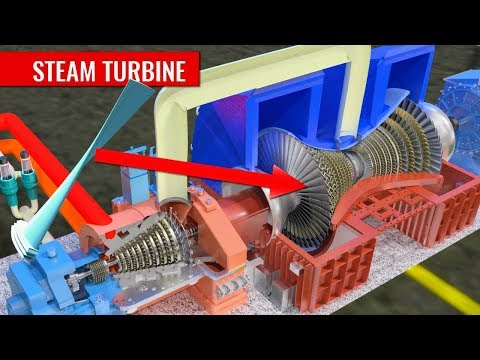
How does a Steam Turbine Work?
Understanding Steam Turbines in Power Plants
Overview of Power Generation
- Nuclear and coal-based thermal power plants generate nearly half of the world's electricity, with steam turbines being central to their operation.
- The video aims to explain the construction and functioning of steam turbines step-by-step.
Blade Design and Functionality
- Steam turbine blades have an airfoil shape that creates a pressure difference when high-energy fluid passes over them, generating lift force that rotates the turbine.
- A fluid possesses three forms of energy: speed, pressure, and enthalpy. As blades absorb energy from the fluid, these energies decrease.
Role of Stators in Energy Conversion
- The stator section is stationary and reduces flow area to increase fluid velocity, acting like a nozzle to enhance kinetic energy while maintaining total energy balance.
- The design includes multiple rotor sets; the degree of reaction (pressure/temperature energy divided by total energy change) determines turbine type.
Expansion and Efficiency Considerations
- During operation, steam pressure drops significantly while its volume increases; thus, blade length increases towards the outlet for effective performance.
- Long blades are twisted for optimal angle attack across all cross-sections; large turbines often use symmetrical units for balanced steam distribution.
Stages of Turbine Operation
- High-capacity power plants utilize various stages: high-pressure, intermediate-pressure, and low-pressure turbines connected to a single shaft linked to a generator.
- Higher temperatures lead to greater efficiency but are limited by material constraints (max 600°C). Reheating after initial stages boosts temperature for improved output.
Speed Regulation Mechanisms
- Maintaining constant turbine speed is crucial as it directly affects electricity frequency. A governing mechanism adjusts steam flow based on load demand.