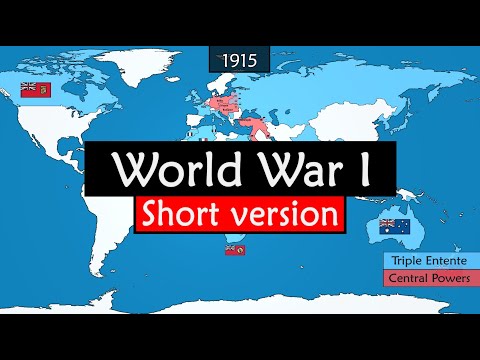
World War I (short version)
The Origins of World War I
This section provides an introduction to the scale and intensity of World War I, involving over 60 million soldiers worldwide. It sets the stage for understanding the origins, events, and consequences of the war.
The Franco-German War and Formation of German Empire
- After the Franco-German war in 1871, France is defeated by the Confederation of North Germany and forms the German Empire.
- Alsace and Moselle are annexed to the new empire, causing frustration on the French side.
Alliances Formed
- Germany advances its industry and economy while forming alliances with Austro-Hungarian Empire and Italy.
- The Triple Alliance is formed as a response to France colonizing Tunisia.
- Germany begins colonizing African territories.
Triple Entente Forms
- France allies with Russian Empire and signs a secret pact with Italy to avoid a second front in case of war.
- British Empire becomes concerned about German army's rise, leading them to move closer to France and Russia.
- Together, they form the Triple Entente.
Tensions in Balkans
- Austro-Hungarian Empire annexes Bosnia and Herzegovina, angering Serbia which dreams of uniting South Slav people.
- Russia diplomatically allies itself with Serbia after being appealed by their cause.
Assassination in Sarajevo
This section covers the assassination that triggered World War I and how it led to declarations of war between various countries.
Assassination Incident
- A young Serbian nationalist assassinates the heir to the throne of Austria and his wife in Sarajevo.
- Austria-Hungary accuses Serbia of organizing the attack and declares war despite Russian threats.
Conflict Spreads
- The conflict spreads between countries of the Triple Entente and Triple Alliance, except for Italy which remains neutral for now.
German Invasion Plan
- Germany plans to overcome the French army by attacking from the north.
- Germany invades Luxembourg and Belgium, forcing French, British, and Belgian armies to retreat.
Trench Warfare and New Fronts
This section explores the establishment of trench warfare and the emergence of new fronts in World War I.
Failure of Schlieffen Plan
- German army's plan to capture Paris fails as they are attacked on flanks by the army of Paris.
- French government moves to Bordeaux fearing capture of Paris.
Trench Warfare Begins
- With German advance halted, 700 km of trenches are constructed from North Sea to Switzerland.
New Fronts Emerge
- Germany sends troops to fight against Russian offensive, putting pressure on Austria-Hungary.
- Ottoman Empire decides to support Germany, creating new fronts in Caucasus, Sinai against British protectorate in Egypt, and Kuwait over oil resources.
Global Involvement in World War I
This section highlights various countries' involvement in World War I across different continents.
Colonies and Enlistment
- Japan seizes German colonies in the Pacific and China.
- French, British, and Belgian forces storm German colonies in Africa.
- People from colonized territories are enlisted in European armies.
Mobilization of Forces
- France mobilizes nearly 800,000 people, with a large proportion coming from its colonies.
- British Empire enlists 2.7 million men, with more than half from British India.
- Bulgaria joins Central Empires to expand its territory.
Technological Innovations and Harsh Conditions
This section explores technological innovations during World War I and the harsh conditions faced by soldiers in the trenches.
Military Innovations
- Germany conducts aerial bombardments using zeppelin airships on London and Paris.
- Submarine warfare is launched by Germany in British territorial waters.
- Toxic gases are used causing significant casualties.
Life in the Trenches
- Soldiers face harsh conditions including mud, vermin, rats, and decaying corpses.
- Mutinies occur on the French side but are suppressed.
The summary has been provided based on the given transcript.
Exhaustion, Revolution, and the End of the Great War
This section discusses the impact of war on Russia, the revolutions that took place, and the involvement of the United States in World War I.
War Exhaustion and Revolutions
- Russia suffers over 1.7 million military casualties and experiences low morale among soldiers and the public.
- A short revolution occurs in Russia, leading to the downfall of the Tsar regime.
- The United States faces a commercial blockade in the Atlantic and decides to join the war alongside the Allies.
- A second revolution in Russia brings the Bolsheviks to power, who sign a ceasefire with the Central Empires.
German Advance and Allied Counterattack
- With control over the Russian front, Germany concentrates its troops on the western front.
- Germany successfully breaks through trenches and approaches Paris but moves too fast southward.
- The French army counterattacks, causing German defenses to disintegrate. German soldiers retreat northward in panic.
Allies Take Lead
- From this point onwards, the Allies lead on all fronts as a result of German setbacks.
- Mutinies and revolutionary movements in Germany force Emperor Wilhelm II to abdicate, leading to signing of Armistice and end of "Great War."
- The war results in more than 18 million deaths worldwide.
Treaty of Versailles
- On June 28, 1919, a peace treaty is signed at Versailles without inviting German representatives.
- Germany is forced to accept all demands from victors and is held solely responsible for war damages.
- Austria-Hungary and the Ottoman empires are dismantled, leading to the creation of new countries or colonies.
Consequences for Germany
- Germany faces humiliation and debt, with its army disbanded and colonies shared among the Allies.
- Approximately 15 percent of German territory is ceded to France, Belgium, Denmark, and Poland.
- Despite losses, Germany remains largely intact as there was no fighting on its territory during the war.