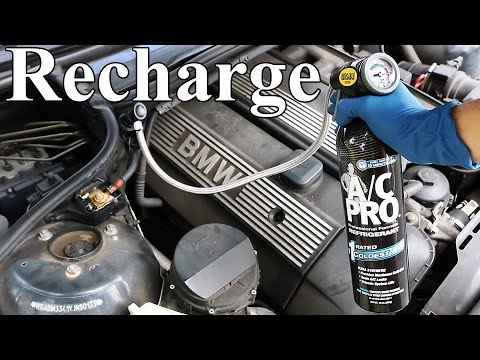
How to Recharge Your Car's AC System (Fast and Easy)
How to Recharge Your Car's AC System
In this video, ChrisFix demonstrates how to recharge your car's air conditioning system using a do-it-yourself refrigerant kit. He explains the type of refrigerant used in cars and how to find the low-pressure service port.
Finding the Low-Pressure Service Port
- The low-pressure service port is located on one of the air conditioning lines.
- Follow the lines until you find the low-pressure service port.
- The adapter only fits on the low-pressure port, so it's impossible to mess up.
Connecting the AC Kit
- Connect your AC kit to the low-pressure service port with an adapter.
- Use an AC Pro kit that has everything you need for this job, including a hose, coupler, and pressure gauge.
- The pressure gauge helps you read the pressure in your AC system so that you don't overfill or underfill it.
Recharging Your AC System
- Once connected, pull back on the adapter and push down to connect it.
- You can disconnect your air conditioning refrigerant kit if you don't need it attached right away.
- Use a refrigerant with a sealer in it if there is a small leak instead of spending thousands of dollars replacing components.
Conclusion
Recharging your car's air conditioning system is easy and rewarding. By following these simple steps, you can make sure that your car stays cool during hot summer days without breaking the bank.
Setting Up the Pressure Gauge
In this section, the speaker explains how to set up the pressure gauge and build up pressure in the car's air conditioning system.
Building Up Pressure
- The pressure gauge should be set to between 45 and 55 psi in the green.
- Turn on the car and check the temperature gauge to know what temperature the air coming out of the vent is.
- Make sure that you have turned on the air conditioner by pressing a button.
- Let the car run for a while and check if it gets cold enough. If not, charge it up.
Checking Compressor Functionality
In this section, we learn how to check if our compressor is running properly.
Checking Compressor Functionality
- Check if your compressor is running by looking at its pulley spinning.
- Turn off your car to see if it stops spinning. Turn it back on again to see if it starts spinning again.
- If your compressor isn't running, don't worry yet. It could mean that you need to boost it with refrigerant.
Charging Your Air Conditioning System
In this section, we learn how to charge our air conditioning system with refrigerant.
Preparing for Charging
- Put on safety goggles and gloves before handling refrigerant.
- Unscrew the top of your bottle and remove any plastic shipping disc.
- Screw on your gauge and trigger back onto your bottle so that you can pierce it open.
- Shake your bottle well so that all of its contents are evenly distributed.
Charging Your System
- Attach a coupler to your low-pressure port by pulling back on its collar and pushing it onto your port. Wiggle it around to make sure it's secure.
- Squeeze the trigger and turn your bottle from side to side in the 12 to 3 o'clock position for about 10 seconds.
- Release the trigger and check the pressure gauge. Repeat this process until your pressure is in the middle of the two red lines at about 50 psi.
- Remove your coupler by pulling back on its collar and pulling it off of your service port. Screw on a cap to seal it up.
Final Check
In this section, we learn how to do a final check of our air conditioning system.
Final Check
- Check that your pressure is in the middle at about 50 psi.
- Make sure that your compressor is running properly.
- If everything looks good, remove your coupler and screw on a cap to seal up your low-pressure service port.
- Check that your air conditioning system is working by checking its temperature output.