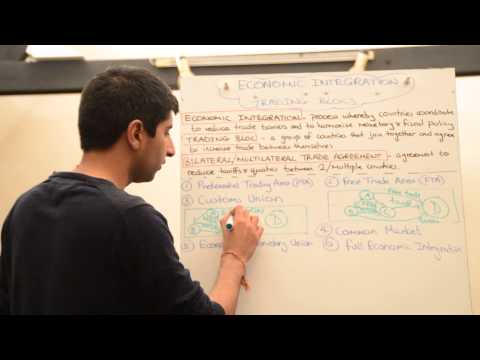
Economic Integration and Trading Blocs
Understanding Economic Integration
Key Definitions of Economic Integration
- Economic integration is a process where countries coordinate to reduce trade barriers and harmonize monetary and fiscal policies.
- It encompasses various types of integration, from basic reductions in trade barriers to deeper forms involving policy harmonization.
Types of Trading Blocks
- A trading block consists of countries that agree to increase trade among themselves, forming either bilateral or multilateral agreements to reduce tariffs and quotas.
Six Types of Economic Integration
1. Preferential Trading Area (PTA)
- In a PTA, countries reduce tariffs or quotas on specific goods and services rather than eliminating all protectionism entirely. An example includes the EU's agreement with African Caribbean Nations for preferential access to certain commodities.
2. Free Trade Area (FTA)
- A free trade area allows member countries to eliminate all trade barriers among themselves while maintaining the freedom to impose their own regulations on non-member nations. NAFTA is cited as a prominent example of this type of integration.
3. Customs Union
- A customs union combines elements of a free trade area but imposes common external tariffs on imports from non-member nations, benefiting only member states through reduced internal barriers. The EU serves as an example here, along with historical examples like the Switzerland-Liechtenstein Customs Union.
4. Common Market
- This stage builds upon a customs union by allowing not just free movement of goods but also labor and capital across member states, exemplified by the EU's single market policies that facilitate easy migration and business operations within its borders.
5. Economic and Monetary Union (EMU)
- An EMU involves deeper integration where member countries adopt a common currency and central bank, aligning their monetary policies; the Eurozone is highlighted as a key instance of this type of economic integration.
6. Full Economic Integration
- This represents the highest level of integration where countries fully harmonize all fiscal and monetary policies under one governing body, akin to how the UK operates with its constituent nations governed by Parliament in London as an example of political unity alongside economic cooperation.
Conclusion & Further Learning Opportunities
- The video concludes with an invitation for viewers to explore additional content regarding the pros and cons associated with economic unions, including discussions on trade creation versus diversion arguments related to customs unions in future videos.