ITIL 4 - Service Management 2
New Section
In this section, the speaker introduces the topic of service relationship management and highlights the importance of understanding terms and conditions in service offerings.
Introduction to Service Relationship Management
- The speaker emphasizes the significance of reading and comprehending terms and conditions before subscribing to a service, using loan apps in Africa as an example.
- Introduces the concept of a service relationship model and mentions defining keywords related to service relationships.
- Describes a visual representation of the service relationship model involving organizations providing services to each other.
Service Relationship Model
This part delves into the role of a third-party risk analyst in assessing cyber security postures of organizations for establishing business agreements based on risk assessments.
Third-Party Risk Analysis
- Explains how a third-party risk analyst assesses organizations like Facebook and Twitter for cybersecurity posture evaluation.
- Highlights the importance of ensuring client data security by auditing organizations' cybersecurity programs.
- Discusses relationships between organizations offering services/products, emphasizing collaboration among entities for enhanced service provision.
Value Proposition in Business Agreements
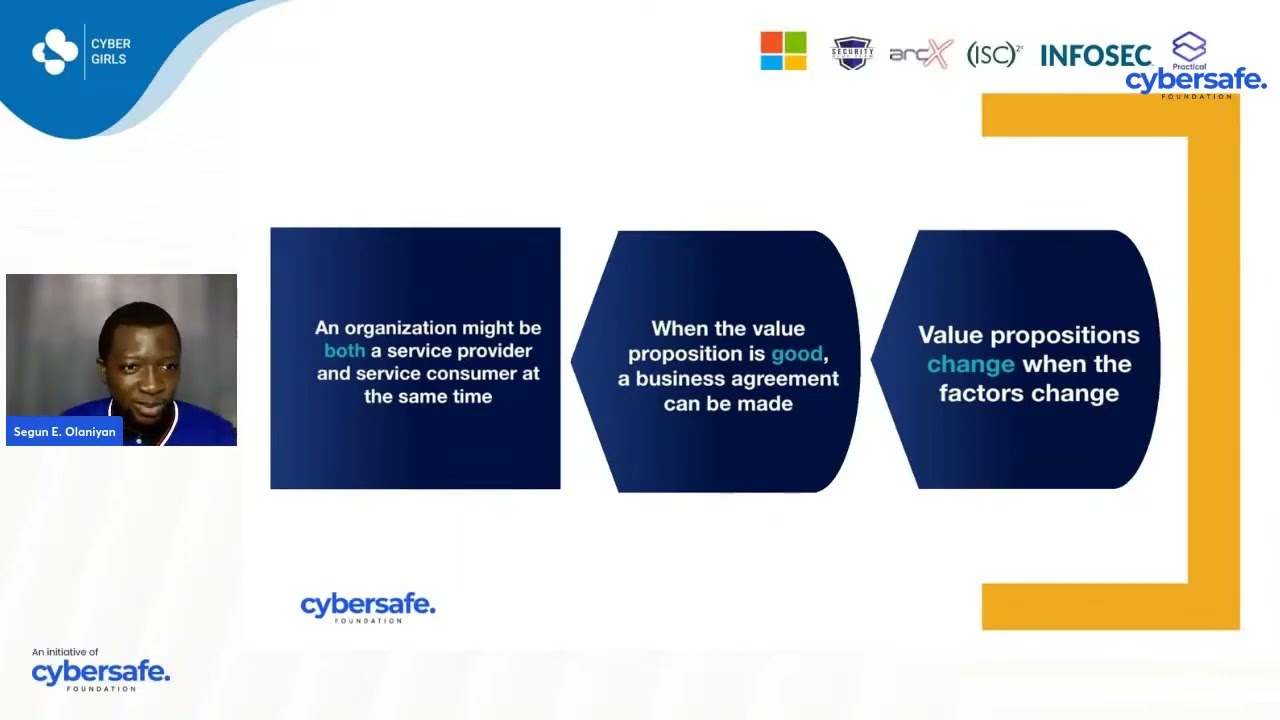
Focuses on how a good value proposition leads to successful business agreements between organizations based on mutual benefits.
Establishing Business Agreements
- Emphasizes that a good value proposition facilitates business agreements where both parties understand the benefits they receive from each other.
Proposition and Value Proposition in Business Agreements
In this section, the speaker discusses how value propositions in business agreements can change based on evolving factors within an organization's environment.
Factors Influencing Value Proposition Changes
- Value propositions can evolve due to changes in the business environment.
- Organizations adapt their value propositions based on environmental changes and IT operations adjustments.
- Output is defined as a tangible or intangible deliverable of an activity, with services facilitating outcomes through one or more outputs.
Services, Outputs, and Outcomes Relationship
This part delves into the relationship between services, outputs, and outcomes in achieving results within organizations.
Understanding Services, Outputs, and Outcomes
- Services facilitate outcomes through one or more outputs; outcomes are what achieve results.
- Outputs are finished products that become outcomes when utilized by users to achieve intended results.
- The example of Nigeria's election system highlights the transition from output to outcome based on system performance during actual usage.
Cost and Risk Elements in Service Relationships
The discussion shifts towards cost reduction and risk management as essential components of service relationships.
Cost Reduction and Risk Management
- Service providers aim to reduce or eliminate costs for clients by streamlining processes through technology.
- Cost reduction involves automating functions to lower expenses for clients.
Risk Management in Service Provision
In this section, the speaker discusses the importance of managing risks in service provision and how consumers and organizations can contribute to risk reduction.
Potentiality of Risk in Service Provision
- Organizations should align investments with their risk appetite and ability to manage risks.
- Risks are inherent when customers receive products or services based on the assumption that the organization's offerings are reliable.
Consumer Contribution to Risk Reduction
- Consumers play a role in reducing risks associated with services they receive.
- Service providers should aim to minimize risks for consumers by implementing technological controls within their IT environments.
Defining Requirements for Risk Reduction
- Organizations must define service requirements and expected outcomes clearly to reduce consumer risks effectively.
- Communication of constraints and critical success factors is crucial for product/service improvement and risk mitigation.
Risk Response Strategies
This segment delves into strategies for managing identified risks, including risk avoidance, acceptance, and response mechanisms.
Managing Identified Risks
- Risk response involves identifying, assessing, and addressing risks within an organization's environment or service offerings.
- Organizations can adopt various strategies such as risk avoidance, acceptance, or mitigation based on the nature and impact of identified risks.
Risk Avoidance vs. Acceptance
- Risk avoidance entails removing risks entirely from a service but may not be feasible if the risk is integral to the offering (e.g., database servers in e-commerce).
Service Management and Risk Mitigation
In this section, the speaker discusses the importance of risk management within an IT environment and how organizations can mitigate risks effectively.
Importance of Risk Management
- Organizations storing passwords in plaintext pose a high security risk, deterring potential business partnerships until the issue is resolved.
- Risk transfer through cyber insurance allows companies to shift their risk burden to another entity capable of managing it effectively.
- Banks insure deposits through entities like NDIC, showcasing how risks are transferred to mitigate potential losses.
Risk Mitigation Strategies
- Organizations often transfer risks to other entities by insuring against them, leveraging Managed Security Service Providers (MSSPs) for enhanced security measures.
- Risk mitigation involves implementing technologies and processes to reduce risks to acceptable levels, distinct from merely accepting risks without action.
Utility Software and Warranty Assurance
This part delves into utility software functionalities and warranty assurances provided by products or services.
Utility Software Functions
- Utility software offers various functions tailored to meet specific needs within an operating system, enhancing its overall functionality.
- Examples include disk fragmentation tools that aid in managing system performance efficiently.
Warranty Assurance