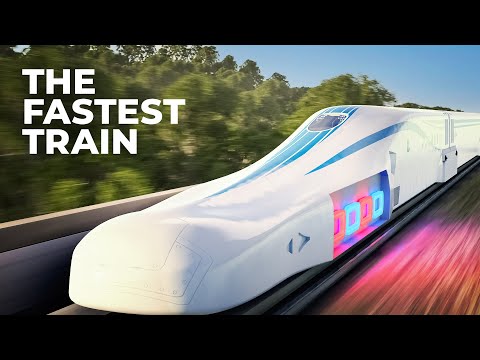
How Japan's Maglev Train Works
Introduction to Maglev Trains
This section introduces the concept of Maglev trains and their unique technology.
Magnetic Levitation Technology
- Maglev trains use superconducting magnets to hover 10 centimeters above the track.
- They can reach speeds of 500 kilometers per hour due to reduced friction and fewer moving parts.
- Unlike traditional high-speed trains, Maglev trains operate without physical contact with the track.
Current Limitations of Maglev Trains
- The only commercial high-speed Maglev line is in Shanghai, which is only 30 kilometers long.
- The short track length limits the advantage of high speed, resulting in an average speed slower than conventional high-speed rail.
- The planned future network of high-speed Maglev tracks is only 400 kilometers long, significantly smaller than regular high-speed rail networks worldwide.
How Maglev Trains Work
This section explains the two primary methods of levitating a train and explores the reasons behind limited deployment.
Electromagnetic Suspension System
- One method involves using attractive forces between a magnetic iron rail and an electromagnet on the train.
- Active controls are required to maintain a crucial gap between the rail and magnet for stable levitation.
- Shanghai's 30-kilometer Maglev line uses this electromagnetic suspension system.
Passive Suspension System
- Japan's approach utilizes passive coils on the track that interact with magnets onboard the train.
- As the train moves over these coils, a changing magnetic field generates an opposing field that lifts the train upward.
- This passive suspension system provides a more stable method of levitation and is suitable for earthquake-prone regions.
Superconducting Coils in SCmaglev Trains
This section focuses on the unique features of SCmaglev trains and their cooling system.
SCmaglev Technology
- SCmaglev trains require superconducting coils to generate a powerful magnetic field for stable levitation.
- These coils must be maintained below their critical temperature using liquid helium and liquid nitrogen.
- The niobium-titanium coils are cooled using a Pulse Tube Refrigerator, similar to the cooling system used in the James Webb telescope.
Using Sound Waves for Cooling
This section explains how sound waves are utilized in the cooling process of SCmaglev trains.
Sound Wave Cooling
- A Pulse Tube Refrigerator uses sound waves to cool the helium, taking advantage of the relationship between pressure and temperature.
- By creating a standing wave in a closed tube, where peaks and troughs are stationary, higher pressure leads to lower temperatures.
- This cooling method ensures that the superconducting coils remain below their critical temperature for optimal performance.
The transcript is already in English.
Heat Transfer and Magnetic Field Control
This section discusses the transfer of heat in superconducting coils and the need to control the magnetic field near passengers.
Transferring Heat and Magnetic Field Control
- Superconducting coils in Maglev trains need to be kept cold, so heat is transferred away from them using radiators.
- The strong magnetic field generated by the coils can cause problems for passengers, so engineers use electric steel shielding to redirect the magnetic field away from cabins and stations.
- Reluctance is used to measure the ease of passage for a magnetic field, similar to how resistance measures the ease of passage for an electric current. Iron has low reluctance compared to copper's low resistance.
- Grain-oriented electrical steel with large crystal grains aligned in a specific direction is used for shielding as it can carry more magnetic flux in that direction.
Tailoring Magnetic Field Shape
- The design of magnets can be manipulated to shape the magnetic field. By arranging parallel magnets with opposite poles facing each other, a low magnetic field bubble is created between them.
- Coils are arranged on either side of the cabin with flipped magnets, creating a low magnetic field bubble through corridors. This reduces the overall field strength to 0.5mT, equivalent to Earth's magnetic field strength.
- Certain materials cannot be used near high-strength magnetic fields, so tracks are constructed from low-magnetic steel or fiber-reinforced composites.
Propulsion and Power Supply
This section explains how Maglev trains propel themselves without touching the ground and how they obtain electricity.
Propulsion Mechanism
- Conventional rail systems use torque applied to wheels to push against the ground, but Maglev trains utilize linear motors.
- Linear motors consist of alternating coils that attract and repel the train with precise timing, providing propulsion.
- Regenerative braking is used by reversing the linear motor system to slow down and recover energy. Wheels also have brakes for low-speed operation.
Power Supply
- Lower-speed Maglev systems use a low-friction third rail, similar to metro systems, to supply electricity to trains.
- Higher-speed Maglev systems, like the Japanese electrodynamic system, collect power from changing magnetic fields using a linear induction coil. This eliminates the need for carrying a large generator onboard but creates some magnetic drag force.
Japan's Pursuit of Maglev Technology
This section explores why Japan is pursuing high-speed Maglev technology.
Development of High-Speed Trains in Japan
- Japan has been at the forefront of train technology since opening their Tokyo-Osaka Shinkansen line in 1964, the world's first high-speed train. They aimed to reduce travel time further after achieving speeds of up to 411 km/h by developing Maglev technology.
- Testing tracks were constructed in Miyazaki and Yamanashi for prototyping and refining high-speed Maglev trains capable of reaching even higher speeds.
Future Plans
- The first phase of the Japanese Line will connect Tokyo to Nagoya covering 285 km and is scheduled to open by 2027. The second phase will extend it further to Osaka, completing a total distance of 723 km within a decade later.
The transcript provided is in English, and the notes have been written accordingly.
The Potential of Maglev Trains in the US
This section discusses the potential of Maglev trains in the US and compares them to other modes of transportation like cars, planes, and traditional trains.
Maglev Trains vs. Other Modes of Transportation
- Maglev trains are often touted for their potential to significantly reduce travel time between cities, such as New York and LA.
- However, building a track of this length is not economically feasible.
- When comparing travel times between San Francisco and LA, trains are found to be the best option despite planes being faster.
- Airports located far outside the city and security wait times increase journey length for planes.
- High-speed trains save passengers time and make economies more productive by reducing travel time.
- A reduction of 2 hours in travel time for 900 passengers equates to 1800 hours or 75 days.
- High-speed rail extends the range at which trains can compete with airlines, making it suitable for large cities between 200 and 800 kilometers apart.
Challenges with Implementing Maglev Systems
- The US is not investing much in high-speed rail, making it even harder to build Maglev systems.
- Maglev systems require completely new tracks with electromagnetic coils along their entire length and specialized materials that can withstand strong magnetic fields at high speeds.
- The cost of building Maglev systems is significantly higher compared to high-speed rail:
- The Japanese line connecting Tokyo to Nagoya had a price increase to $13.7 billion dollars.
- Maglevs are between 10 and 50 times more expensive than high-speed rail.
- Even when compared to existing high-speed rail routes, the cost per kilometer for maglev systems is much higher.
Challenges Specific to the Tokyo-Nagoya Line
- The Tokyo-Nagoya line takes a direct route through mountainous terrain, with 86% of the track being underground.
- Tunneling over 200 km significantly increases costs and leads to increased operational expenses.
- Traveling through tunnels creates additional drag due to the air having no escape route, requiring more force to propel the train forward.
- The energy usage of the new line will be 30% higher compared to the existing Tokyo-Osaka line.
Conclusion
- Maglev technology is unlikely to be used extensively beyond special projects due to the radical increase in costs compared to high-speed rail.
- The US is currently struggling to establish regular rail service even in areas suitable for it, like the Texas triangle.
- Interest in superconductor technologies that could make maglev trains easier to build is increasing online.
Learning about Magnetism and Electricity on Brilliant.org
This section promotes a free course on Brilliant.org that teaches magnetism and electricity fundamentals.
- Understanding how magnetic fields work is essential for engineers and many important technologies depend on this physical phenomenon.
- A free course on Brilliant.org offers an opportunity to learn about magnetism and electricity.
- Brilliant provides interactive courses that test knowledge along the way, making learning easy and enjoyable.
- In addition to magnetism and electricity, Brilliant offers courses on various topics such as AI, data science, neural networks, and probability prediction.