Applying BlockChain to Supply Chain Management
Introduction to Blockchain
In this section, Caitlin Barron welcomes the participants to the Lunch and Learn webinar. Quintin Samuelson will be presenting on the topic of blockchain.
Introduction and Upcoming Events
- The webinar is hosted by the Apex Inland Empire chapter.
- Participants are encouraged to check out upcoming events on the APICS Inland Empire chapter website.
- The spring symposium on May 5th will feature a panel discussion on manufacturing at the Harvey Mudd School of Engineering in Claremont.
Speaker Background
- Quintin Samuelson introduces himself as a consultant for IBM with 30 years of experience in various electronics industries.
- He has been working with blockchain for nearly two years and believes it has transformative potential similar to the introduction of the World Wide Web.
Practical Focus of the Webinar
- The webinar will focus on practical use cases and implementation of blockchain in companies.
- It aims to provide information on how blockchain can be applied rather than discussing technical details.
- Samuelson mentions that he may repeat concepts in different ways to aid comprehension.
Understanding Blockchain
This section provides an overview of blockchain technology and its key characteristics.
Definition and Benefits
- Blockchain is a new technology that removes cost and complexity from multi-party transactions.
- It uses a shared, secure, synchronized, and immutable ledger.
- Best use cases involve transferring physical, financial, or virtual assets among multiple parties requiring validation or verification.
- Blockchain is not intended as a replacement for ERP systems but works best when collaborating with other companies.
Key Features and Advantages
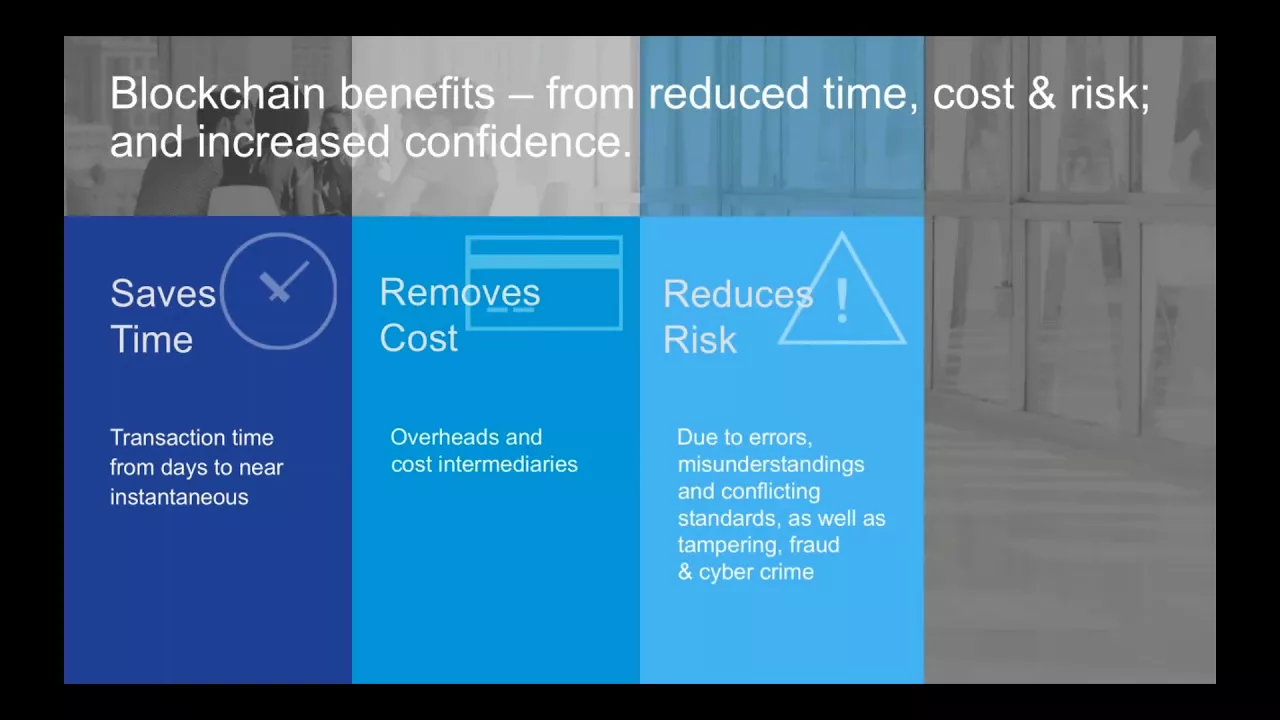
- Shorter cycle times, lower costs, increased confidence are common benefits of implementing blockchain.
- Agile development methodology is typically used for developing blockchain applications.
- Partners can be full participants or interact with the process, reducing the need for extensive computing power.
- Blockchain is not meant to replace existing solutions that work well for high-volume, low-value real-time transactions.
Shared Secure Ledger
- Blockchain creates a permanent record of transactions shared between multiple parties.
- It can be compared to a bank account ledger involving multiple parties and updating only with properly configured transactions.
- Participants in blockchain applications define the rules, unlike traditional bank accounts where rules are inherited from the justice system.
- A blockchain ledger involves at least three parties but can have more depending on the transaction.
Comparison to Bank Account Ledger
This section compares blockchain to a bank account ledger to highlight similarities and differences.
Similarities with Bank Account Ledger
- Both involve multiple parties, such as an individual, a bank, and potentially other intermediaries like payment processors.
- Ledgers are updated when properly configured transactions are received, following predefined rules.
Differences with Blockchain
- In blockchain, participants define the rules of the ledger application.
- Blockchain can involve more than three parties in a transaction.
- Actions triggered by ledger status are typically performed by banks in traditional systems but can vary in blockchain applications.
The transcript does not provide further sections or timestamps.
Blockchain Application in Supply Chain Management
In this section, the speaker discusses how blockchain can be used in supply chain management to ensure the quality and traceability of products.
Benefits of Using Blockchain in Supply Chain Management
- Blockchain can track each action as a product changes hands, ensuring its quality and authenticity.
- It allows for real-time monitoring of temperature and GPS location during transportation.
- By removing points of conflict, blockchain improves trust and reduces risk.
- It can significantly reduce transaction time and cost.
Key Attributes of Blockchain
- Shared ledger: All parties involved can access the ledger.
- Synchronized and transparent: Transactions are updated in real-time and visible to all participants.
- Secure and immutable: Transactions cannot be altered once recorded.
- Privacy control: Each participant only sees relevant parts of the ledger.
- Consensus-based and controlled: Transactions are validated before being recorded, with built-in audit processes.
Use Cases for Blockchain in Supply Chain Management
- Complex and inefficient business processes are ideal candidates for blockchain implementation. Look for processes that cause frustration, hinder customer service or business performance, or incur unnecessary time and cost.
Bitcoin as an Example of Blockchain Application
The speaker explains that Bitcoin was the first blockchain application, designed as a cryptocurrency with anonymity.
Bitcoin vs Business Blockchain Applications
- Bitcoin is anonymous, while business blockchain applications are not; they require named users for transparency purposes.
- Bitcoin intentionally requires extra computing resources due to its anonymity feature, whereas most business blockchain applications do not.
Elements of Blockchain Use Cases
The speaker discusses the four key elements commonly found in blockchain use cases: shared ledger, smart contract, trust, and privacy.
- Blockchain use cases typically involve a combination of these four elements.
Identifying Potential Blockchain Processes
The speaker suggests looking for complex and inefficient business processes as potential candidates for blockchain implementation.
- Processes that cause frustration, hinder customer service or business performance, or incur unnecessary time and cost are good examples.
- For example, the DMV's car license or driver's license application process is often needlessly complex.
Use Cases and IBM Applications
The speaker presents different categories of blockchain use cases and mentions IBM's own applications.
- Use cases can be categorized into operations and supply chains, finance and payments, identity management, legal contracts, and digital rights management.
- IBM has developed its own applications in various areas to demonstrate the potential of blockchain technology.
Introduction to Blockchain Applications
In this section, the speaker discusses how blockchain offers solutions for companies dealing with cash disparities and provides an example of a meaningful application for technical teams.
Blockchain Solutions for Cash Disparities
- Companies often face situations where one has plenty of cash while the other does not.
- Blockchain offers interesting solutions in such cases.
Example of a Basic Blockchain Application
- The most basic blockchain application is tracking the location of products throughout the supply chain.
- Traditional supply chains have become complex, involving multiple parties and warehouses.
- Existing systems are inefficient in tracking product availability and movement.
- Blockchain's shared ledger allows parties like EMS providers and logistics companies to add information about product status.
- This enables efficient tracking from the EMS provider to the OEM warehouse or distribution center until delivery to the customer.
- IBM's joint venture with Maersk is an example of using blockchain to manage inventory in transit, leading to potential increases in worldwide GDP and trade volume.
Streamlining Supply Chain Processes
In this section, the speaker highlights how blockchain can streamline supply chain processes by reducing barriers and improving efficiency.
Reducing Barriers in Global Supply Chains
- The World Trade Organization estimates that reducing barriers in global supply chains could increase worldwide GDP by 5% and total trade volume by 15%.
- An example is given where tracking a shipment of flowers from Kenya to Rotterdam involved hundreds of non-value-added interactions through reports, forms, and emails.
Enabling Vendor Managed Inventory (VMI)
- VMI involves minimizing inventory by having component suppliers ship products to a third-party logistics managed warehouse.
- With traditional systems, managing VMI becomes challenging due to information flow complexities.
- Blockchain allows for a shared ledger where suppliers, warehouses, and customer factories can share information about inventory.
- This enables better coordination and visibility, leading to efficient inventory management and direct payment from the customer to suppliers.
Improving Provenance and Recall Management
In this section, the speaker discusses how blockchain can enhance provenance tracking and recall management in supply chains.
Enhancing Provenance Tracking
- Provenance tracking involves tracing the origin of parts/components used in products.
- Traditional recall processes often require recalling entire batches if the source is uncertain.
- Blockchain enables tracing the provenance of parts/components back to their origin, allowing targeted recalls and minimizing product wastage.
Managing Recalls Efficiently
- Blockchain's shared ledger facilitates efficient recall management by providing accurate information on product origins.
- By knowing the exact source of a defective product, companies can minimize recalls to only those affected.
- This reduces costs associated with recalls and improves overall supply chain efficiency.
The transcript does not provide further sections or relevant content beyond this point.
Recall Management and Tracking
In this section, the speaker discusses the ability to minimize the cost of recalls while ensuring that every recalled product is tracked and accounted for.
Ability to Minimize Cost of Recalls
- The speaker mentions having the ability to minimize the cost of recalls.
- Emphasis on tracking and ensuring that every recalled product is accounted for.
Automotive Recall Application
- A demo application is mentioned that can notify customers about automotive recalls through their dashboard.
- The application allows tracking when a car arrives at the repair center and if the recall has been performed.
Automotive Companies' Recall Challenges
- Automotive companies have previously struggled with manual processes in handling recalls.
- Blockchain technology offers a solution by providing a common shared ledger for instant access to recall information.
Provenance Examples in Different Industries
This section explores how provenance can be applied in various industries, including assembly processes like automotive and electronics, as well as food production.
Assembly Processes (Automotive & Electronics)
- Most assembly processes involve combining individual components to create a final product.
- Provenance can be used to track and verify the origin of these components.
Food Production
- In food production, provenance works differently as it involves either sourcing from a farmer's field or an individual animal.
- IBM has developed a provenance engine that works in both directions, allowing for effective tracking in the food industry.
Unconventional Use Cases: Procurement Space
This section discusses unconventional use cases of blockchain technology, specifically in the procurement space where companies lack secure communication methods with suppliers.
Communication Challenges in Procurement
- Many companies, especially those in developing countries, lack secure ways to communicate with suppliers regarding transactions, demand forecasts, shipping notices, etc.
- Blockchain can provide a secure and efficient solution for multi-party communications in the procurement process.
Including Logistics and Banks in Blockchain Solutions
This section highlights the potential of blockchain solutions to include logistics companies and banks in the procurement process.
Multi-Party Communications
- The use of blockchain allows for both point-to-point and multi-party communications.
- Logistics companies and banks can be included in the blockchain solution, enhancing efficiency and security.
Blockchain as a Substitute for Traditional Technologies
This section discusses how blockchain can serve as a substitute for traditional technologies like EDI (Electronic Data Interchange) and RosettaNet.
Procurement Process Enhancement
- For companies that have not implemented traditional technologies like EDI or RosettaNet, blockchain can serve as an alternative.
- While not intended to replace functioning systems, blockchain offers a secure substitute for older technologies.
Supplier Quality Data Exchange
This section focuses on the exchange of quality data among suppliers using blockchain technology.
Challenges in Quality Data Exchange
- Exchanging standardized quality data across industries has been challenging due to its varied formats.
- Certifying suppliers helps but leaves room for improvement, especially with inexperienced or mechanical part suppliers.
Finance Operations Improvement through Blockchain
This section highlights how implementing blockchain technology improved finance operations by reducing disputes and resolving them more efficiently.
Capital Tied Up in Disputes
- A substantial amount of capital was tied up due to disputes, resulting in delays in resolving issues related to received goods.
- Implementing a blockchain process significantly reduced invoice disputes and decreased resolution time from over six weeks to under two weeks.
Additional Companies Exploring Blockchain Applications
The speaker mentions other companies that have explored blockchain applications, particularly in secure on/off switching and software downloads.
Secure On/Off Switching and Software Downloads
- Blockchain technology can provide a secure method for turning things on/off or downloading fresh software.
- This application is relevant to both owners of items and those accessing them, particularly in Europe.
The transcript provided does not contain any repeated words or irrelevant content.
Use Cases of Blockchain in Power Grid Management
In this section, the speaker discusses some use cases of blockchain technology in power grid management.
Implementing Brownout Regulation and Solar Battery Power Flow Control
- Blockchain can be used to regulate the flow of power in a grid.
- Example 1: A power grid with electric vehicle chargers experienced a minor brownout. Blockchain was used to temporarily turn off the chargers and regulate the power flow.
- Example 2: Another power grid operating on solar batteries wanted to keep power running all night. Blockchain enabled them to turn on the flow of power from the batteries temporarily.
Importance of Balancing Power Grids
- The goal is to keep power grids well balanced.
- Different strategies are employed, such as turning off chargers or turning on battery power, depending on the situation.
Getting Started with Blockchain Implementation
This section covers how to get started with implementing blockchain technology.
Starting Point
- Typically, getting started involves attending seminars or learning about blockchain technology.
- Focus should be primarily on understanding how blockchain can be used in specific scenarios.
Moving Forward with Use Cases
- After gaining knowledge about blockchain, people start thinking about potential use cases for their own situations.
- Active assistance is provided in identifying the best use cases to move forward with.
Agile Development Methodology
- IBM prefers using an agile development methodology for blockchain projects.
- Agile development allows for flexibility and iterative problem-solving.
- Projects are broken down into small sprints, solving one problem at a time and building outward from there.
Scaling Up Successful Projects
- Once a working solution is developed, it can be scaled up for full-blown production networks.
- IBM has successfully implemented over three dozen production blockchain networks.
Developing a Business Case for Blockchain Implementation
This section discusses the process of developing a business case for implementing blockchain technology.
Understanding Benefits and Project Feasibility
- Developing a business case involves understanding the benefits and assessing the feasibility of the project.
- Factors to consider include ease of implementation, executive support, and clear project goals.
Involving Subject Matter Experts
- It is important to involve subject matter experts who have hands-on experience in executing processes related to the project.
- Their insights help in identifying potential benefits and success factors.
Identifying High-Benefit Projects with High Likelihood of Success
- The focus is on identifying projects that offer high benefits and have a high likelihood of success.
- These projects are typically towards the top-right quadrant in terms of benefits and ease of implementation.
Understanding Project Benefits and Success Factors
This section delves deeper into understanding project benefits and success factors.
Aligning Benefits with Current Goals
- Project benefits should align with current goals, whether it's saving money, improving cash flow, increasing profits, or reducing costs.
- Understanding the specific benefits desired for each year helps prioritize projects accordingly.
Creating Potential Use Cases
- A set of potential use cases is created based on identified benefits.
- These use cases serve as starting points for further exploration and development.
Evaluating Project Success Factors
- Project success factors are assessed to determine if they can be met.
- Factors such as executive support, clarity of project goals, and understanding what needs to be done contribute to project success.
New Section
In this section, the speaker discusses the importance of looking at multiple projects during the blockchain implementation process and outlines the major categories that create a compelling business case for blockchain.
Importance of Looking at Multiple Projects
- It is important to look at more than one project during the blockchain implementation process.
- This helps in understanding different use cases and identifying potential benefits and challenges.
Major Categories for a Compelling Business Case
- Compliance with applicable laws and regulations or customer requirements.
- Addressing multi-party situations where specific processes need to be followed.
- Eliminating major problems such as counterfeit materials through provenance capabilities.
- Saving time, money, and eliminating non-value-added steps in processes.
- Enabling new processes that were previously impossible or impractical.
New Section
In this section, the speaker highlights additional factors that indicate suitable use cases for blockchain implementation.
Indicators of Suitable Use Cases
- Siloed repositories with multiple versions of truth can benefit from blockchain's ability to establish a single version of truth.
- Situations involving multiple companies interacting with a process rather than just one company executing it.
- Minimal trust in data provided by business partners, which can be addressed through standardization.
- Processes with well-defined steps and dependencies that can be executed repeatedly.
New Section
In this section, the speaker shares insights on previous engagements related to blockchain implementation and expectations for future growth.
Previous Engagements and Future Growth
- Over 400 individual engagements have been conducted, including proofs of concept and ongoing projects.
- Expectation of significant growth in the number of production networks during 2018.
- Notable indicators of use cases for blockchain include solving data truth issues, involving multiple companies, minimal trust in data, and well-defined processes.
New Section
In this section, the speaker discusses the evaluation framework for blockchain implementation and addresses questions from the audience.
Evaluation Framework
- Key factors to evaluate a business case include clarity of the case, entities involved, asset management, frequency of exchange, and required proofs.
- The evaluation framework helps assess individual business cases for blockchain implementation.
Questions from Audience
- The program is being recorded, and a link will be provided.
- The cost for hands-on activities depends on travel requirements but is typically not charged.
- The cost of the first project can vary but usually ranges from tens to low hundreds of thousands of dollars.
- Costs increase with scaling based on network size and data volume.
Timestamps are approximate and may vary slightly.
Incorporating Blockchain into ERP Companies
The speaker discusses how big ERP companies like JP and Oracle are working to incorporate blockchain technology into their processes and databases. While there may be some challenges, companies like IBM have already made significant investments in blockchain technology.
Big ERP Companies and Blockchain Integration
- JP and Oracle have initiatives to figure out how they can interact with blockchain due to the nature of their processes and databases. However, it can be problematic in some cases.
- IBM has made a substantial investment in blockchain technology and is an early adopter. They have been working with clients since late 2015.
- There are dedicated application companies building specific blockchain applications for various use cases, many of which are startups. Some will succeed while others may not.
- Companies are also exploring how to integrate blockchain into their own products. For example, IBM operates the second-largest business network where they have opened up their network for logistics companies to access transactions through blockchain, enhancing efficiency without replacing existing networks.
Getting Leadership Team Up to Speed on Blockchain
The speaker provides resources for getting leadership teams up to speed on blockchain technology, including distributing slides as PDFs, sharing YouTube videos, white papers from IBM's Institute of Business Value, and a simple infographic explaining what blockchain is.
Resources for Leadership Team
- Slides will be distributed as PDFs after the presentation.
- YouTube videos provide examples and explanations of blockchain technology.
- White papers from IBM's Institute of Business Value cover various aspects of blockchain, including blockchain in electronics.
- A simple infographic explaining what blockchain is can be printed and shared with executives.
- Additional information and tutorials can be found on the IBM website at ibm.com/blockchain.
- The speaker has also published blogs on LinkedIn that provide basic answers to common questions about blockchain.
Connecting Company Blockchains
The speaker discusses the ability to connect company blockchains and explains different methods for achieving this, such as using a shared blockchain application or setting up communication through technologies like RosettaNet or XML.
Connecting Company Blockchains
- As technology advances, it is becoming possible to move multiple companies onto the same blockchain application and establish channels where only certain parties can see specific transactions. This allows for cross-communication between companies while maintaining privacy.
- Another method is to set up communication through technologies like RosettaNet or XML.
- There are ongoing efforts to develop technology that connects blockchains without the need for intermediaries, although this may not yet be available.
The transcript does not provide any examples of improving traceability in configuration management opportunities in engineering development.
Conclusion
In summary, big ERP companies like JP and Oracle are working on incorporating blockchain into their processes, while startups are building specific applications for various use cases. IBM has made significant investments in blockchain technology and offers resources such as slides, YouTube videos, white papers, infographics, and tutorials to help leadership teams understand blockchain better. Connecting company blockchains can be achieved through shared blockchain applications, channels, or technologies like RosettaNet or XML. Efforts are underway to develop technology that connects blockchains without intermediaries.
Synchronizing Designs in OEM Manufacturing
The speaker discusses the challenge of synchronizing designs in Original Equipment Manufacturer (OEM) manufacturing, where multiple designs are being manufactured at different factories. This poses a significant challenge for companies to ensure that the right products are built at the right factories and at the right times.
Challenges in OEM Manufacturing
- OEMs often have multiple designs for electronic products.
- These designs may be manufactured at different factories.
- There can be iterations of the product design being produced simultaneously.
- Synchronizing these designs between the OEM's design staff and program managers is a monumental challenge.
Using Shared Ledger for Design Synchronization
The speaker highlights how a shared ledger can be an effective solution for synchronizing designs in OEM manufacturing. By using a shared ledger, such as blockchain technology, companies can ensure that all stakeholders involved in the design process have access to up-to-date information.
Benefits of Using a Shared Ledger
- A shared ledger provides an obvious way to synchronize designs in OEM manufacturing.
- It allows the OEM's design staff and program managers to access real-time information about the products being manufactured.
- By keeping all stakeholders on the same page, a shared ledger helps prevent errors and miscommunication.
Counterfeit Prevention with Blockchain
The speaker discusses how blockchain technology can be used for counterfeit prevention. Counterfeit parts sold on the gray market pose a significant risk, as they may pass initial quality tests but fail in actual use. Blockchain offers a solution by registering each device on the blockchain using a unique code.
Preventing Counterfeits with Blockchain
- Counterfeit prevention is an ongoing issue, especially with parts sold on the gray market.
- Blockchain technology can help prevent counterfeits by registering each device on the blockchain using a unique code.
- By verifying the authenticity of each device, companies can avoid using counterfeit parts that may fail in the field.
Building a Core Functionality for Project Execution
The speaker discusses how their company is developing a core functionality for project execution by finding commonalities among different projects. This allows them to build upon existing data fields and combine them in new and interesting ways, making it easier to execute new projects.
Developing Core Functionality for Project Execution
- As the company develops more active projects, they are finding commonalities among them.
- Over half of the projects have some element of commonality with past ones.
- This accumulation of core functionality makes it easier to execute new projects by leveraging existing data fields.
Conclusion
The speaker concludes the presentation by thanking the audience for their attention and providing contact information for further questions or inquiries.