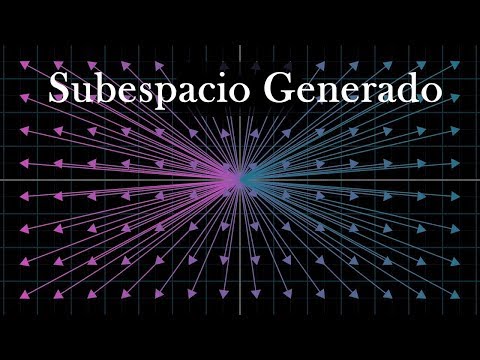
Combinaciones lineales, subespacio generado y bases | Esencia del álgebra lineal, capítulo 2
Introduction to Vector Coordinates and Base Vectors
In this section, the concept of vector coordinates and base vectors in algebraic terms is introduced, emphasizing the significance of choosing specific pairs of numbers to describe vectors.
Understanding Vector Coordinates
- Each coordinate in a vector represents a scalar that scales or shrinks vectors in the x-y coordinate system.
- The x-coordinate stretches the unit vector i (x-hat) while the y-coordinate scales the unit vector j (y-hat), resulting in a vector described by these coordinates as a sum of scaled vectors.
- Base vectors i-hat and j-hat are fundamental components when considering coordinates as scalars for scaling vectors.
Choosing Base Vectors
- Different pairs of base vectors can lead to equally valid coordinate systems, impacting how numerical values are associated with two-dimensional vectors.
- Selecting new base vectors allows for diverse sets of two-dimensional vectors, highlighting the importance of understanding how bases influence numerical descriptions.
Exploring Subspaces Generated by Vectors
This section delves into subspaces generated by combinations of two vectors, elucidating how these subspaces relate to fundamental operations like vector addition and scalar multiplication.
Subspace Generation
- The subspace generated by two vectors encompasses all possible outcomes from combining those two fundamental operations, offering insights into attainable vector spaces.
- Understanding subspaces sheds light on how different pairs of base vectors can either span the entire two-dimensional space or reduce to a single line based on their alignment.
Visualizing Vector Spaces
Visual representations aid in comprehending collections of vectors within various spaces, simplifying complex concepts through geometric interpretations.
Geometric Interpretation
- Representing collections of vectors as points in space facilitates visualizing lines or planes corresponding to specific sets of endpoints.
Understanding Subspaces in Linear Algebra
In this section, the concept of subspaces generated by vectors in a three-dimensional space is explored. The discussion delves into how combinations of vectors create subspaces and the implications of adding more vectors to the mix.
Subspace Generated by Two Vectors
- When considering two vectors in 3D that do not point in the same direction, their subspace generated consists of all linear combinations of these two vectors.
- Visualize this subspace as an infinite plane passing through the origin, formed by scaling and summing the two original vectors.
Adding a Third Vector
- Introducing a third vector alters the subspace generated; if it lies within the existing subspace, no new dimensions are added.
- However, if the third vector is not within the existing subspace, it introduces a new direction, expanding the reach to any vector in space.
Linear Dependence and Independence
This part discusses linear dependence and independence among vectors within subspaces, highlighting their significance in determining redundancy or additional dimensions.
Linear Dependence
- A vector is considered linearly dependent if it can be expressed as a combination of other vectors within the subspace.
- Removing a linearly dependent vector does not reduce the subspace's span as it does not contribute new directions.
Linear Independence
- Vectors that add new dimensions to a subspace are termed linearly independent, enhancing its span.
Defining Base Vectors in Vector Spaces
The technical definition of base vectors in a vector space is explored concerning linearity and spanning properties crucial for understanding spaces' completeness.
Base Vectors Definition
- Base vectors form a set that is both linearly independent and spans the entire space when combined.
Turn any video into a summary like this
YouTube links, meetings, lectures. With transcripts, search, and chat.