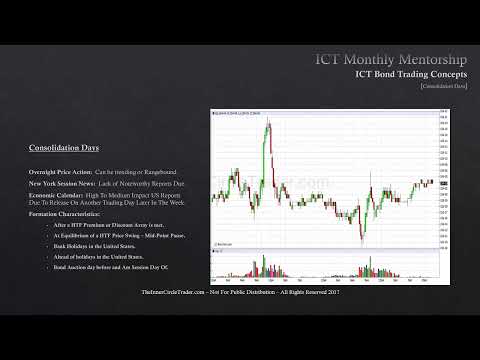
ICT Mentorship Core Content - Month 10 - Bond Trading - Consolidation Days
ICT Mentorship: Bond Trading Lesson 3 Consolidation Days
In this lesson, the instructor teaches about consolidation days and how to incorporate bond analysis into Forex trading.
Overnight Price Action
- When anticipating a consolidation day, refer to overnight price action.
- Overnight price action can be trending or range-bound.
- There is no specific precursor to overnight price action.
- London trading does not always translate to future prognostication for New York trading hours.
Economic Calendars
- High-to-medium impact US reports due to release on another trading day later in the week promote the idea of a consolidation day.
- Lack of noteworthy reports during the New York session creates a dead space in the bond market.
- FOMC date coupled with high impact news creates high volatility days.
Formation Characteristics of Consolidation Days
- After hitting a higher time frame premium or discount array, one of three things can happen: pause and consolidate, retrace after consolidation, or reverse.
- Profit-taking comes in when price hits a higher time frame PD array.
- Equilibrium of a higher time frame price swing or midpoint leads to anticipation of pause or consolidation before next move.
Retracements and Reversals
- Markets move from consolidation to expansion and back again.
- Retracements and reversals occur during expansions.
- Consolidations are by far the most dominant consideration when looking at price action.
Understanding Consolidation Days in Bond Trading
This transcript discusses the impact of holidays and bond auctions on the bond market, and how to identify consolidation days. It also provides tips for trading during consolidation periods.
Identifying Consolidation Days
- Bank holidays in the United States cause consolidation days ahead of the holiday.
- Bond auction days can also cause consolidation.
- Understanding what causes or promotes consolidation in the bond market is important for developing a game plan.
Trading During Consolidation Periods
AM Session
- Scalp for 5 to 10 ticks during consolidation days.
- Look for small opening ranges (12 ticks or less), which usually lead to an expansion move.
- Determine direction based on institutional order flow.
PM Session
- Only trade if AM session has not yet run a stop run.
- Generally, there are no stop runs in PM sessions on consolidation days.
Tips for Trading During Consolidation Periods
- Avoid trading AM session on bond auction days and PM session when interest rate drivers are due (2:00 pm New York time).
- Focus on trading higher time frame premium arrays.
Trading Small Ranges
In this section, the speaker discusses how to adapt to price action and operate in a scalper's mentality during small range days. He emphasizes the importance of welcoming consolidations as they provide an opportunity to formulate a plan for the next trading opportunity.
Adapting to Price Action
- During small range days, it is important to adapt to what price action is telling you.
- Remove the insatiable desire to be doing a whole lot and swinging for the fences.
- Professional-minded traders welcome consolidations because it allows them time to formulate a plan on how they can study where the next movement is going to be.
Consolidation Days
- Consolidation days provide little periods of time when traders can take a breather, take a step back, and formulate an idea based on that consolidation day.
- Consolidation days are like big banner signs that indicate there's a big opportunity coming. It's going to be a juicy price move, so be aware of it and start doing your homework.
- These pauses or these consolidation periods are gold mines in the making.
Scalping Strategies
- If you're going to be scalping, you need to give the market your 100 undivided attention. Have charts right in front of you and avoid distractions.
- Always allow your limit exits to exceed your targets because this will give you a bonus if there's a large expansion move.
- Keep overnight short-term highs and lows in mind for low resistance liquidity runs as that's where your liquidity is going to be during consolidation days.
PM Session Trades
- Consolidation days typically offer setups in the AM session, so avoid forcing PM session trades routinely. All trading should be done before 11 o'clock AM New York time.
Conclusion
In this section, the speaker concludes by summarizing the key points discussed in the video and emphasizing the importance of having a plan and being disciplined when trading small ranges.
- The speaker emphasizes that traders need to adapt to what price action is telling them during small range days.
- Having a plan is crucial when trading small ranges as it allows traders to formulate an idea based on consolidation days.
- Traders need to be disciplined and avoid forcing PM session trades routinely.
- By following these strategies, traders can take advantage of consolidation days and turn them into gold mines.
Consolidation and Professional Trading
In this section, the speaker discusses how consolidation periods in the market can lead to expansion and how professional traders should approach these situations.
Identifying Market Behavior
- When the market is likely to trade in a small range or consolidation day, note that the next trading day or the day not long after it will produce a large range day or trending day.
- Economic calendars can help identify high impact days in news that will create volatility.
- Just because one asset class is in consolidation doesn't mean other asset classes will be volatile.
Professional Mindset
- Professional traders need to have rule-based ideas and parameters to operate within.
- Operating within small range consolidation days promotes a professional trading perspective and removes anxiety.
- Focusing on rule-based ideas removes focus on fear and greed, allowing traders to focus on process and parameters.
- By having rule-based ideas, traders can remove uncertainty about what's going to happen next.
Trade Psychology
- Fear and greed are common psychological effects of trading that can be detrimental if not managed properly.
- By focusing on rule-based ideas, traders can harness trade psychology and master fear and greed.
Keeping Perspective as a Professional Trader
In this section, the speaker emphasizes the importance of maintaining a professional mindset when trading and not treating it like gambling. He stresses the need to focus on longevity and holding onto one's account by operating within clear, rule-based parameters.
Key Points:
- Traders should maintain a professional mindset and avoid treating trading like gambling.
- It is important to focus on longevity and hold onto one's account by operating within clear, rule-based parameters.
- Traders should give themselves permission to miss opportunities that do not fit within their rule-based ideas.
- Low expectations across all asset classes are important for maintaining perspective.
The Bond Market and Consolidation
In this section, the speaker discusses how consolidation in the bond market can impact other asset classes. He explains that when the bond market leaves consolidation, it tends to enter a trending environment which can lead to easier trading days.
Key Points:
- Consolidation in the bond market can impact other asset classes.
- When the bond market leaves consolidation, it tends to enter a trending environment which can lead to easier trading days.
- The longer consolidation lasts, the more likely it is that there will be a protractionary state where prices move in a trend.
- The speaker believes that fall 2017 will offer good trading opportunities due to consolidation in the bond market.
Smart Trading During Consolidation Periods
In this section, the speaker advises traders on how to approach trading during consolidation periods. He emphasizes the importance of not arm wrestling the market and instead letting it grind down other traders emotionally and psychologically.
Key Points:
- During consolidation periods, the smart money is setting up for the next big move.
- Traders should avoid arm wrestling the market and instead let it grind down other traders emotionally and psychologically.
- Understanding principles in the bond market can help Forex traders make better trading decisions.
Turn any video into a summary like this
YouTube links, meetings, lectures. With transcripts, search, and chat.