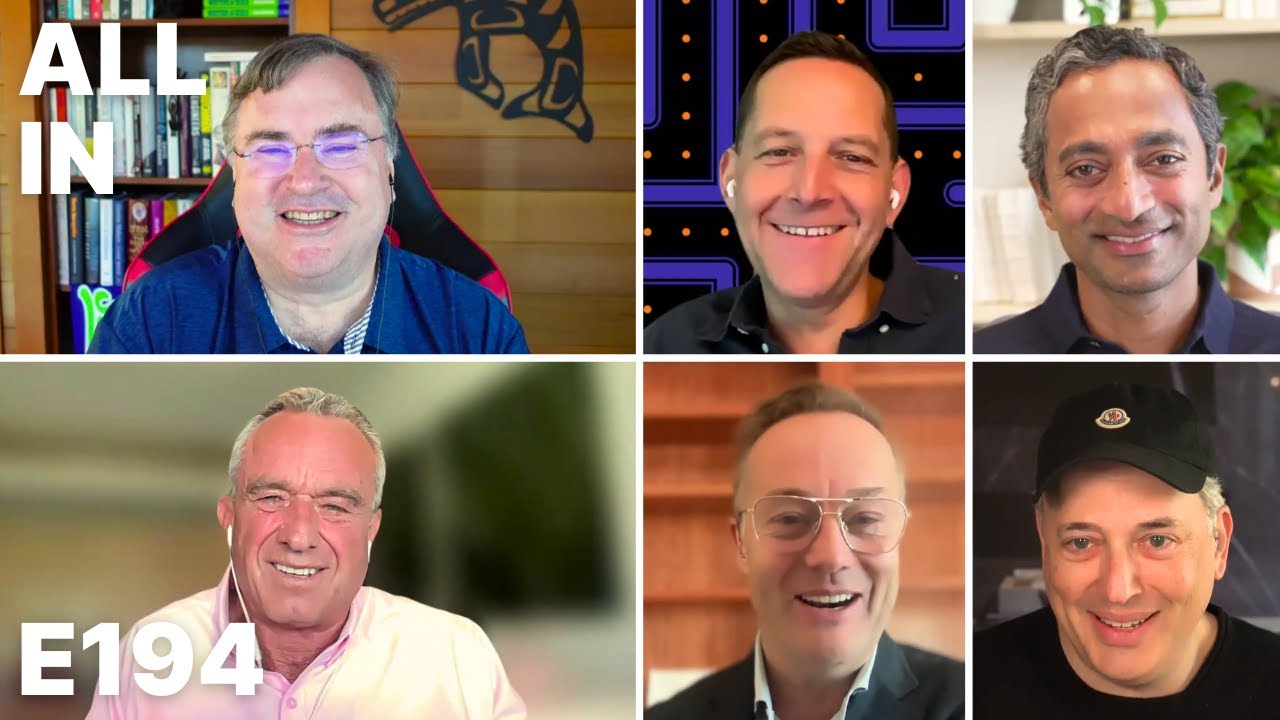
In conversation with Reid Hoffman & Robert F. Kennedy Jr.
Welcome to the Allin Podcast
Introduction of Guests
- Host Jay Cal introduces the podcast as a leading business, technology, and political show.
- David Freeberg is introduced as the "Sultan of Science," previously known for his quinoa business.
- Shamal Ptia returns from Italy, humorously discussing his appearance and hair care post-trip.
Casual Banter
- The group engages in light-hearted banter about clothing choices and personal grooming.
- David Sachs is introduced as "the Dark Knight" and "Rainman," adding to the playful atmosphere.
Reed Hoffman Joins the Discussion
Background on Reed Hoffman
- Reed Hoffman is introduced as a venture capitalist, board member at Microsoft, and co-founder of LinkedIn.
- He shares his connection with David Sachs through their time at PayPal.
Memories from PayPal Era
- Reed recounts meeting David Sachs through Peter Thiel and highlights Sachs' quick adaptation to PayPal's environment.
- He emphasizes learning from each other during their time at PayPal, particularly regarding product cycles on eBay.
Key Contributions at PayPal
David Sachs' Role
- Sachs reflects on how he navigated existential threats from larger companies like Visa and Mastercard while at PayPal.
- He credits Reed for managing relationships with these entities to prevent crises.
Memorable Moments
- The conversation shifts to memorable moments during their tenure at PayPal, focusing on teamwork and high performance.
- Reed shares a significant memory involving Elon Musk's decisive leadership style during a merger with X.com.
Business Insights and AI Developments
The Legendary Antonio's Nut House
- Discussion begins with a nostalgic reference to Antonio's Nut House, a now-defunct venue in Palo Alto where significant business discussions took place.
- Mention of Bill's demise at PayPal, humorously referred to as "The Nut House coup," indicating the informal yet impactful nature of meetings held there.
Nvidia's Financial Performance
- Reed highlights Nvidia’s impressive quarterly results, noting they beat expectations but saw stock decline due to profit-taking.
- Key figures: Nvidia reported $26.3 billion in revenue (87% from data centers), net income of $16.6 billion, and a gross margin of 75%.
- Acknowledgment that while Nvidia has seen unprecedented growth, there are signs of cooling off in revenue growth rates.
Sustainability and Competition in AI
- Inquiry into whether Nvidia’s current success is sustainable amidst growing competition from other companies entering the AI space.
- Response indicates that while Nvidia has a strong position now, the intense demand for inference chips may lead to increased competition affecting margins.
Market Dynamics and Future Outlook
- Discussion on how competition will influence pricing strategies for Nvidia; potential challenges ahead as new players enter the market.
- Emphasis on not shorting Nvidia stocks currently due to expected continued growth despite impending competition.
Strategic Investments in AI Infrastructure
- Freeberg raises questions about the rationale behind massive investments in AI infrastructure by major companies like Microsoft.
- Reference to Gavin Baker discussing ROI considerations versus strategic necessity for building out digital capabilities.
Microsoft's Approach to AI Investment
- Reed discusses his perspective on Microsoft's investment strategy under CEO Satya Nadella, emphasizing both strategic insight and return on capital considerations.
Business Outcomes and AI Development
Focus on Business Applications
- The speaker emphasizes the importance of targeting business outcomes rather than spending resources indiscriminately, likening it to "spending like drunken sailors."
- There is a clear distinction made between discussing practical applications (like office and cloud solutions) versus abstract concepts such as AGI or digital gods, indicating a pragmatic approach to AI development.
Engagement with New Platforms
- The rise of hyperscalers is attributed to their engagement with new platforms that enhance software capabilities across various devices, including phones and computers.
- The motivation behind this engagement is the potential intelligence increase in devices equipped with CPUs or GPUs, highlighting the urgency not to miss out on emerging technologies.
Open Source vs. Closed Source in AI
OpenAI's Position
- The discussion shifts to open source versus closed source models, noting that OpenAI was never fully open source but focused on safety and equitable access.
- It’s clarified that while OpenAI maintains its principles of openness, it does not equate to being entirely open-source.
Future of AI Models
- Predictions are made about multiple winners emerging from both open-source and proprietary models; success will depend on specific market opportunities rather than a single dominant player.
- Various startups are expected to thrive by focusing on niche applications within sectors like coding or healthcare.
The Evolution of Language Models
Scaling Challenges
- A key question arises regarding when we will see significant scaling in language models, with speculation around future iterations like GPT-6.
- Smaller models may still rely heavily on larger models for training effectiveness, suggesting an interdependence in model development strategies.
Market Dynamics
- The conversation highlights the diversity of opportunities within AI investments since 2014/2015, emphasizing that there will be wins across different approaches rather than a binary choice between two extremes.
The Concept of a 'God Model'
Misconceptions About Dominance
- There's skepticism about the idea of one overarching model dominating all tasks; instead, smaller specialized networks may outperform larger generalist models.
- This perspective challenges the notion that a singular "god model" can effectively address all needs in software development.
Practical Considerations
Understanding the Future of AI Models and Corporate Structures
The Evolution of AI Models
- Discussion on the emergence of networks of models in AI, emphasizing that agents will not rely on a single model but rather a blend of various models.
- Highlights the potential for startups in this space due to the need for diverse and cost-effective solutions rather than relying solely on large models like GPT-3.
- Introduces the concept of multimodal approaches, suggesting that smaller, specialized models can be trained effectively using high-quality data alongside larger models.
OpenAI's Corporate Structure
- Explains the initial nonprofit structure (501c3) established by OpenAI to ensure open access to AI technology while seeking philanthropic support.
- Discusses how Sam Altman's strategy involved creating a commercial entity to attract capital, leading to a hybrid model where research benefits also yield commercial returns.
- Describes Reed's involvement as an investor despite initial concerns about lacking business plans, highlighting his belief in the potential scale and impact of their work.
Investment Dynamics and Legal Issues
- Details how strategic partnerships with major tech companies were formed to secure additional funding after early successes with AI developments.
- Outlines how Microsoft’s investment transformed OpenAI into a subsidiary under its nonprofit umbrella, benefiting both parties through shared resources and goals.
Elon Musk's Lawsuits
- Reflects on Elon Musk's legal actions against OpenAI, interpreting them as stemming from feelings of exclusion rather than legitimate grievances regarding investment opportunities.
- Suggests that Musk was offered significant investment opportunities but chose not to participate due to concerns over control and future success.
Emotional Responses from Investors
Elon Musk's Financial Concerns and Philanthropy
Discussion on Philanthropic Donations
- Elon Musk expresses concerns about financial transparency in philanthropy, emphasizing the importance of not using philanthropic donations for personal enrichment.
- The conversation touches on the separation of funds within 501(c)(3) organizations, highlighting that their mission remains intact despite financial complexities.
Intellectual Property (IP) in AI
- A shift to discussing intellectual property raises questions about how AI models like OpenAI's should handle copyrighted content.
- The New York Times lawsuit against OpenAI is mentioned, indicating issues with unauthorized indexing of paywalled content by AI systems.
Economic Implications for Content Creators
- Reed Hoffman discusses the balance between protecting content creators' rights and allowing AI models to learn from available data.
- He argues that copyright laws may need updates to accommodate new technologies while ensuring fair compensation for creators.
Innovation vs. Regulation
- The discussion highlights the tension between innovation and regulatory frameworks, suggesting that overly strict regulations can stifle technological advancement.
- Hoffman advises news organizations to focus on brand value rather than solely monetizing training data, as synthetic data will diminish individual contributions' significance.
Trends in AI Development Deals
Inflection AI and Market Timing
- Inquiry into Inflection AI reveals a transfer payment from Microsoft and comparisons with Google's character AI initiative.
- The conversation reflects on market timing challenges faced by startups, particularly regarding product launches and audience growth strategies.
Pivoting Business Models
- Discussion emphasizes the necessity for startups to pivot their business models based on market conditions, moving from B2C to B2B approaches when needed.
Discussion on M&A and Lena Khan's Impact
The Role of Non-Exclusive IP Licenses
- The potential for outside parties to facilitate non-exclusive IP licenses, allowing selective hiring and dividend distribution to investors.
- This structure provides optionality for investors in B2B businesses, enabling a pivot that benefits all stakeholders involved.
Concerns Over Market Competition
- Discussion on Lena Khan's approach to competition and its implications for market dynamics, particularly regarding Google.
- Observations about the existential crisis faced by Google due to emerging language models like ChatGPT affecting search engine usage.
Implications of Regulatory Approaches
- Commentary on how Lena Khan’s regulatory stance has led to a freeze in mergers and acquisitions (M&A), impacting capital allocation.
- Acknowledgment of her successes in addressing price cartels and anti-competitive practices but criticism over her understanding of large tech companies.
Venture Capital Investment Challenges
- Critique of Khan's theory that aims to prevent power aggregation through strict scrutiny of acquisitions, which may deter venture capital investment.
- Emphasis on the necessity for acquisition exits as part of venture funding strategies, highlighting the need for competitive dynamics among top tech firms.
The Current State of Competition Among Tech Giants
- Analysis indicating that competition is increasing among major tech companies rather than consolidating into monopolies.
- Mention of new players like Nvidia entering the market, suggesting a more dynamic competitive landscape than perceived.
Consequences of Restrictive Policies
- Argument that overly restrictive policies could lead to reduced competition by limiting capital flow into startups needing funding for growth.
- Reflection on political discourse surrounding these issues, with acknowledgment of differing views within the industry regarding M&A regulations.
Diverging Views on Big Tech Power
- Agreement that Lena Khan’s broad approach has had a chilling effect on M&A activity crucial for innovation in venture capital markets.
The Role of American Tech Companies in Global Competition
Overview of American Competitiveness
- The thesis posits that strong American tech companies derive over half their revenue from international markets, creating technology platforms that differentiate the U.S. favorably in global contexts.
- There is intense competition among major players like ChatGPT and Google Search, highlighting the essence of capitalism through competitive pressure.
Antitrust Concerns and Big Tech
- Discussion on the need for the FTC to limit anti-competitive practices by large tech firms, with Apple cited as a prime example due to its App Store policies.
- Advocates for consumer options such as side loading apps, arguing it could enhance safety and security while promoting innovation.
Government Intervention and Breakup Mandates
- The speaker expresses skepticism about mandated breakups of companies like Google or Apple unless capitalism fails to function properly.
- Emphasizes minimal intervention strategies to restore competition without resorting to drastic measures like breaking up companies.
Challenges in Addressing Apple's Market Power
- The case against Apple has progressed less than that against Google due to political complexities; iOS's popularity complicates public sentiment towards regulation.
- Suggestion that allowing alternative app stores could mitigate issues related to Apple's App Store monopoly, referencing Epic Games' model as a potential solution.
Political Dynamics and Leadership Perception
- A reflection on President Biden's performance during discussions compared to his debate performance raises questions about consistency in leadership effectiveness.
Discussion on Democratic Processes and Candidate Selection
Integrity in Leadership Decisions
- The speaker reflects on Biden's integrity, emphasizing that leadership should prioritize the country over personal interests.
- It is noted that ultimately, decisions regarding candidacy are personal and cannot be forced by others, including party leaders like Pelosi.
Open Primaries and Voter Inclusion
- The discussion raises questions about whether an open primary would have benefited Kamala Harris, highlighting the endorsements she received from key contenders.
- There is a concern about whether voters felt excluded from the decision-making process within the Democratic Party.
Backroom Conversations and Party Dynamics
- The conversation critiques backroom discussions among party leaders and donors that may undermine democratic processes by limiting candidate choices.
- A philosophical inquiry into democracy arises, questioning if such practices set a bad precedent for voter choice in elections.
Influence of Media and Economic Factors
- The speaker acknowledges that various influences exist in a republic, including media power and economic resources affecting political dynamics.
- Emphasis is placed on maintaining democratic processes where all eligible voters participate actively in elections.
Proposed Changes to Electoral Systems
- Suggestions for reform include implementing ranked-choice voting and open primaries to enhance voter representation.
- Criticism is directed at the two-party system as a fundamental issue needing resolution to allow for more diverse political representation.
Independent Candidates' Challenges
- Discussion touches upon independent candidates often acting as spoilers in elections due to systemic biases favoring two major parties.
- Clarification is sought regarding funding allegations related to efforts against RFK Jr.'s ballot access, with an emphasis on anti-democratic implications of such actions.
Current Political Landscape Concerns
Partisan Politics and Ballot Access
The Role of Third Parties in Elections
- Discussion on the inconsistency of Democratic strategies regarding third-party candidates, highlighting their support or opposition based on perceived electoral impact.
- Emphasis on the importance of following legal processes for ballot access, contrasting it with illegal actions like pressuring officials for votes.
- Questioning the legality and democratic nature of state decisions to remove candidates from ballots, particularly in reference to Trump and RFK.
- Criticism of Democratic groups suing RFK to keep him off the ballot, viewed as an anti-democratic action aimed at undermining his campaign.
- Noting that political calculations influence whether parties support or oppose third-party candidates' presence on ballots.
Anti-Democratic Actions Against Candidates
- Assertion that funding various groups can lead to unintended consequences in political campaigning; highlights a focus on exposing candidate flaws rather than outright removal.
- Acknowledgment that while drawing attention to issues is valid, actively suing third-party candidates is fundamentally anti-democratic.
Current Events: Cornell West's Candidacy
- Inquiry about support for efforts to remove Cornell West from Michigan's ballot; initial stance is opposition due to lack of details but emphasizes democratic principles.
Cultural Issues: Anti-Semitism and Political Representation
Rising Concerns Over Anti-Semitism
- Discussion about perceptions of growing anti-Semitism linked to extreme left ideologies; mentions Josh Airo as a potential candidate affected by religious bias.
- Personal endorsement of Josh Airo’s candidacy potential; reflects on decision-making within party dynamics regarding candidate selection.
Addressing Anti-Semitism Across Political Lines
- Recognition that anti-Semitism is a bipartisan issue requiring collective action against it from both sides of the political spectrum.
- Advocacy for a unified stance against racism and anti-Semitism while also addressing broader humanitarian concerns such as genocide.
Kamala Harris's Position on Israel-Palestine Conflict
- Evaluation of Kamala Harris's speech addressing both Israeli defense rights and humane treatment for Gaza civilians; seen as a rational approach amidst complex issues.
- Agreement with her balanced perspective advocating for protection against genocide affecting both Palestinians and Jews.
Discussion on Economic Policies and Social Justice
The Intersection of Policy and Cultural Phenomena
- Discussion begins with the influence of cultural phenomena on policymaking, particularly concepts of equity rooted in social justice and Marxist principles stemming from the Industrial Revolution.
- Price fixing proposals, such as wealth taxes and price caps on food, are highlighted as methods to address perceived power imbalances within society.
Anti-Semitism and Political Dynamics
- The conversation touches upon how anti-Semitism may be linked to perceptions of privilege among certain cultural classes, specifically Jews.
- Acknowledgment that there is a growing influence of the far-left within the Democratic Party, which some argue leads to misunderstandings about critical issues like genocide.
Responses to Inflationary Pressures
- Kamala Harris's proposal for price fixing is framed as a response to inflation, emphasizing a 20% erosion in purchasing power over four years.
- The discussion includes differing views on the causes of inflation, with one participant attributing it primarily to government monetary policy rather than corporate greed.
Economic Principles and Market Control
- Agreement that while good monetary policy is essential, excessive money printing can lead to negative economic outcomes; however, monopolies should still be regulated.
- Inflation affecting commodities like food staples is discussed; it's noted that these issues stem from broader market factors beyond just monopolistic practices.
Concerns Over Government Intervention
- There are concerns regarding government intervention in free markets being a step towards socialist principles; setting prices could disrupt market efficiencies.
Discussion on Economic Policies and Political Dynamics
Perspectives on Price Capping and Taxation
- The speaker expresses skepticism about price capping as an independent principle, indicating a nuanced view of economic policies.
- Criticism is directed towards Elizabeth Warren's views on capitalism, highlighting ideological disagreements within the political spectrum.
- A significant concern is raised regarding a proposed 25% unrealized gains tax, which is met with strong opposition from Silicon Valley stakeholders.
Impact of Unrealized Gains Tax
- The proposed tax structure requires individuals to have 80% of their net worth liquid; otherwise, they can defer taxes but face penalties.
- The speaker categorizes the unrealized gains tax as "stupid" and detrimental to the startup ecosystem in Silicon Valley.
Political Strategy and Voter Dynamics
- There’s a perception that both major parties are converging on key issues, forcing candidates to appeal to their respective flanks for votes.
- The discussion touches upon how extreme proposals may serve as "sacrificial lambs," allowing more moderate policies to advance.
Abortion Rights Debate
- The conversation shifts to abortion rights, noting Trump's historical actions and current stance against a national ban while emphasizing state-level decisions.
- It’s argued that Trump has effectively returned the abortion issue to states rather than imposing federal restrictions.
Views on Republican Party Moderation
- One speaker identifies Trump as a moderate within the Republican Party concerning abortion and foreign policy interventions.
Discussion on Kamala Harris's Economic Policies
Support for Economic Proposals
- The Democratic platform includes support for certain economic proposals, which have been confirmed by top advisers and the campaign of Kamala Harris.
- There is skepticism about whether her support translates into actionable priorities, raising questions about her effectiveness as a candidate.
Perception of Political Ideology
- A debate arises regarding whether Harris is viewed as a moderate or leaning towards socialism, with concerns about potential far-left policies.
Inflationary Policies
- Discussion highlights Trump's tariff policy as inflationary, equating it to price gouging in food prices; both are seen as detrimental economic strategies.
Silicon Valley's Stance on Taxation
- Questions arise about supporting Harris despite opposing her proposed tax policies, such as a 44% capital gains tax and a 25% unrealized gains tax.
- Many in Silicon Valley view these taxes as harmful to the startup ecosystem, leading to discussions on whether they should still back her candidacy.
Polling Insights
- An objective poll conducted by "The Information" indicates broader support for the Biden-Harris ticket among Silicon Valley compared to Republicans.
- Business leaders emphasize that lower capital gains taxes promote long-term investment but also value stability and rule of law over tax rates alone.
Rule of Law and Legal Proceedings Against Trump
Concerns Over Legal Actions
- The conversation shifts to various legal cases against Trump, including insurrection charges and other allegations related to financial misconduct.
Funding Legal Defense
- One participant discusses funding legal efforts for E. Jean Carroll, emphasizing the importance of providing power to those threatened by wealthy individuals in court settings.
Importance of Rule of Law
- The speaker stresses that laws must apply equally to all individuals regardless of wealth or power, highlighting America's commitment to the rule of law.
Critique of Prosecution Methods
Legal Proceedings Against Trump: Analyzing the Cases
Overview of Trump's Legal Challenges
- Discussion centers on the perceived abuse of the legal system for partisan goals, questioning whether this aligns with the rule of law.
- Mention of four key cases against Trump: two convictions and two outstanding cases, highlighting public sentiment regarding fairness in these proceedings.
- The conversation touches on various interpretations of "lawfare," suggesting that many view it as a misuse of legal processes by those opposed to Trump.
Convictions and Allegations
- Reference to a unanimous conviction in one case involving 12 jurors, including one juror who sourced news from Truth Social, indicating potential biases in jury selection.
- Vice President Pence's testimony is cited, where he claims Trump attempted to illegally overturn the election results, adding weight to allegations against Trump.
Perspectives on Justice and Accountability
- Acknowledgment that laws should apply equally to powerful individuals; if Trump broke laws, he should face consequences like any other citizen.
- Critique of delays attributed to Trump's legal team; suggests that strategic postponements may have influenced trial timelines leading into an election year.
January 6th Incident Analysis
- Discussion about new charges filed by Jack Smith related to January 6th; initial DOJ analysis found insufficient grounds for incitement prosecution against Trump.
- Claims that Biden pressured Merrick Garland for more aggressive action against Trump following the January 6th events are mentioned.
Incitement and Legal Implications
- Reed argues that January 6th represents a significant breach where incitement occurred despite differing opinions on its legal ramifications.
- The discussion includes assertions about violence during the Capitol riot and how it reflects on Trump's rhetoric encouraging such actions.
Clarifications and Misconceptions
- A fact-checking moment occurs regarding police fatalities during the riot; clarification provided that no officers were killed directly due to rioters' actions.
- Debate over whether Trump's comments post-riot could be interpreted as encouragement for similar future actions among his supporters.
Conclusion and Further Discussion Invitation
Interview with RFK Jr. on His Campaign Suspension
Introduction to the Interview
- The interview begins with a mention of Robert F. Kennedy Jr. (RFK Jr.) joining the podcast, highlighting his recent vacation and willingness to discuss his campaign status.
- Host introduces RFK Jr. to Reed Hoffman, indicating this is their first meeting.
Discussion on Campaign Suspension
- RFK Jr. clarifies that he has suspended his campaign rather than terminated it, explaining efforts to remove himself from ballots in certain states while remaining on 39 others.
- He notes that the decision was influenced by polling data suggesting he could negatively impact Trump’s chances in battleground states.
Media Coverage Challenges
- RFK Jr. discusses feeling shut out from mainstream media coverage, citing only two live interviews over 16 months compared to Ross Perot's extensive media presence during his campaign.
- He expresses frustration over negative portrayals in media outlets aligned with the Democratic National Committee, which hindered his ability to reach broader audiences.
Audience Dynamics and Support Base
- Despite strong support among Independents and younger voters, RFK Jr. struggled to connect with older demographics who primarily consume news through mainstream channels.
- He reflects on how these audiences held a low opinion of him due to biased information sources.
Engagement with Trump Administration
- After being approached by a food advocate post-tragedy at Butler, RFK Jr. initially declined an offer for the vice presidency but later agreed to discussions with President Trump.
- Their meetings included talks about forming a Unity ticket where both parties could criticize each other while aligning on key issues.
Key Issues of Agreement
- During discussions, they identified critical issues such as ending the war in Ukraine, addressing censorship, and tackling childhood chronic disease epidemics as areas of mutual concern.
- RFK Jr. emphasizes concerns regarding regulatory agencies like USDA and FDA being influenced by large pharmaceutical and food processing industries.
Clarification on Vice Presidency Offer
- A question arises about whether he considered being Trump's VP; RFK Jr. reiterates disinterest in that role due to its limitations within Washington politics.
Understanding Political Dynamics and Personal Journeys
The Power Dynamics in Politics
- The President holds significant power over staff and resources, including the ability to restrict access to official residences like the Naval Observatory.
- Acknowledgment of Reed's participation in a challenging political environment, highlighting the difficulty of engaging with opposing views.
Transition from Democratic Party to Trump Support
- Bobby discusses his past as a "never Trumper" and the personal fallout from this stance, particularly within his community and family.
- Describes a difficult transition away from the Democratic party after realizing it was rigged against him during his campaign efforts.
Family Legacy and Political Identity
- Bobby reflects on his family's deep roots in the Democratic party, dating back to 1848, emphasizing their historical significance in American politics.
- He recounts notable family members' contributions to politics, including John F. Kennedy's presidency and Ted Kennedy's long Senate career.
Disillusionment with the Democratic Party
- Bobby expresses that he felt forced out of the Democratic party due to its shift away from democratic principles and fairness.
- He believes that many traditional values held by Democrats have been abandoned, leading to a disconnect between current leadership and historical ideals.
Current State of American Politics
- Observes that both parties have undergone significant demographic changes; Democrats are now seen as elite while Republicans appeal more to working-class citizens.
Discussion on Political Control and Populism
The Nature of Tribalism in Politics
- The speaker describes Donald Trump's influence as a dangerous form of orchestrated tribalism, highlighting the Democratic Party's mistrust of the populace.
- Emphasizes that instead of engaging with voters, the Democratic Party resorts to eliminating electoral competition, showcasing their lack of faith in democratic processes.
Election Manipulation Allegations
- Discusses how the Democratic Party allegedly used significant financial resources not to promote their message but to remove candidates like himself from ballots through legal means.
- Points out a growing divide between populist movements and authoritarian control, citing recent events in Europe as examples of this trend.
Free Speech Concerns
- Highlights France's historical commitment to free speech and contrasts it with current actions against dissenting voices, such as the arrest of Telegram founder Pavel Durov.
- Critiques European officials for attempting to silence political discourse by restricting media access to prominent figures like Donald Trump.
Vision for Future Governance
- Questions about potential roles within a Trump administration lead to discussions on co-governance and collaboration with other political figures who share similar views.
- Outlines three primary goals: ending censorship, resolving the Ukraine conflict swiftly, and addressing issues related to food safety and corruption in regulatory agencies.
Health Recommendations for Families
- Expresses skepticism towards government health recommendations due to perceived conflicts of interest among decision-makers in food and pharmaceutical industries.
- Advises parents on being cautious about vaccines and food choices, emphasizing that many industry experts prioritize profit over public health.
Industry Influence on Public Health
- Argues that there is a significant profit motive behind keeping children unhealthy, creating lifelong consumers for expensive medical products.
The Impact of Chemicals in Food and Chronic Disease
Introduction to Chemical Concerns
- Discussion on the presence of thousands of chemicals in food that are banned in Europe and other countries, highlighting concerns about their introduction by chemists and poor body handling.
Historical Context of Chronic Disease
- Reference to a time when only 6% of Americans had chronic diseases during the speaker's uncle's presidency, contrasting it with today's $4.3 trillion expenditure on chronic disease management.
The Role of Pharmaceutical and Insurance Companies
- Critique of pharmaceutical companies profiting from chronic diseases, alongside insurance companies that benefit financially from sick patients rather than promoting wellness.
Corporate Influence on Health Advice
- Examination of how trusted health advisors may be compromised due to corporate capture, complicating public health messaging.
Debate on Industrialized Food Systems
Perspectives on Processed Foods
- Acknowledgment that while industrialized and processed foods have negative health impacts, there is skepticism about a grand conspiracy behind these practices.
Economic Incentives in Food Production
- Argument that economic incentives drive the production of unhealthy foods; people prefer tastier options which leads to higher sales for companies producing them.
Lack of Malicious Intent
- Assertion that individuals within government or private industry do not intentionally design harmful products but respond to market demands for more appealing food options.
Personal Experiences with Food Quality
Observations from Living Abroad
- Personal account illustrating changes in body composition when consuming fresh Italian produce versus processed foods available elsewhere, emphasizing the impact of diet quality.
Cost Considerations for Healthy Eating
The Impact of Processed Foods and Weight Loss Drugs
Access to Food and Health Implications
- Discussion on the differences in access to ultra-processed foods, highlighting that while they may be cheap on shelves, they impose significant health costs.
- Mention of weight loss drugs (OIC), with personal anecdotes indicating their effectiveness in reducing cravings and altering food perception.
The Rise of Obesity and Diabetes
- Statistics reveal a dramatic increase in juvenile diabetes cases; from one case per pediatrician's career to one in three children being diabetic or pre-diabetic today.
- Autism rates have also surged, with current statistics showing one in 34 children affected compared to much lower rates decades ago.
Economic Considerations of Food Choices
- Critique of pharmaceutical companies profiting from obesity treatments instead of addressing root causes through diet and exercise.
- Argument against the reliance on medications like OIC for treating conditions that could be managed by better food choices.
Government Policies and Food Subsidies
- Examination of how agricultural subsidies favor processed foods over healthier options, leading to poor dietary habits among low-income populations.
- Discussion about the SNAP program where a large percentage is spent on processed foods, raising concerns about public health implications.
Concerns Over Children's Health
- Alarm raised over the high percentage (77%) of unhealthy foods provided through school lunch programs, questioning societal values regarding children's health.
- Historical context provided: only 6% of American kids had chronic diseases when the speaker was young; now it’s 60%, emphasizing a need for urgent action.
Legislative Challenges and Lobbying Influence
- Overview of federal spending on food stamps ($20 billion annually), with soda being the top purchase item despite its negative health impacts.
Discussion on Food Supply and Health Inequities
Misaligned Incentives in Food Programs
- The speaker highlights the misincentives and disincentives present in food supply programs, suggesting that these issues are expanding annually.
Organic Food Accessibility Concerns
- A discussion arises about how focusing on organic food can inadvertently exclude certain communities, raising concerns about potential racial biases in dietary preferences.
Impact of Corporate Funding on Advocacy Groups
- It is noted that organizations like the NAACP receive significant funding from the food industry, which may compromise their advocacy for minority communities affected by federal policies.
Health Risks in Food Deserts
- The speaker argues that providing unhealthy food options to predominantly Black communities constitutes a form of racism, especially since these areas often lack access to grocery stores with healthier choices.
Need for National Policy Changes
- There is a call for national policies aimed at ensuring healthy food access, emphasizing the need to alter agricultural subsidies that currently promote low-nutrient commodity crops.
Critique of Democratic Party Dynamics
Observations on Bobby Kennedy's Campaign
- The conversation shifts to Bobby Kennedy's campaign, commending its focus on free speech and civil liberties while criticizing the Democratic party's treatment of him during his candidacy.
Allegations of Undemocratic Practices
- The speakers express outrage over perceived unfair practices by the Democratic party against Kennedy, including attempts to keep him off ballots and limit debate opportunities.
Historical Context of Democratic Values
- There's a reflection on how issues championed by Kennedy align with traditional Democratic values from earlier eras, particularly those represented by his father and President John F. Kennedy.
Criticism of Biden’s Nomination Process
- The discussion critiques Biden’s nomination process as lacking transparency and fairness, highlighting concerns over his ability to engage effectively without scripted support.
Hypocrisy in Claims of Democracy
Discussion on Trump and Populism
The Role of Trump in Current Politics
- The speaker emphasizes Trump's significance as a pivotal figure in politics, particularly for harnessing populist energy against perceived elite authoritarianism.
- There is a critique of the current political climate, highlighting issues like censorship and the maintenance of unnecessary wars, suggesting that diplomatic solutions are often overlooked.
Perspectives on Trump's Leadership
- Acknowledgment of Trump's flaws as a leader; however, he is viewed as the candidate who embodies populist resistance to authoritarianism.
- Discussion about how a potential second term for Trump could reveal a different approach compared to his first term, indicating personal growth and focus on legacy.
Insights from Personal Experience with Trump
- The speaker shares personal anecdotes about their long history with Trump, including litigation and friendship, suggesting an understanding of his character evolution over time.
- Mention of Project 2025—a conservative agenda—highlighting Trump's unfamiliarity with it until it was brought up by critics.
Legacy and Governance Considerations
- Trump’s desire to leave behind meaningful accomplishments is noted; he appears more open to diverse perspectives than before.
- The speaker expresses hope that Trump will engage with broader stakeholder input during governance preparations.
Public Perception and Candidate Preferences
- Concerns are raised about Trump's tendency to revert to controversial topics (race, gender), which frustrates moderates seeking stability in leadership.
- A debate arises regarding whether voters should prioritize policy alignment over stylistic preferences in candidates.
Critique of Democratic Candidates' Communication Skills
- Observations are made about the inability of Democratic candidates to handle unscripted interviews effectively, raising questions about their readiness for leadership roles.
- Emphasis on the importance of articulate communication for leaders handling critical responsibilities like nuclear codes.
Conclusion: Political Landscape Reflection
- The discussion reflects concerns over America's global image due to ineffective political discourse among leading candidates.
Tribal Resistance to New Knowledge
Critique of Political Apparatus
- Discussion on tribal resistance to new knowledge, highlighting how individuals often vote for the political apparatus rather than specific candidates.
- Questions raised about the effectiveness of this apparatus in serving the American public, citing issues like open borders and national debt.
- Mention of high inflation rates and its impact on the American middle class as a failure of the current political system.
Reflection on Podcast Interviews
- Acknowledgment of past podcast guests and their contributions, emphasizing the value of long-form discussions in understanding complex issues.
- Expression of respect for efforts aimed at improving health in America, regardless of differing opinions on other political matters.
Engagement with Audience and Promotions
Community Interaction
- Light-hearted commentary suggesting a need for community bonding through shared experiences, reflecting a casual tone among hosts.
Upcoming Events and Subscriptions
- Announcement about the All In Summit taking place in Los Angeles, encouraging audience participation through applications.
- Promotion of various social media platforms where listeners can engage with content related to the podcast.
Opportunities for Founders
Support for Startups
- Invitation extended to founders seeking funding or support through accelerator programs offered by Jason Calacanis.
- Highlighting Athena wow.com as an exciting opportunity for virtual assistant services at an affordable rate.
Turn any video into a summary like this
YouTube links, meetings, lectures. With transcripts, search, and chat.