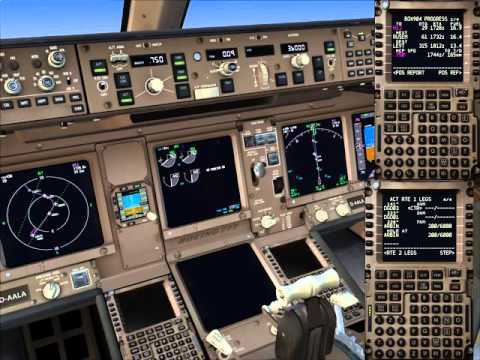
08 - Preparación de la llegada STAR y app ILS
Arrival Procedure to Victoria
Setting Up for Arrival
- The speaker discusses the need to configure the arrival at Victoria using available charts from AENA, emphasizing that there will be no issues as all necessary charts are accessible.
- As the top of descent approaches, the speaker plans to reduce speed to allow time for explanations and ensure a smooth approach. Speed is reduced to 0.8 Mach.
Flight Plan Adjustments
- The speaker mentions needing to input the flight plan into Active Sky before checking wind conditions at the destination airport, noting that prior checks indicated calm winds.
- The preferred runway for landing is identified as runway 04 due to coming from the south, leading into discussions about how to introduce their arrival procedure effectively.
Arrival Procedure Details
- The chosen arrival route is "Domingo 1 Charlie," which directs towards LNA (Initial Approach Fix). The speaker inputs this information into their system while explaining its simplicity.
- There’s a mention of an option to intercept directly if flying towards another airport not on their route; however, this option won't be utilized in this case as they focus on their planned approach.
Verifying Arrival Charts
- Upon reviewing the instrument arrival chart, it confirms that after reaching LNA, they will proceed towards Victoria and then follow specific waypoints until landing at the runway. This includes verifying altitude requirements along the approach path.
- An issue arises where an incorrect waypoint appears in their system; adjustments are made by repositioning waypoints according to correct procedures outlined in charts. This highlights attention to detail during flight planning and execution.
Altitude and Speed Management
- The importance of maintaining specific altitudes during different phases of descent is emphasized; initially set at 6000 feet upon reaching IAF (Initial Approach Fix) with a target clean maneuvering speed around 220 knots being discussed for safety and efficiency purposes.
- As they near top of descent, further adjustments are made regarding altitude settings and speeds based on proximity to key points like FAP (Final Approach Point), ensuring compliance with operational standards throughout descent phases.
Final Approach Considerations
- Discussion includes managing speeds close to final approach while considering fuel consumption and timing implications; it's noted that exact speed settings become less critical as they near landing but still require careful monitoring for safe operations during approach phases.
Flight Navigation and Approach Procedures
Initial Approach Setup
- The speaker discusses integrating into a holding pattern, referencing the NDB (Non-Directional Beacon) and specific headings to intercept.
- The radial 037 is introduced as a critical point for navigation, indicating the need to adjust course towards radial 043.
- A correction is made regarding the intended radial; emphasis on manually inputting points for accurate navigation rather than relying solely on FMC (Flight Management Computer).
Adjusting Radials and Distances
- The speaker explores adjusting distances from DGO to ensure proper interception of radial 043, experimenting with various mileages.
- A successful adjustment is noted at 28 miles, highlighting the importance of manual corrections in flight planning.
Navigational Corrections and Frequency Settings
- The speaker reflects on being 160 miles from top of descent, preparing to navigate towards Sierra DG LNA.
- Emphasis is placed on tuning into an NDB frequency (Victoria 345), which is crucial for arrival procedures.
Finalizing Departure and Arrival Procedures
- Additional frequencies are set up for departure from Sunday and arrival at Victoria, ensuring all necessary radials are correctly inputted.
- The departure radial from Sunday (344 degrees) aligns with the approach chart, confirming accuracy in navigation setup.
Holding Pattern Configuration
- A fix point (Lima Echo Victor Tango) is established directly above the runway, aiding in visualizing approach paths.
- Discussion about creating a gate point at 30 miles out at an altitude of 10,000 feet emphasizes strategic altitude management during descent.
ILS Frequency Setup and Holding Patterns
- Setting up ILS frequency (108.9 MHz), with an entry heading of 038 degrees prepares for final approach alignment.
- The speaker details configuring a published hold pattern due to potential delays entering Victoria; specifics include left turns on heading 039.
Execution of Holding Procedure
- Parameters for holding patterns are finalized: speed settings adjusted based on clean maneuvering speed while maintaining specified distances between legs.
- Demonstration of how automated systems manage entries into holds effectively showcases technology's role in aviation safety.
Approaching Flight Procedures
Entry Techniques for Holding Patterns
- Discusses the different entry techniques for holding patterns, including a teardrop entry that involves turning right by 30 degrees before entering.
- Mentions the necessity of having a VOR tuned in to properly execute the hold and describes using the Vitoria NDB for this purpose.
Managing Flight Parameters
- Highlights the importance of verifying flight parameters, such as ensuring correct distance settings (5 miles for Arvin).
- Explains minimum maneuvering speed, emphasizing its role in maintaining safety margins during flight operations.
Speed Management and Safety Margins
- Clarifies that the aircraft will not decelerate below minimum maneuvering speed unless manually overridden, ensuring safe handling characteristics.
- Notes adjustments to target speed to allow more time before reaching top of descent while maintaining operational safety.
Fuel Management Strategies
- Discusses setting autobrakes for long runways and calculating fuel consumption to avoid arriving overweight.
- Describes procedures for dumping fuel safely, including obtaining air traffic control permission and monitoring remaining fuel levels.
Approach Preparation and Decision Heights
- Outlines how to check if the aircraft is overweight by comparing approach reference speeds with flap configurations.
Checklist and Descent Preparation
Pre-Descent Checklist
- The speaker mentions reaching 2070 feet, indicating a critical altitude in the approach phase.
- A checklist for descent is initiated, which is standard procedure before beginning the descent.
- Key items on the checklist include recalling checks, autobrake settings, and confirming landing gear status.
- The approach wing has been completed normally, suggesting that all systems are functioning as expected prior to descent.
Turn any video into a summary like this
YouTube links, meetings, lectures — with transcripts, search, and chat.