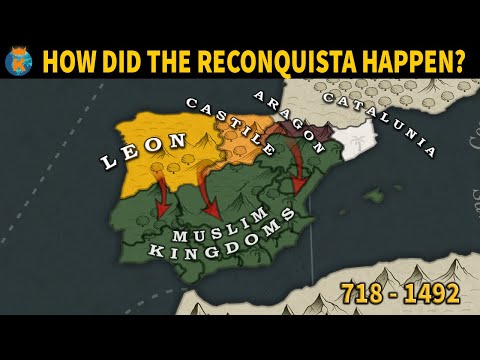
How did the Reconquista Actually Happen? - Explained in 11 Minutes
The Reconquista: A Historical Overview
Introduction to the Reconquista
- The Reconquista refers to the reconquest of the Iberian Peninsula, a period marked by conflict between Christian kingdoms and Muslim caliphates.
- This struggle lasted nearly 800 years, beginning with the Umayyad Caliphate's conquest in 711, which dismantled the Visigothic Kingdom.
Early Resistance and Key Battles
- The initial resistance was led by Pelagius of Asturia at the Battle of Covadonga, where he successfully routed Umayyad forces.
- This victory ignited a crusader spirit among Christians but was followed by a slow period of reconquest as Muslims consolidated power from Cordoba.
Expansion of Christian Kingdoms
- By the 11th century, several Christian states emerged, including Castile and Leon, joining efforts for reconquest. Toledo fell to Castile in 1085 under King Alfonso VI's leadership.
- Despite early victories, Muslim forces called upon Almoravid warriors from Africa to counteract Christian advances.
Establishment of Portugal
- A significant milestone occurred on June 24, 1128, when Afonso Henriques declared an independent Kingdom of Portugal after defeating his mother Teresa at the Battle of Sao Mamede.
- This independence was recognized by León in 1143 and later by the Pope in 1179, marking a pivotal moment for Christians in Iberia.
Shifts in Power Dynamics
- The Almoravids initially succeeded but were eventually overthrown by Almohads; however, they faced defeat against united Christian forces at Las Navas de Tolosa in 1212.
- Following this victory, Ferdinand III expanded his kingdom significantly through strategic campaigns against remaining Muslim territories like Cordoba (1236).
Final Stages and Cultural Integration
- By 1250, most of Iberia was under Christian control except for Granada; Ferdinand III allowed it to remain Muslim while paying tribute to avoid economic repercussions.
- The establishment of institutions like the Escuela de Traductores facilitated cultural exchange between Islamic and Christian worlds during this period.
Conclusion: Ongoing Conflicts
- Although Christians appeared satisfied with their territorial gains for a time, conflicts persisted until major battles like Rio Salado solidified their dominance over Iberia’s landscape.
The Catholic Monarchy and the Fall of Granada
The Rise of the Catholic Monarchy
- The wedding of Ferdinand II of Aragon and Isabella I of Castile in 1469 marked the establishment of the Catholic Monarchy, which was characterized by a less tolerant approach compared to previous leadership.
- In 1491, they laid siege to Granada, aiming to eliminate the last Muslim stronghold in the Iberian Peninsula.
The Surrender of Prince Boabdil
- Prince Boabdil negotiated a truce with his Spanish opponents, promising surrender if he could not secure support from other Muslim states within four months.
- After failing to receive aid from the Marinids of Morocco, Boabdil surrendered on January 2, 1492.
Religious Implications Post-Reconquista
- The victory over Granada symbolized redemption for Christians following the Fall of Constantinople in 1453; it also led to significant religious persecution.
- The Alhambra Decree expelled practicing Jews from Spain and mandated conversions for remaining Jews and Muslims under Catholic rule.
Legacy of the Reconquista
- The Reconquista was a prolonged series of campaigns lasting nearly eight centuries aimed at reclaiming territory from Muslims by Christian forces.
- Internal conflicts among Christian kingdoms and external Muslim support delayed progress; however, ultimately Christians recaptured their lands.