Discovery of the Electron: Cathode Ray Tube Experiment
Discovery of the Electron by JJ Thompson
In this video, we learn about how JJ Thompson discovered the electron in 1897 through the cathode ray tube experiment. We explore the concept of atoms and their subatomic particles, and how Thompson's discoveries challenged existing theories.
John Dalton's Model of the Atom
- John Dalton proposed in the early 1800s that all matter is made up of tiny indivisible particles called atoms.
- Initially, his idea faced skepticism but gained acceptance over time.
- However, it remained uncertain whether atoms were truly indivisible or composed of smaller components.
Cathode Ray Tube Experiment
- JJ Thompson used a cathode ray tube to investigate the nature of atoms.
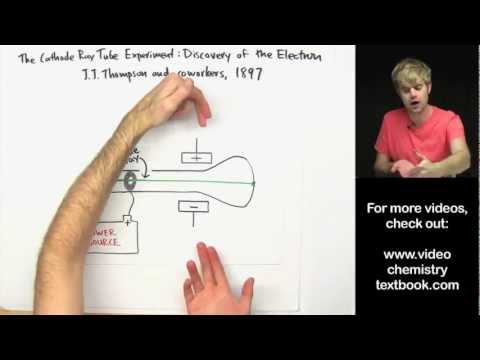
- The cathode ray tube is a sealed glass tube with metal pieces at each end connected to a power source.
- When activated, a ray was emitted from one end and created a glowing spot when it hit a special coating inside the glass.
Observations and Conclusions
- Thompson observed that the cathode ray bent towards positively charged plates and away from negatively charged plates.
- This indicated that the cathode ray was made up of negatively charged particles attracted to positive charges.
- To further confirm his findings, he used a magnet and observed that the cathode ray bent in response to magnetic fields.
- Based on these experiments, Thompson concluded that cathode rays were composed of tiny negatively charged particles called electrons.
Implications for Atomic Structure
- Combining his experimental data with other observations, Thompson determined that electrons were approximately a thousand times smaller than hydrogen atoms (the smallest known atoms).
- Regardless of which metal was used in the cathode tube, similar results were obtained, suggesting that electrons are present in all types of atoms.
- These conclusions led to the understanding that atoms are not solid and indivisible but consist of smaller subatomic particles, particularly electrons.
Significance of Thompson's Discoveries
- Thompson's discoveries challenged the prevailing notion of atoms as indivisible entities.
- His experiments provided evidence for the existence of electrons and paved the way for further advancements in atomic theory.
Conclusion
The video concludes by addressing potential confusion regarding how Thompson's experiments with cathode rays relate to the existence of electrons within atoms. It emphasizes that during Thompson's time, it was widely accepted that all matter was composed of atoms, making his discoveries significant in understanding atomic structure.
Discovery of Electrons and the Plum Pudding Model
In this section, we explore J.J. Thompson's discovery of electrons and how it led to the development of the plum pudding model.
J.J. Thompson's Discovery
- J.J. Thompson discovered that electricity is made of electrons.
- He questioned where these electrons come from and realized they must be coming from other atoms.
- Thompson observed that different types of atoms are able to release or give off electrons, indicating that electrons are present in all atoms.
Disproving Dalton's Atomic Model
- Dalton's atomic model proposed that atoms are indivisible and not made up of anything smaller.
- Thompson's discovery of electrons inside atoms disproved this part of Dalton's model, suggesting that atoms are not indivisible.
The Plum Pudding Model
- Thompson noticed that while electrons have a negative charge, atoms as a whole are usually electrically neutral.
- To explain this, he proposed the plum pudding model, also known as the blueberry muffin model.
- In this model, the atom is compared to a blueberry muffin, with negatively charged electrons stuck in a positively charged dough-like substance.
- The positive charge balances out the negative charge of the electrons, resulting in an electrically neutral atom.
Limitations of the Plum Pudding Model
- Later discoveries revealed that the positive charge in an atom is concentrated in its nucleus rather than spread throughout like dough or pudding.
- This realization paved the way for further understanding and exploration of the structure of an atom.
[t=0:07:24] Elektronların Keşfi ve Erikli Puding Modeli
Bölüm Genel Bakışı: Bu bölümde, J.J. Thompson'ın elektronların keşfi ve bu keşfin erikli puding modelinin gelişimine nasıl yol açtığını araştırıyoruz.
J.J. Thompson'ın Keşfi
- J.J. Thompson, elektriğin elektronlardan oluştuğunu keşfetti.
- Elektronların nereden geldiğini sorguladı ve bunların diğer atomlardan gelmesi gerektiğini fark etti.
- Thompson, farklı tipteki atomların elektronları salabileceğini gözlemledi, bu da tüm atomlarda elektronların bulunduğunu gösterdi.
Dalton'un Atom Modelinin Çürütülmesi
- Dalton'un atom modeline göre atomlar bölünemez ve daha küçük bir şeyden oluşmaz.
- Thompson'ın atom içindeki elektronları keşfi, Dalton'un modelinin bu kısmını çürüttü ve atomların bölünemez olmadığını gösterdi.
Erikli Puding Modeli
- Thompson, elektronların negatif yüklü olduğunu fark ettiği gibi genel olarak atomların genellikle elektriksel olarak nötr olduğunu da fark etti.
- Buna açıklama olarak erikli puding modelini veya blueberry muffin modelini önerdi.
- Bu modele göre, atom bir blueberry muffine benzetilirken negatif yüklü elektronlar pozitif yüklü hamur benzeri bir maddeye yapışmıştır.
- Pozitif yük, elektronların negatif yükünü dengeleyerek elektriksel olarak nötr bir atom oluşturur.
Erikli Puding Modelinin Sınırlamaları
- Sonraki keşifler, atomdaki pozitif yükün hamur veya puding gibi yayılmak yerine çekirdeğinde yoğunlaştığını ortaya çıkardı.
- Bu farkındalık, atomun yapısının daha fazla anlaşılması ve araştırılması için yol açtı.