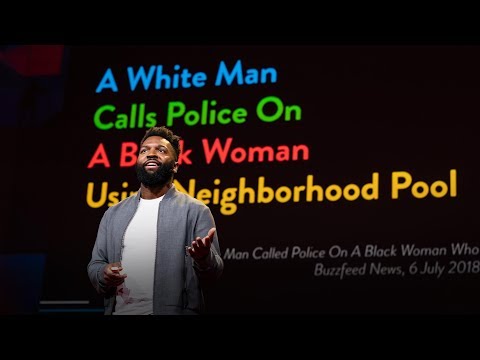
How to deconstruct racism, one headline at a time | Baratunde Thurston
My Extraordinary Name
In this section, Baratunde Rafiq Thurston talks about his unique name and the origins behind it.
Baratunde's Name
- Baratunde Rafiq Thurston is the speaker's full name.
- Baratunde is a Yoruba name from Nigeria, even though his family is not Nigerian.
- Rafiq is an Arabic name chosen by his mother to potentially cause difficulty boarding planes.
- Thurston is a British name, which the speaker finds useful as a Starbucks name.
Lessons from His Mother
The speaker reflects on the lessons he learned from his mother and his experiences at Sidwell Friends School.
Renaissance Woman Mother
- The speaker's mother, Arnita Lorraine Thurston, was a renaissance woman with various skills and experiences.
- She taught him about black history, martial arts, urban farming, and prepared him for the world.
Sidwell Friends School Experience
- The speaker attended Sidwell Friends School in seventh grade.
- He had two key tasks at school: maintaining his black identity and keeping his glasses.
- The school provided opportunities to learn arts, sciences, and living among whiteness.
Reminded of Being Black in America
The speaker shares an incident where he was pulled over by the police while visiting his fiancé's parents in Wisconsin.
Pulled Over Incident
- While driving with his fiancé in her parents' car, they were pulled over by the police.
- The speaker felt scared but followed protocols to stay safe during the encounter.
Stories of Living While Black
The speaker discusses stories that highlight racial profiling incidents experienced by black individuals.
Changing Stories
- Previously, stories of unarmed black people being shot by the police were prevalent.
- In 2018, stories emerged where white individuals called the police on black people for mundane activities.
Diagramming Sentences and White Supremacy
The speaker explains how he analyzed headlines and diagrammed sentences to understand white supremacy.
Analyzing Headlines
- The speaker collected stories of racial profiling incidents and created a database.
- He used sentence diagramming to understand the layers in each headline.
Understanding White Supremacy
- White supremacy refers to a system that favors white people in social, economic, and political arenas.
- It is a narrative of racial difference used to justify slavery, Jim Crow laws, mass incarceration, etc.
Objective: Real or Fake
The speaker introduces the objective of determining whether a given scenario is real or fake. They present an example and ask the audience to indicate their belief by clapping.
Determining Real or Fake
- The speaker presents an example of a headline about a Catholic University Law Librarian calling the police on a student for being argumentative.
- The audience is asked to clap if they believe the scenario is real or fake.
- The majority of the audience believes it is real.
Reverse the Roles
The speaker discusses reversing roles in scenarios to increase believability and challenge biases.
Level One: Reverse Roles
- The objective is to reverse the roles in scenarios.
- Examples are given, such as a Black Oregon lawmaker calling the police on a woman instead of vice versa.
- The speaker humorously suggests absurd additions to make the reversal more believable, like touching hair without permission or making oat milk while riding a unicycle.
Change the Action
The focus shifts to changing actions rather than simply reversing them, emphasizing that justice should be sought rather than vengeance.
Level Two: Increase Believability
- Level two aims to increase believability in reversed scenarios.
- Examples are provided where white individuals engage in activities that would warrant police involvement if done by black individuals, such as talking over others in meetings.
- Humorously highlights relatable situations where people have experienced similar behavior.
Level Three: Change Action
- Changing actions becomes the objective at level three.
- Calling the police should not be seen as the only option when faced with certain situations.
- Examples are given where subjects take alternative actions instead of calling law enforcement, such as expressing disbelief without involving authorities.
Living as Crime
The speaker discusses how everyday activities for marginalized individuals are often interpreted as crimes, leading to the need for self-policing.
- Everyday activities of marginalized individuals are perceived as criminal.
- The speaker highlights the disproportionate use of force by police against black people compared to white people.
- Research shows that many interactions between police and citizens result from 911 calls, with increased use of force in areas experiencing gentrification.
Weaponized Discomfort
The speaker emphasizes the weaponization of discomfort and draws parallels between historical racial terror lynchings and modern-day incidents involving calling the police.
- The California Safeway incident is likened to ordering an armed response against a black woman donating food to the homeless.
- Historical examples of racial terror lynchings are mentioned, highlighting the headlines associated with them.
- The need for changing actions, such as refraining from calling the police, is emphasized.
Inclusion
The final bonus level focuses on inclusion and suggests alternative actions that promote understanding and support rather than resorting to law enforcement.
- Inclusion becomes the objective in this bonus level.
- Examples are given where gratitude or support could replace calling the police in certain situations.
- Encourages minding one's own business as a positive choice.
Conclusion
The speaker concludes by emphasizing the importance of changing actions rather than perpetuating harmful biases through calls to law enforcement.
- Changing actions is crucial in addressing systemic issues.
- Calls for gratitude, support, and minding one's own business instead of relying on law enforcement interventions.
New Section
This section discusses the structure of systemic abuses of power, such as white supremacy and misogyny, and emphasizes the importance of recognizing the humanity of those affected by these structures.
Understanding Systemic Abuses of Power
- White supremacy, misogyny, and other systemic abuses of power have a structured nature.
- Recognizing the structure is crucial in understanding how these systems operate.
- It is important to acknowledge the humanity of individuals who are targeted by these structures.
Personal Experience and Awareness
- The speaker shares their personal experience, highlighting that despite being privileged in many ways, they still live in fear due to being perceived as a threat.
- Carrying the burden of other people's fears is exhausting for many individuals affected by systemic abuses of power.
Changing the Narrative
- The speaker expresses their exhaustion with carrying this invisible burden and emphasizes that change is possible.
- By changing our actions and narratives, we can challenge and transform the systems that perpetuate these stories.
Collective Stories and Systems
- Systems are collective stories that society collectively buys into.
- Understanding this collective narrative is essential in addressing and dismantling systemic abuses of power.
Turn any video into a summary like this
YouTube links, meetings, lectures. With transcripts, search, and chat.