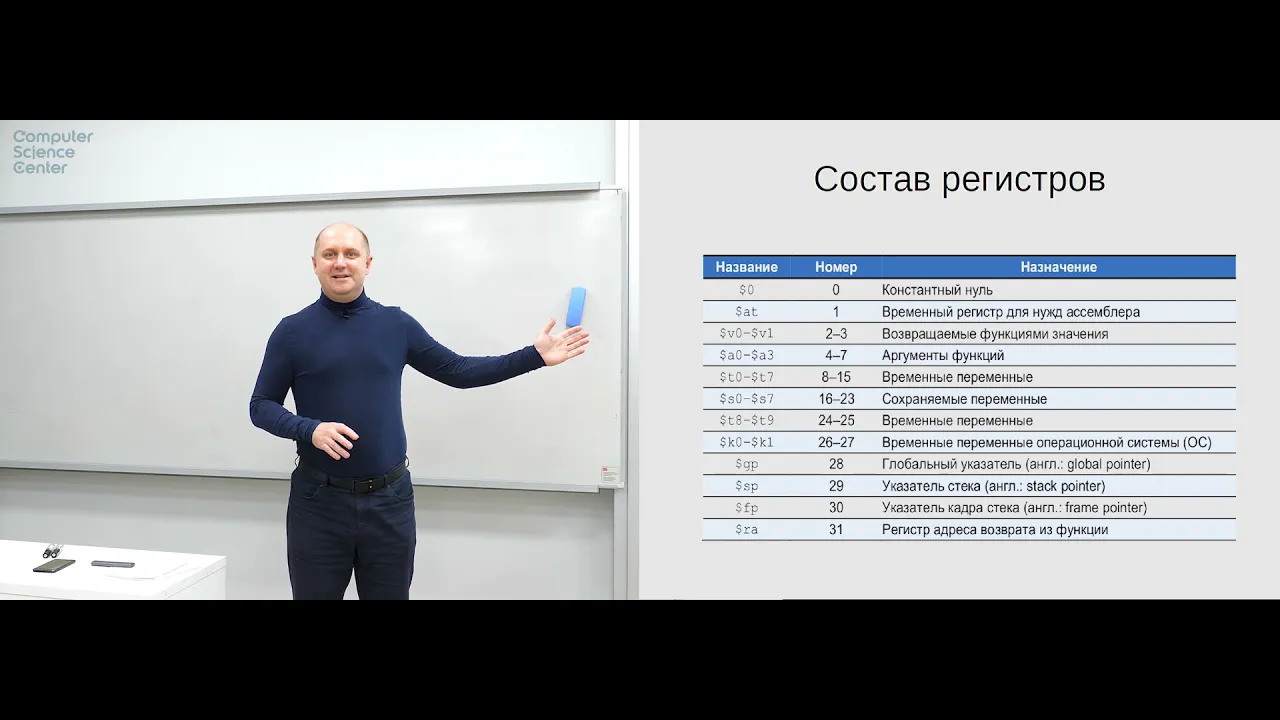
Архитектура ЭВМ. Лекция 3: Кодирование и тип инструкций процессора.
New Section
In this section, the speaker introduces the topic of computer construction and discusses the basic blocks that make up a computer.
Introduction to Computer Construction
- : The speaker mentions that they will be building a simple computer over several lectures by adding different components.
- : Discusses the risk involved in computer design and introduces the concept of control units.
Designing a Computer
This section delves into how computers are designed, touching on elements like data paths, control units, and memory devices.
Understanding Computer Design
- : Explains the role of data paths in computers and how control units manage data processing.
- : Highlights the importance of control units in managing data flow within a computer system.
Architectural State and Instruction Set
This part focuses on defining architectural states and instruction sets essential for designing a processor's architecture.
Defining Architectural State
- : Explores the concept of architectural state concerning processor architecture.
- : Discusses how registers play a crucial role in executing operations on stored data within a processor.
[Registers and System Commands]
This section covers registers' significance in executing commands within processors and understanding system commands as part of an architecture.
Registers and Commands
New Section
The speaker discusses how memory is structured similarly to having address and data buses, emphasizing the binary nature of interfaces.
Memory Structure
- Memory is structured with address and data buses.
- Memory sizes are powers of two, leading to efficient memory usage.
- Each wire in the address bus encodes 0 or 1, resulting in power-of-two configurations.
- Register size is typically in powers of two for efficiency.
Memory Interface and Registers
The discussion delves into the design considerations for memory interfaces and registers within a processor architecture.
Register Design Considerations
- Registers can be designed as general-purpose or specialized for specific functions.
- Specialized registers can include those for pointers or memory control.
Naming Conventions and Assembly Language
Exploring how registers are named and utilized in assembly language programming.
Register Naming
- Developers determine register names based on architecture requirements.
- Assembly language serves as an intermediary between human-readable mnemonics and machine code instructions.
Processor Architecture Development
Discussing the decision-making process behind processor architecture development.
Processor Design Process
- Developers have flexibility in naming registers during processor design.
New Section
In this section, the speaker discusses the renaming of components and the support for assembly language in a system architecture.
Components Renaming and Assembly Language Support
- The speaker talks about the possibility of renaming components in a system architecture.
- Assembly language support is highlighted as an essential feature for developers.
- Developers can declare how registers are named and used in documentation.
- The relationship between assembly code and higher-level languages like C is explained.
New Section
This part focuses on understanding the structure behind processors and their command systems, emphasizing the translation process from human-readable to machine-readable instructions.
Processor Structure and Command Systems
- Explanation on how processors interpret commands and translate them into machine-readable instructions.
- The importance of defining registers within a processor's architecture.
- Introduction to assembly language syntax with an example provided.
- Contrasting code examples between high-level languages like C and assembly language.
New Section
This section delves into the limitations posed by processor capabilities when interpreting high-level programming languages like C into machine-executable instructions.
Interpreting High-Level Code
- Challenges faced when a processor encounters operations beyond its capabilities.
- Clarification on variables in high-level languages translating to memory cells in assembly language.
- Demonstration of moving data between memory cells and registers using assembly language instructions.
New Section
The discussion shifts towards the complexity of designing instruction sets for processors due to limited register availability, leading to constraints in executing universal instructions efficiently.
Designing Instruction Sets
- Limitations imposed by a processor's register count on executing complex operations universally.
- Introduction to assembly language as a simplified yet efficient means of communication with processors.
- Exploring the classification of instructions based on their operands and operation types.
New Section
This part explores categorizing processor instructions based on their operand types, aiming to streamline instruction execution efficiency through grouping similar operations together.
Categorizing Processor Instructions
- Grouping processor instructions based on operand types for improved operational efficiency.
- Identifying common structures among instruction classes for streamlined execution processes.
Introduction and Register Encoding
In this section, the speaker discusses register encoding and the number of bits required for encoding registers.
Register Encoding
- 32 registers are available.
- Special reserved codes exist for future use.
- Commands are encoded with 6 bits for operations like add, subtract, and transfer.
- Fields control ALU operations such as inversion or selection of results.
Assembler Instructions and Encoding
This section covers assembler instructions and their encoding process.
Assembler Instructions
- Codes related to ALU functions may be introduced later.
- Specific codes associated with ALU operations might be revealed in the future.
Instruction Coding Process
The speaker explains the process of coding instructions in assembly language.
Instruction Coding
- Writing an instruction in assembly language involves encoding it.
- Three registers are needed for operands and results: source, destination, and possibly a temporary register.
Command Encoding Techniques
This part delves into techniques used to encode commands efficiently.
Command Encoding
- Commands can be encoded by referencing tables containing SAP codes and register numbers.
- A simple method is shown to encode commands that interact with the ALU effectively.
Binary vs. Machine Code
The distinction between binary code and machine code is discussed here.
Binary vs. Machine Code
- Machine code simplifies program execution on processors without additional efforts from users.
- Immediate values can be obtained directly from commands without checking registers.
Jump Instructions and Addressing
Jump instructions' significance in managing program flow is explained along with addressing methods.
Jump Instructions
- Jump instructions aid in controlling program flow without computational tasks.
New Section
Explanation of instruction encoding in x86 architecture.
Instruction Encoding in x86
- Instructions in a risk machine are all the same size, allowing for easy decoding.
- Instructions consist of register-register, register-immediate, or register-memory operations.
- Encoding includes one to three bytes, with possible prefixes and memory access modes.
- Decoding an instruction requires reading a variable number of bytes from memory.
New Section
Comparison between different processor architectures.
Processor Architectures
- Mention of MIPS and RISC processors being popular in mobile devices.
- Likelihood of MIPS processors in mobile devices due to their efficiency.
- Discussion on the complexity of studying RISC processors.
New Section
Operand encoding considerations for arithmetic operations.
Operand Encoding
- Illustration of how arithmetic operations are encoded in instructions.
- Explanation on encoding arithmetic functions like addition and subtraction.
New Section
Handling positive and negative numbers in operand encoding.
Positive and Negative Numbers
- Need for handling both positive and negative numbers using operand encoding.
- Importance of correctly interpreting immediate values to avoid errors.
New Section
Understanding control flow and labels in assembly language programming.
Control Flow and Labels
- Use of labels as references for control flow instructions like jumps.
New Section
In this section, the speaker discusses the process of storing values in registers and conditional branching in programming.
Storing Values in Registers
- The speaker explains how to store values in registers using symbols like $ for register A and B.
- An example is provided to illustrate the process of storing values in registers.
Conditional Branching
- Conditional branching based on comparisons between register A and B is explained.
- The concept of conditional branching (branch if less than) is discussed.
New Section
This section delves into flag registers and their role in indicating the outcome of previous operations in a processor.
Flag Registers
- The purpose of flag registers and their significance in storing operation outcomes are explained.
- Different flags such as negative (N), zero (Z), etc., are raised based on operation results.
New Section
Here, the speaker introduces instructions related to conditional jumps based on flag statuses set by previous operations.
Conditional Jumps
- Instructions for conditional jumps based on flag statuses are discussed.
New Section
In this section, the speaker discusses automatic variables and stack frames in programming languages.
Automatic Variables and Stack Frames
- The number of automatic variables can be significant, leading to a large stack frame.
- When functions are called repeatedly, multiple stack frames are created, potentially causing a stack overflow.
- In assembly language like x86, the return value is typically stored in a register rather than directly returned.
- Upon returning from a function, the stack is reset to its initial state before the function call.
New Section
This section delves into memory storage concepts like little endian and big endian.
Memory Storage Concepts
- Little endian stores the least significant byte first, while big endian stores the most significant byte first in memory addresses.
- Understanding memory storage order is crucial for interpreting data correctly in different architectures.
New Section
The speaker explains the process of converting programs into machine code and executing them.
Converting Programs to Machine Code
- Programs are converted into machine code through compilation and linking processes for execution by the processor.
New Section
Explanation of a 32-bit read data interface and memory access.
Understanding the 32-Bit Read Data Interface
- The system operates on a 32-bit read data interface.
- Inputting a register number yields the corresponding data from memory.
- Harvard architecture allows reading and writing at specific addresses.
- Signals A and B control data writing when activated.
New Section
Discussion on connecting components for address input and command interpretation.
Connecting Components for Address Input