Comunicação e Expressão - UN3 - Vídeo 06
Understanding Text Composition and Communication
Concept of Text
- The text is defined as a fundamental linguistic unit that serves as a product of human verbal activity, characterized by its social nature and semantic content.
- It possesses both deep and superficial coherence, which is essential for creating an integral text through the interaction between speaker and audience.
Cohesion vs. Coherence
- Cohesion refers to the connection between elements within the text, primarily achieved through the use of connectives that link sentences or ideas.
- An example illustrates cohesion: "We do not know who the lucky one is, but she does," where "but" connects two parts of information.
- Coherence encompasses the overall relationship among paragraphs and how they relate to internal or external context, ensuring all parts contribute to a unified message.
Denotation and Connotation
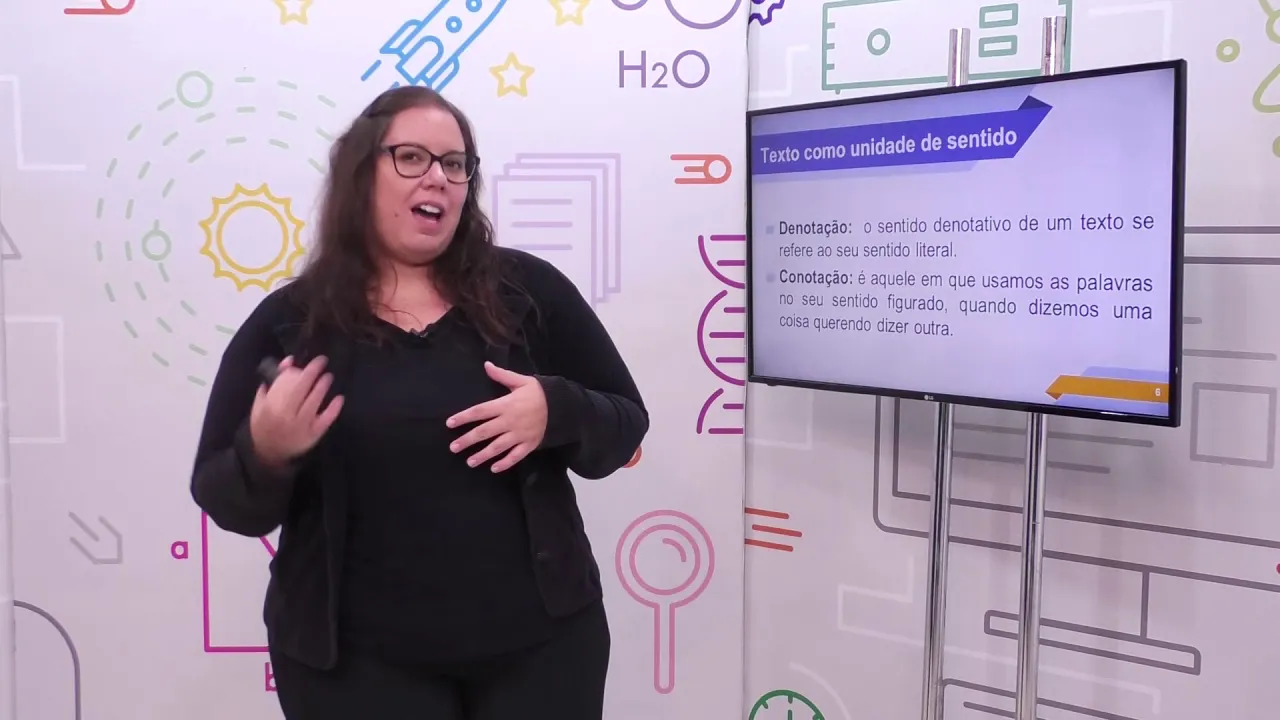
- Denotation refers to the literal meaning of words used in a text, while connotation involves figurative meanings often employed in irony or dialogue.
- Understanding these concepts helps clarify how language can convey different meanings based on context.
Intertextuality and Ambiguity
- Intertextuality occurs when references are made to existing texts within new compositions, enhancing ideas but requiring careful balance to avoid overwhelming readers with excessive information.
- Ambiguity can add humor or irony but should be avoided in informative texts where clarity is crucial; it depends on the author's intent.
Language Vices
- Language vices are elements that may unintentionally emphasize points through repetition or pleonasm; intentional use depends on the writer's objectives.
- It's important for authors to review their work for unintentional vices while recognizing when such devices serve a purpose.
Genres of Discourse
- Discourse genres arise from verbal interactions and encompass various forms of communication classified into primary (simple oral forms like dialogue) and secondary (complex written forms like articles).
- Bakhtin categorizes discourse genres into primary (related to everyday conversation) and secondary (more structured forms), highlighting their significance in understanding communication dynamics.
Genres of Discourse and Their Classification
Overview of Discourse Genres
- The speaker discusses various genres of discourse, emphasizing their classification into primary and secondary categories.
- Examples provided include: announcement, conference, cordel (a type of Brazilian poetry), chronicle, fable, news article, parlenda (a type of children's rhyme), medical recipe, culinary recipe, report, repente (improvised poetry), reportage, and novel.
- All these genres can be classified as discourse genres according to the speaker's framework.
- The classification is based on the understanding that all these forms serve specific communicative purposes within different contexts.
- The discussion highlights the importance of recognizing both primary and secondary genres in understanding discourse effectively.