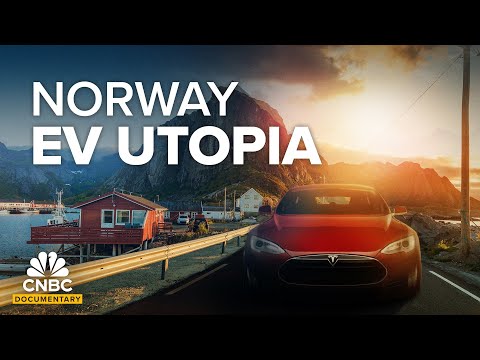
How Norway Built An EV Utopia While The U.S. Is Struggling To Go Electric | CNBC Documentary
Norway's Electric Vehicle Revolution
This section discusses Norway's high adoption rate of electric vehicles and the factors contributing to this trend.
Norway's High EV Adoption Rate
- Norway boasts the highest EV adoption rate globally, with over 82% of new car sales being electric vehicles in 2023.
- In contrast, the U.S. had only 7.6% of new car sales as electric vehicles in 2023.
- The country aims for all new cars by 2025 to be zero-emission vehicles.
Oslo's Electrification Efforts
- Oslo is electrifying its public transportation, aiming for all public transport within the city to be zero-emission by the end of a specific year.
Impact on Environment and Society
This section explores how Norway's shift to electric vehicles has impacted the environment and society.
Environmental Impact
- The streets in Oslo are quiet, air quality has improved significantly, leading to a reduction in local pollution by around 20%.
Societal Response
- While some still drive gas-powered cars due to affordability or range anxiety, many Norwegians have embraced EVs, owning multiple electric cars at home.
Policies Driving EV Adoption
This section delves into the policies and incentives that have accelerated Norway's transition to electric vehicles.
Policy Measures
Incentives for EV Ownership
This section highlights support mechanisms facilitating consumers' transition towards electric vehicles in Norway.
Consumer Support
New Section
The discussion revolves around changes in preferences towards electric vehicles, public transportation, and government incentives in Norway.
Changes in Transportation Preferences
- More people are opting to drive electric vehicles over taking public transportation due to increased cars on the road.
- Government subsidies of $1,000 per inhabitant for EV purchases have made them more affordable than internal combustion engine cars.
- Norway's wealth from oil and gas is shifting towards renewable energy with a goal of 55% emission reduction by 2030.
New Section
Focuses on Norway's transition from oil industry to renewable energy sources and its impact on the economy.
Transition to Renewable Energy
- Norway plans wind production on its continental shelf as part of transitioning to renewable energy.
- With a quarter of cars being electric, demand for petrol and diesel is decreasing, signaling a shift in the global oil industry.
New Section
Discusses long-term planning and investments in battery technology for sustainable energy solutions.
Battery Technology Advancements
- Freyr, a battery company, is building factories in Norway and Georgia for grid applications like solar and wind power plants.
- Hope for European governments to follow the U.S. lead in stimulating the market for sustainable energy solutions.
New Section
Examines factors influencing EV adoption rates and future goals towards achieving 100% EV usage.
Factors Influencing EV Adoption
- Economic factors play a significant role in Norwegians choosing EVs over environmental concerns.
Capital Intensive
Discussion on the capital investment in building infrastructure for electric vehicles.
Capital Investment
- The company has been building infrastructure for over ten years with the belief that it will be profitable.
- Initially, there was minimal support for charging, leading early adopters to charge at home.
- City of Oslo addressed charging concerns by installing chargers around town and in parking garages.
- Oslo is a leader in EV infrastructure, converting buses to electric and experimenting with innovative solutions.
EV Infrastructure Development
Details about the development of EV infrastructure in Oslo.
Infrastructure Development
- Oslo city acted as a first mover, investing in over 2,000 public chargers and electrifying transportation.
- Initially, the city bore some costs for charging; now users pay a small fee instead of taxpayers.
- Oslo's public transportation is entirely zero-emission, including ferries charged with renewable energy.
Charging Stations Expansion
Challenges and developments related to expanding charging stations.
Charging Stations
- Establishing new sites requires agreements with landowners and authorities due to existing electrical grid limitations.
- Grid demands are increasing, necessitating collaboration between companies and grid operators for sustainable solutions.
Gas Station Transformation
Transition of gas stations into energy stations with fast chargers.
Gas Station Evolution
- Circle K leads fast-charging market in Norway; diversifying due to declining fuel demand from passenger cars since 2016.
Introduction and Charging Challenges
The speaker discusses challenges faced with new superchargers and the need for standardized charging methods.
Challenges with Superchargers
- Speaker faced issues with new v4 superchargers.
- Different companies having their own apps for charging, making it inconvenient.
- Regulations in Norway and EU pushing for standardization of payment methods at chargers.
Efficiency of Fast Chargers
The efficiency and speed of fast chargers are highlighted, along with the convenience of charging in Norway.
Fast Charging Experience
- DC fast charger filled up the car to 70% in just 15 minutes.
- Positive feedback on Tesla's V4 superchargers for their speed and convenience.
Range Anxiety and Winter Performance
Discussion on range anxiety, winter performance, and improvements in electric vehicles.
Range Anxiety and Winter Performance
- Moments of range anxiety experienced during trips in Norway.
- Past range anxiety due to limited range but not an issue anymore.
Incentives and Future Changes
Changes in incentives for EV drivers as adoption increases are discussed.
Incentives Evolution
- Changes in incentives as EV market share increases.
- Phasing out subsidies like discounts on parking, ferries, and road tolls due to EV becoming the norm.
Battery Recycling and Longevity
Battery recycling efforts, longevity of batteries, and the robust used EV market in Norway are mentioned.
Battery Recycling Efforts
- European regulations on battery recycling with projects in Norway.
Is there a big used EV market in Norway?
Discussion on the presence of a significant used electric vehicle market in Norway and the longevity of EV batteries.
Used EV Market in Norway
- Norway has a substantial used EV market with many electric cars.
- There are still skeptics about EVs, both internationally and within Norway.
- Despite rumors, fires related to electric vehicles have not been a significant issue in Norway.
Environmental Impact of Electric Cars vs. Gas-Powered Cars
Addressing concerns regarding the environmental impact of electric cars compared to gas-powered vehicles.
Environmental Impact Comparison
- Transition to EVs should not be rushed unnecessarily due to environmental concerns.
- Emphasis on using old cars for their entire lifespan and considering production emissions when changing policies.
Challenges and Lessons for Electric Vehicle Adoption
Discussing challenges faced and lessons learned in the adoption of electric vehicles.
Challenges and Lessons Learned
- Charging infrastructure remains challenging globally, requiring standardization for user convenience.
- Importance of having adequate charging infrastructure before widespread adoption of electric vehicles.
Misconceptions About Electric Vehicles
Clarifying common misconceptions surrounding electric vehicles and their charging process.
Misconceptions Clarified