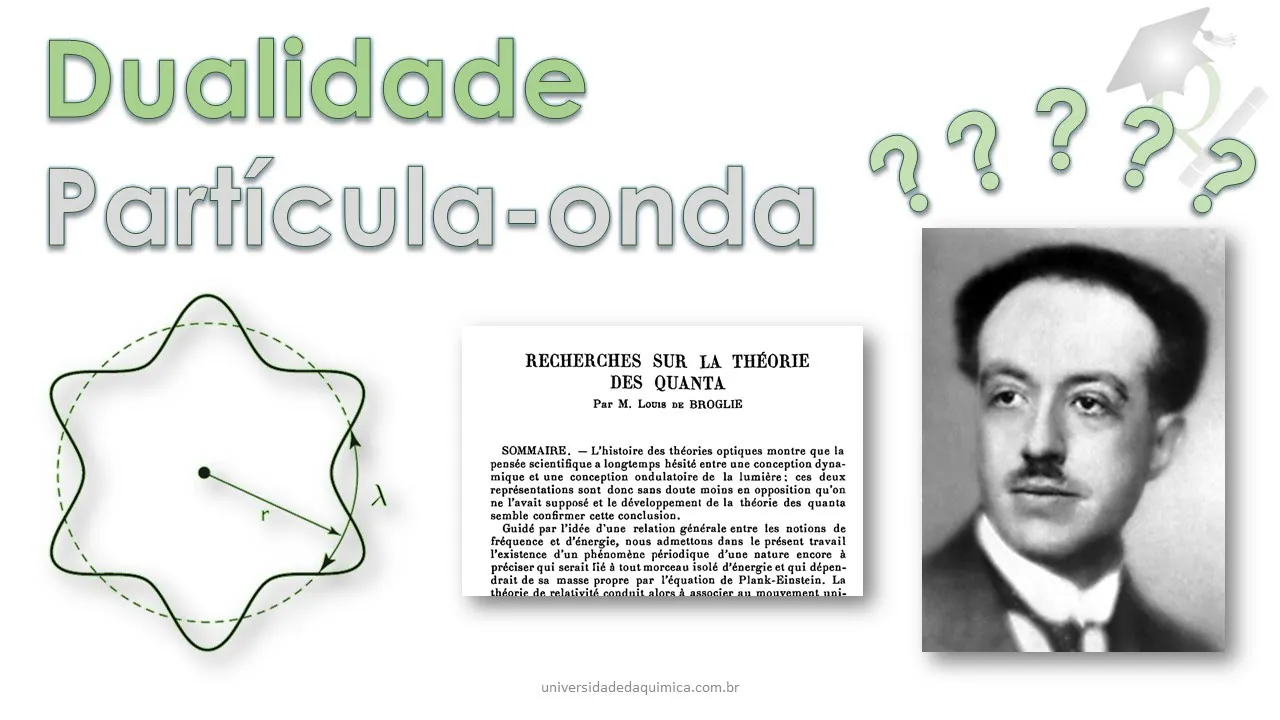
Episódio 10 - Como uma onda ... (Hipótese de De Broglie e a dualidade onda-partícula)
New Section
The discussion delves into the evolution of atomic models, focusing on key contributions from scientists like Niels Bohr, Sommerfeld, and Louis de Broglie.
Niels Bohr's Atomic Model
- Bohr proposed his atomic model around 1913, which incorporated an equation to show a relationship between energy levels and integers.
- His model introduced the concept of quantized energy levels based on the assumption that angular momentum is quantized in integer multiples of Planck's constant divided by 2π.
Sommerfeld's Contributions
- Sommerfeld enhanced Bohr's model by introducing additional quantum numbers and restrictions, leading to the idea of sublevels within orbits.
- This modification aimed to address limitations observed in more complex atoms like sodium with 12 electrons.
New Section
The focus shifts to Louis de Broglie's groundbreaking proposal regarding the wave-particle duality of electrons and its impact on atomic structure.
Louis de Broglie's Thesis
- In his doctoral thesis defended in 1923, De Broglie proposed a revolutionary idea that would reshape the understanding of atoms, particularly electrons.
- Drawing inspiration from Einstein's work on the photoelectric effect in 1905, De Broglie suggested that matter particles like electrons could exhibit wave-like behavior.
Wave-Particle Duality
- De Broglie introduced the concept of matter waves or "wave of matter," suggesting that electrons could behave as both particles and waves simultaneously.
- This notion marked a significant shift in how atoms were perceived, akin to how light exhibited both particle-like (photons) and wave-like properties.
Understanding the Electron as a Wave
In this section, the discussion revolves around the concept of electrons behaving as waves and the implications of this wave-like behavior on their orbits and properties.
The Wave Nature of Electrons
- The wavelength of an electron must have integer values to form a closed loop around the nucleus.
- The circumference of the electron's orbit must be equal to an integer multiple of its wavelength.
- By relating linear momentum to wavelength, a formula is derived linking matter and energy.
- The conclusion is drawn that electrons behave like waves with angular momentum quantized in integer multiples.
Bohr's Model and Electron Behavior
- Bohr's model describes electrons' angular momentum as integral multiples, aligning with wave behavior.
- Despite bold propositions, questions remain about the three-dimensional nature of electron waves.
Confirmation of Electron Wave Properties
This section delves into how experimental evidence confirmed the wave-like properties of electrons proposed by Bohr.
Experimental Validation
- Davisson and Germer's 1927 experiment demonstrated electron diffraction through nickel crystals, supporting wave characteristics.
- Bohr's Nobel Prize win in 1929 was attributed to his thesis on electron nature and subsequent experimental validation by Davisson and Germer.
Implications for Quantum Mechanics
This part discusses how Bohr's work paved the way for quantum mechanics due to its profound impact on understanding atomic structure.
Quantum Mechanics Emergence
- George Thomson, son of J. Thomson known for atomic models, also won a Nobel Prize for proving electron wave properties.