Архитектура ЭВМ. Лекция 1: Типы архитектур. Комбинационная и последовательная логика.
Understanding the Issue with Hanging Contacts
The speaker discusses the problem of hanging contacts and explains how it affects the functioning of a transistor.
The Issue with Hanging Contacts
- When a contact is left hanging, it can cause problems in the circuit.
- The speaker recalls a specific incident involving a switch that supplied current to a transistor, which in turn controlled an LED.
- Without proper connection or closure of the contact, the transistor may not open as expected, leading to issues in circuit operation.
Resolving the Issue with Resistors
The speaker suggests using resistors to address the issue of hanging contacts and improve circuit performance.
Using Resistors for Improvement
- By connecting a resistor to the hanging contact, electrons can flow through it instead of being dispersed in the air.
- This helps maintain a stable potential difference and ensures predictable behavior of the transistor.
- The resistor compensates for any small value currents that may be required to open or close the transistor effectively.
Impact of Adding Resistors on Circuit Behavior
The speaker explains how adding resistors affects circuit behavior and potential differences.
Impact on Potential Differences
- Connecting a resistor allows electrons to flow through it, reducing potential differences between different points in the circuit.
- This compensation occurs due to a small current flowing through the resistor, which balances out any potential difference caused by floating electrons in the air.
Predictable Transistor Operation with Resistors
The speaker highlights how resistors enable predictable operation of transistors and discourage hanging contacts.
Predictable Transistor Operation
- When resistors are added, electrons can easily flow through them, leading to predictable and controlled transistor behavior.
- The speaker emphasizes the importance of avoiding hanging contacts to ensure reliable operation of transistors.
Practical Application of Resistors in Circuit Design
The speaker discusses practical applications of resistors in circuit design and their role in achieving desired potential differences.
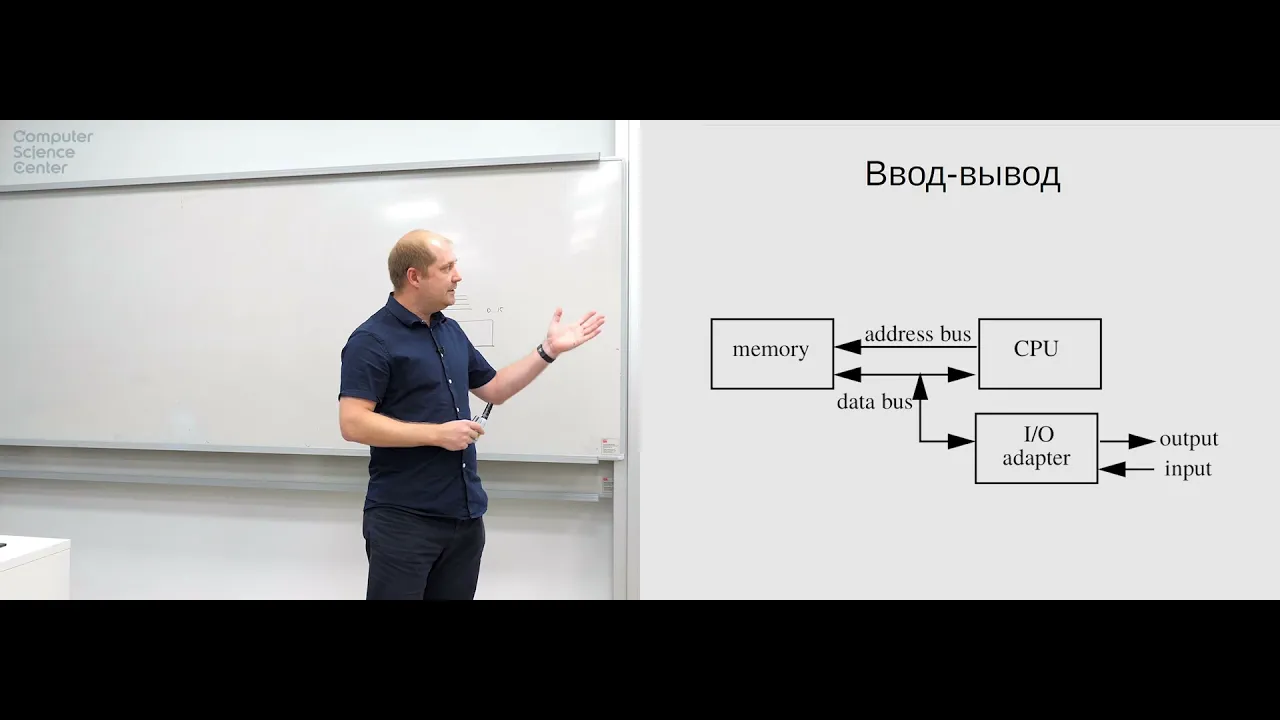
Architecture and I/O Adapters
This section discusses the architecture of computer systems and the role of I/O adapters in input/output operations.
Architecture and I/O Adapters
- The architecture of a computer system includes memory, CPU, and I/O devices.
- I/O adapters are controllers that facilitate communication between external devices and the data bus.
- These adapters can either send data from external devices to the data bus or receive data from the data bus and send it to external devices.
- Examples of external devices that interact with I/O adapters include mice, keyboards, displays, sound cards, etc.
Functionality of I/O Adapters
This section explains how I/O adapters function as additional electronic devices connected to the data bus.
Functionality of I/O Adapters
- I/O adapters are additional electronic devices that have access to the data bus.
- They can either set values on the data bus from external sources or read values from the data bus and send them to external devices.
- The connection between an adapter and an external device is represented by arrows labeled "input" and "output."
- Input refers to setting values on the data bus, while output refers to reading values from the data bus.
- Examples of input/output devices include keyboards, displays, sound cards, etc.
Two-Way Communication with Data Bus
This section discusses how I/O adapters enable two-way communication with the data bus.
Two-Way Communication with Data Bus
- I/O adapters can either set values on the data bus from external sources or read values from the data bus for output to external devices.
- The communication between an adapter and the data bus is bidirectional.
- The adapter can
Computer Architectures: Von Neumann and Harvard
This section discusses the differences between the Von Neumann and Harvard computer architectures, which are still in use today. It also introduces the concepts of CISC and RISC computers.
Differences between Von Neumann and Harvard Architectures
- The Von Neumann architecture and the Harvard architecture have distinct characteristics.
- Both architectures coexist and have led to the development of two types of computers: CISC and RISC.
CISC (Complex Instruction Set Computer)
- CISC stands for Complex Instruction Set Computer.
- It refers to a computer with a limited set of instructions.
- These computers have a complex instruction set, meaning they can execute various operations on fixed-size data.
RISC (Reduced Instruction Set Computer)
- RISC stands for Reduced Instruction Set Computer.
- It refers to a computer with a more complex instruction set.
- These computers have a reduced set of instructions but can perform operations on larger data sizes.
Key Differences between CISC and RISC Computers
- The size of instructions in RISC computers is equal to one machine word, while it varies in CISC computers.
- The data bus width in RISC computers determines their data capacity, such as 64-bit or 32-bit systems.
- The address bus width in RISC computers determines their memory capacity.
Machine Word Size and Data Bus Width
- Machine word size corresponds to the size of data that a processor can handle at once.
- Data bus width represents the number of wires used for transferring data between components like memory, processor, and registers.
Address Bus Width
- Address bus width determines the maximum amount of memory that can be addressed by the computer system.
- For example, a 64-bit computer has a 64-bit address bus, allowing it to access large amounts of memory.
RISC and Machine Word Size
This section further explores the concept of machine word size and its relationship to RISC computers.
Machine Word Size and RISC Computers
- The machine word size corresponds to the data size with which a processor operates.
- RISC computers have a machine word size equal to the size of their instructions.
- This allows for efficient execution of instructions in a single clock cycle.
Execution Time
- In RISC computers, the execution time for one instruction is equal to one clock cycle.
- This means that all necessary operations are performed within a single clock cycle, resulting in faster processing.
Address Bus Width and Data Bus Width
This section discusses the importance of address bus width and data bus width in computer systems.
Address Bus Width
- The address bus width determines the number of wires used for addressing memory locations.
- It affects the maximum amount of memory that can be accessed by the computer system.
Data Bus
Understanding Processor Execution
In this section, the speaker explains how a processor executes instructions and the difference between RISC and CISC processors.
Processor Execution Process
- The processor starts executing an instruction at a specific point and finishes at another point.
- If there is only one instruction to be executed, there are no intermediate states where the instruction is not fully processed.
- This process reduces energy consumption but does not allow for flexibility in interrupting or pausing instructions.
RISC vs CISC Processors
- RISC processors have fewer instructions and simpler designs, making them more efficient and suitable for miniaturization.
- CISC processors have more complex designs with a wider range of instructions, providing higher-level programming capabilities.
Introduction to Digital Logic Elements
This section introduces digital logic elements and their basic functions.
Binary Functions and Logic Gates
- Binary functions are represented by logic gates that perform specific operations based on input signals.
- Logic gates include AND, OR, NOT gates, which can be combined to create more complex circuits.
- These elements are building blocks used to construct computer systems.
Digital Circuit Design Notations
This section explains the notation used in digital circuit design.
H&H Notation
- H&H refers to Harris & Harris, authors of a book on digital circuit design.
- The notation includes ASCII characters representing different elements in circuit diagrams.
Resources for Learning Digital Circuit Design
This section provides resources for learning digital circuit design.
Recommended Book on Digital Circuit Design
- A recommended book on digital circuit design is "Digital Design and Computer Architecture" by Harris & Harris.
- The book
Understanding the Decoder
In this section, the speaker introduces the concept of a decoder and its role in computer architecture.
The Purpose of a Decoder
- A decoder is used in computer construction to convert binary signals into specific outputs.
- It can be used to translate binary numbers into different representations or to select specific lines based on a binary input.
How a Decoder Works
- A decoder takes multiple inputs and produces multiple outputs.
- Each output corresponds to a specific combination of inputs.
- By manipulating the input signals, the decoder can activate or deactivate certain lines.
Applications of Decoders
- Decoders are commonly used in computer memory systems to address specific memory cells.
- They can also be used for data encoding and decoding purposes.
Introduction to Flip-Flops
This section focuses on flip-flops, which are sequential logic circuits that store information.
Understanding Flip-Flops
- Flip-flops are devices that can store one bit of information (either 0 or 1).
- They have two stable states, which can be represented as 0 or 1.
- Flip-flops can be set or reset based on input signals.
RS Flip-Flop (Latch)
- The RS flip-flop, also known as a latch, has two inputs: R (reset) and S (set).
- Depending on the input combination, it can enter different stable states.
- If R = 1 and S = 0, it resets to state 0.
- If R = 0 and S = 1, it sets to state 1.
- If both R and S are either 0 or 1 simultaneously, it maintains its current state.
Understanding Memory Cells
This section explores the concept of memory cells and their role in storing information.
Memory Cell Basics
- A memory cell is a component that can store a single bit of information.
- It can be set or reset based on input
Introduction to Logic Gates and Sequential Logic
In this section, the speaker introduces the concepts of logic gates and sequential logic. They explain the difference between combinational and sequential logic and discuss how these elements are used in computer architecture.
Combinational Logic vs Sequential Logic
- Combinational logic refers to circuits where the output is solely determined by the current input values.
- Sequential logic, on the other hand, depends not only on the current inputs but also on previous states or inputs.
Importance of Sequential Logic
- Sequential logic is crucial for building more complex systems as it allows for memory storage and control functions.
- It enables computers to perform calculations, handle input/output operations, and manage control units.
Components of Sequential Logic
- Flip-flops: These are basic building blocks of sequential circuits that can store a single bit of information.
- Clock Signal: The clock signal synchronizes the operation of flip-flops and determines when data should be read or written.
Challenges with Simultaneous Set/Reset Signals
- Simultaneously setting and resetting a flip-flop can lead to ambiguity in its state.
- This issue arises because it is unclear whether the flip-flop should be set or reset when both signals are active at once.
Designing Sequential Circuits
- Designers use various techniques to avoid simultaneous set/reset signals, such as incorporating additional logical elements like AND or OR gates.
- These techniques ensure that data is written into a flip-flop only when specific conditions are met.
Combinational vs Sequential Logic
The speaker further explains the differences between combinational and sequential logic. They discuss how combinational logic is used for simple computations while sequential logic plays a vital role in more complex systems.
Combinational Logic
- Combinational logic circuits produce outputs solely based on the current input values.
- They are used for straightforward calculations and basic input/output operations.
Sequential Logic
- Sequential logic circuits depend not only on the current inputs but also on previous states or inputs.
- These circuits are essential for memory storage, control functions, and more complex operations.
Examples of Combinational
Understanding the Purpose
In this section, the speaker discusses the purpose behind creating a complex circuit involving two cells and a trigger.
The Complexity of the Circuit
- The speaker explains that they have created a complex circuit involving two cells, but they have removed unnecessary parts.
- They connect the output of one trigger to the input of another trigger using clock and frequency signals.
- The purpose of this setup is to ensure that certain bits are not accidentally changed or tampered with during specific time intervals.
Ensuring Data Integrity
- By connecting triggers in this way, they create a protection mechanism to prevent accidental changes or interference with specific bits.
- This protection ensures that the state of the output remains consistent and does not depend on when a bit was changed.
Registers in Processors
- The speaker introduces registers as components in processors that store binary data.
- Registers are used to hold operands, intermediate data, and other information necessary for executing instructions in processors.
Working with Parallel Registers
In this section, the speaker explains how parallel registers work and their significance in processor design.
Connecting Parallel Registers
- Parallel registers allow multiple bits to be loaded simultaneously within one clock cycle.
- These registers are commonly used in processors for storing binary numbers of specified lengths.
Importance of Registers in Processors
- Registers play a crucial role in processors by storing data required for executing operations or instructions.
- They can hold operands, intermediate results, or other temporary data needed during processing tasks.
Protecting Data Integrity
In this section, the speaker discusses protecting data integrity by implementing safeguards within register designs.
Preventing Accidental Changes
- While copying values between
Signal Copying and Synchronization
In this section, the speaker discusses the need for signal copying and synchronization in a circuit design. They explain that it is important to ensure that signals are copied and switched synchronously within one clock cycle.
Importance of Signal Copying and Synchronization
- Signals need to be copied and switched synchronously within one clock cycle.
- The complexity of the circuit design increases due to the requirement of synchronous switching.
- Ensuring synchronous switching guarantees that the circuit transitions from one state to another within a single clock cycle.
The transcript is not in English.