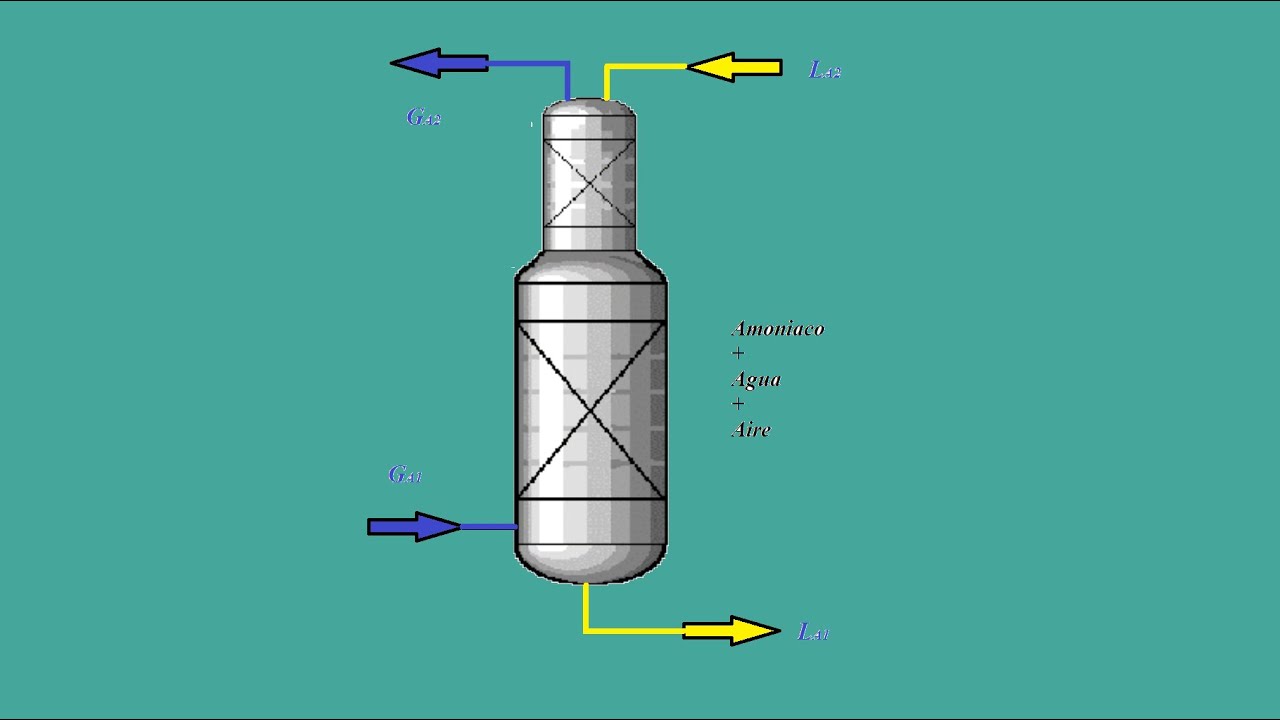
Problema 1: Solución al diseño de una columna Absorción. Parte II
Understanding Chemical Processes
In this section, the speaker delves into the process of absorption in a chemical column, emphasizing the importance of working with specific indices for calculations.
Working with Specific Indices
- The speaker discusses the importance of maintaining consistency by working with specific indices such as G1 and L1 throughout calculations.
- Finding densities is crucial in these processes, with examples like water density in kilograms per cubic meter being highlighted.
- Viscosity and density play key roles in calculations to ensure accuracy without altering the overall diagram.
Calculations for G1 Primate
- The focus shifts to determining G1 Primate squared, highlighting its significance in relation to cross-sectional area.
- Detailed steps are outlined to find G1 Primate Testado, involving calculations related to molecular weights and fractions within liquids.
Further Calculations and Densities
- The process continues by determining L1 based on known values and proceeding to calculate G1 Testado using similar principles.
- Molecular weights are crucial in these computations, as seen through the calculation of L1 and subsequent operations for G1 Testado.
Final Density Calculations
- The speaker elaborates on calculating final values such as density of G1 de Estado, emphasizing the conversion from moles to kilograms for accurate results.
New Section
In this section, the speaker discusses calculations related to density and other parameters in a scientific context.
Calculations for Density and Parameters
- : Detailed calculation involving density, weight, and other factors.
- : Explaining the process of locating values on a diagram based on calculations.
- : Locating specific values on a graph using logarithmic scales.
- : Determining a value from calculations to correspond with an expression.
- : Substituting values into an equation to find a specific parameter.
New Section
This part delves into further calculations involving viscosity, density, and acceleration constants.
Further Calculations on Viscosity and Density
- : Determining values for viscosity and density in the given scenario.
- : Calculating differences in densities for further analysis.
- : Solving equations to find specific parameters like g1 prime of state.
- : Converting units for consistency in calculations.
- : Applying converted units to derive final values.
New Section
This segment focuses on determining column diameter based on cross-sectional area calculations.
Column Diameter Calculation
- : Deriving column diameter using cross-sectional area formula.
- : Calculating the diameter of the column through mathematical operations.
New Section
The discussion shifts towards calculating height using global coefficients and molar ratios.
Height Calculation Using Global Coefficients
- : Introducing the concept of calculating height using global coefficients and molar ratios.
New Section
In this section, the speaker discusses the calculation of coefficients for corresponding fluxes in a chemical process.
Calculation of Coefficients for Flux 1
- The coefficient for Flux 1 can be determined using the global volumetric coefficient in concentration units of pressure.
- The gradient of partial pressures needs to be considered due to atmospheric gradients.
- The aim is to find Ka (uppercase) by equating the flux with the global volumetric coefficient and concentration ratio multiplied by their respective gradients.
New Section
This part delves into determining coefficients through resistance relationships in absorption processes.
Determining Coefficients Using Resistance Relationships
- Start by calculating the global volumetric coefficient through resistance relationships.
- Determine Kga (uppercase) by multiplying it with its gradient after finding Kgam (uppercase).
- Calculate values based on resistance percentages provided in the problem statement.
New Section
Here, a general formula relating mass transfer coefficients is discussed.
General Formula for Mass Transfer Coefficients
- Utilize a formula equating individual and total resistances to determine mass transfer coefficients.
- Expressions involving concentrations and pressures are crucial in these calculations.
New Section
This segment focuses on deriving specific values for mass transfer coefficients.
Deriving Values for Mass Transfer Coefficients
- Solve equations to isolate and calculate specific coefficients like Kga (medium value).
Despejando Valores y Cálculos
In this section, the speaker discusses calculations involving various values and equations related to the process being analyzed.
Calculating Flux and Values
- When graphing points 1 and 2, the operation line is found, which is SLS divided by GS of operation.
- The flux 1 value is calculated as 0.342 kilomoles per hour per cubic meter.
- By substituting values into the equation, a value of 35.73 kilomoles per hour per cubic meter for delta Y is obtained.
Global Coefficient Calculation
This part focuses on determining global coefficients and their significance in the overall process analysis.
Determining Global Coefficients
- The value for coefficient A2 is calculated as 65.89 kilomoles per hour per cubic meter.
- Substituting values for both coefficients yields a volumetric average of 60.81 kilomoles per hour per cubic meter for delta Y*.
Transfer Unit Analysis
Exploring transfer unit analysis and its implications on understanding the process dynamics.
Transfer Unit Calculation
- The transfer unit height in the gas phase is determined to be 0.4482 meters based on calculations involving global coefficients.
Gas Phase Analysis
Delving into specific analyses related to the gas phase components and their interactions.
Gas Phase Concentration Analysis
New Section
In this section, calculations are performed to determine specific values in a mathematical context.
Calculations for Determining Values
- : Calculation involving point 0.056 results in the value of 0.1675.
- : Substitution leads to the value of 7.29 after performing operations.