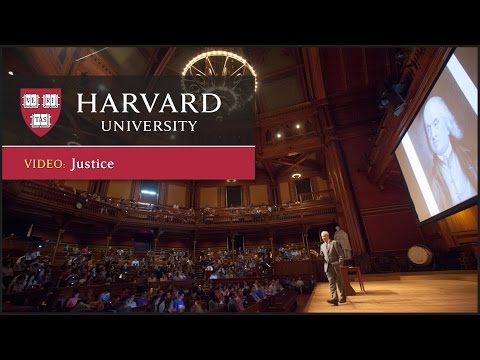
Justice: What's The Right Thing To Do? Episode 03: "FREE TO CHOOSE"
Understanding Mill's Utilitarianism and the Challenge of Rights
Mill's Distinction Between Pleasures
- The discussion begins with John Stuart Mill's response to critics of Bentham's utilitarianism, emphasizing the ability to distinguish between higher and lower pleasures.
- An experiment using "The Simpsons" and Shakespeare reveals a dilemma: many prefer "The Simpsons" yet still regard Shakespeare as a higher pleasure, questioning Mill’s qualitative distinctions.
Justice and Individual Rights in Utilitarianism
- Mill argues that individual rights deserve special respect, claiming justice is the most sacred part of morality.
- A challenge arises regarding why justice is deemed the chief moral component; Mill suggests it benefits society in the long run by respecting rights.
- The question is raised about exceptions where violating rights might lead to greater overall benefit—does this justify using individuals?
Ethical Implications of Violating Rights
- A hypothetical scenario illustrates potential adverse effects on societal trust if a doctor were to violate an individual's rights for utilitarian gain.
- This raises concerns about whether intrinsic respect for individuals matters beyond mere utility, suggesting limitations in Mill’s framework.
Exploring Stronger Theories of Rights
- To address these objections, we must consider theories that provide independent moral standards for evaluating pleasures and justice.
- There’s suspicion that Mill leans on notions like human dignity which may not align strictly with utilitarian principles.
Libertarianism: A Strong Theory of Rights
Fundamental Principles of Libertarianism
- Libertarianism posits that individuals are separate beings deserving respect, not merely tools for social purposes or utility maximization.
- It emphasizes liberty as a fundamental right, allowing individuals to choose how they live their lives while respecting others' rights.
Government Role According to Libertarians
- Robert Nozick articulates that individual rights raise questions about state actions; libertarians argue against three main types of government interventions:
- Paternalist Legislation: Laws protecting people from themselves (e.g., seat belt laws).
- Morals Legislation: Laws promoting societal morals (e.g., anti-LGBTQ+ laws).
- Redistributive Policies: Taxation aimed at wealth redistribution viewed as coercion or theft.
Libertarian Views on Wealth Distribution and Justice
Minimal State and Taxation
- Libertarians, including Nozick, advocate for a minimal state that only taxes for essential services like national defense, police, and judicial systems.
- The discussion prompts reactions to the libertarian view on wealth distribution in the U.S., noted as one of the most unequal among advanced democracies.
Justice in Wealth Distribution
- Libertarians argue that one cannot determine if wealth distribution is just or unjust solely based on its pattern; context matters.
- Two principles are crucial:
- Justice in Acquisition: Were initial holdings obtained fairly?
- Justice in Transfer: Did the distribution arise from free consent through market transactions?
Case Study: Bill Gates
- Using Bill Gates as an example, his immense wealth raises questions about fairness and taxation.
- Gates's net worth allows him to afford luxuries beyond typical means; he could stay overnight at the Lincoln bedroom for 66,000 years with his wealth.
Utilitarian Perspective vs. Libertarianism
- A utilitarian approach would support taxing wealthy individuals like Gates to improve lives of those less fortunate since it would have minimal impact on them but significant benefits for others.
- However, libertarians contend that if wealth was earned without violating rights or through coercion, taking it away would be unjust.
Redistribution Debate
- Michael Jordan's earnings illustrate similar points; despite not being as wealthy as Gates, his income raises questions about obligations to society.
- Critics of redistribution argue that taxing high earners violates their rights and constitutes coercion.
Arguments Against Redistribution
- Some participants agree with libertarian views against redistribution while others challenge this perspective by highlighting societal contributions to individual success.
- One argument suggests that successful individuals owe a larger obligation back to society due to the advantages they received.
Taxation and Self-Possession: A Libertarian Perspective
The Justification of Injustice
- The speaker argues that in extreme circumstances, overlooking injustice may be necessary, such as in dire situations where survival is at stake (e.g., a cabin boy killed for food).
- Taxing individuals like Michael Jordan at a high rate for charitable causes is viewed as theft by the speaker, emphasizing that earned money rightfully belongs to the individual.
Defining Theft and Redistribution
- A counterpoint suggests that taxation isn't akin to taking away essential resources but rather redistributing excess wealth from those who have more than they can use.
- Concerns are raised about inequality of opportunity if wealth isn't redistributed, highlighting societal imbalances.
Nozick's Argument on Taxation
- Philosopher Robert Nozick agrees with the notion of taxation being theft but emphasizes its moral implications further than Joe does.
- Nozick posits that taxation equates to taking the fruits of one's labor, which he argues is morally similar to forced labor.
Implications of Forced Labor
- The argument extends to suggest that if the state claims earnings through taxation, it implies ownership over an individual's labor and time.
- This leads to a conclusion where lack of self-possession equates to slavery; if one cannot claim their own labor, they are not truly free.
Fundamental Libertarian Principle
- The core libertarian principle discussed is self-possession—individual ownership over oneself and one's actions.
- This principle underpins arguments against utilitarianism and laws restricting personal freedoms or enforcing charity through taxation.
Moral Stakes in Taxation Debate
- The stakes are highlighted regarding whether taxing wealthy individuals for social good infringes upon their rights similarly to forced labor.
- To reject this libertarian view requires challenging the chain linking taxation with slavery and affirming self-possession principles.
Questioning Self-Possession
- A participant questions whether living in society compromises true self-possession since societal rules limit individual actions (e.g., violence).
Libertarian Perspectives on Redistribution and Collective Goods
The Choice of Retirement Savings
- Discussion on individual freedom regarding retirement savings, emphasizing that people should have the choice to prioritize current living over future security.
- Highlights the conflict between social security and Milton Friedman’s concept of a minimal state.
Free Riders and Private Solutions
- Introduction of the free rider problem associated with collective goods like fire protection, suggesting public provision is not the only solution.
- Example of Salem Fire Corporation in Arkansas, which operates on a subscription model for fire services, illustrating an alternative to public fire departments.
Consequences of Non-Subscription
- A case study where a homeowner's house burned down because he failed to renew his subscription; the fire company did not intervene as per their policy.
- Emphasizes that without incentives (like subscriptions), there would be no motivation for individuals to pay for services.
Self-Ownership and Coercion
- Libertarians argue against coercion in taxation by asserting self-possession as a fundamental moral principle.
- Nozick's perspective: Taxing wealthy individuals implies society claims ownership over them, violating self-ownership principles.
Addressing Objections to Libertarianism
- Acknowledgment of objections raised against libertarian views; opportunity given for libertarians present to respond.
Key Objections Raised:
- Need-Based Argument:
- The poor require financial support more than wealthy individuals like Bill Gates or Michael Jordan do.
- Taxation as Coercion:
- Counterargument that taxation in a democratic society is not coercive since it is enacted by elected representatives.
- Debt to Society:
- Some argue successful individuals owe society for their success through taxes; this notion will be debated further by libertarians present.
Responses from Libertarians
John Sheffield's Response:
- Argues that while the poor may need money more urgently, redistributing wealth violates established property rights derived from self-possession principles.
Julia Roto's Contribution:
- Julia indicates she has additional points but does not elaborate at this moment.
The Debate on Needs vs. Deserves
Understanding Needs and Deserves
- A distinction is made between needing something and deserving something, suggesting that in an ideal society, needs would be met but the concept of deserving is more contentious.
- The speaker argues that while victims of Hurricane Katrina are in desperate need of help, they do not necessarily deserve it based on societal standards.
Taxation and Resource Distribution
- Discussion arises about property rights being established by a democratic government, which should decide how resources from taxation are distributed.
- Raul emphasizes that taxation is legitimate as it operates under the consent of the governed; citizens like Bill Gates and Michael Jordan have voting rights to influence policy.
Democracy vs. Mob Rule
- John raises concerns about majority rule where the middle class decides what happens to the wealth of the top 10% for the benefit of the bottom 10%.
- The difference between democracy and mob rule is highlighted; individuals can address grievances through representatives within a democratic framework.
Individual Rights vs. Majority Decisions
- Alex expresses frustration over having minimal influence in a large democracy regarding personal property rights.
- A counterargument suggests that individuals can advocate for their beliefs democratically without needing to convince everyone.
Constitutional Limits on Democracy
- Alex advocates for a limited form of democracy where fundamental rights are protected from majority decisions.
- The discussion shifts to whether individual rights such as private property should hold equal weight as other fundamental rights like freedom of speech.
Economic Stability and Social Responsibility
- Anna argues that economic success relies on social stability provided by government support for lower-income groups through taxation.
Is It Wrong to Steal to Feed a Starving Family?
The Ethics of Theft for Survival
- A discussion begins on whether it is wrong to steal a loaf of bread to feed a starving family, with the initial consensus leaning towards theft being wrong due to property rights.
- The argument emphasizes that justifying theft requires examining the violation of self-possession and property rights, which are agreed upon as fundamental principles.
- Julia expresses her belief that stealing food or medicine for survival may be acceptable, suggesting individual circumstances can justify such actions even from a libertarian perspective.
- The conversation shifts towards the idea that wealthy individuals owe society a debt because their success often relies on cooperation and societal support.
Wealth and Societal Contribution
- Julie argues against the notion of a societal debt, stating wealth is earned through providing valued services rather than an obligation owed back to society.
- The example of Michael Jordan illustrates how his wealth was generated through personal talent and societal appreciation, implying he has already "paid" his debt by contributing entertainment value.
Self-Possession in Society
- Victoria challenges the concept of self-possession within society, arguing that living in a community limits individual rights and responsibilities toward others.
- She questions if true self-possession exists when one must consider societal implications in their actions, particularly regarding wealth distribution.
Libertarian Perspectives on Wealth Distribution
- Alex responds by asserting that while luck plays a role in wealth accumulation, it does not negate the legitimacy of acquiring wealth through voluntary exchanges in free markets.
- He emphasizes that moral considerations should focus on how individuals acquire their resources rather than questioning their inherent worthiness.
Conclusion: Ownership and Justice
- The discussion wraps up with reflections on whether we truly own ourselves; rejecting this premise could lead back to utilitarianism where individuals might be used for collective benefit.
Understanding Self-Ownership and Private Property
The Philosophical Foundations of Self-Possession
- The concept of self-possession is explored through the lens of John Locke, who provides a foundational argument for private property emerging from the state of nature.
- Locke posits that private property arises when individuals mix their labor with unowned resources, thereby acquiring property rights. This claim hinges on the idea that individuals own their labor and, by extension, themselves.
- To fully grasp the moral implications of libertarian views on self-ownership, it is essential to delve into Locke's theories regarding private property and self-ownership.
Engaging with Justice Online