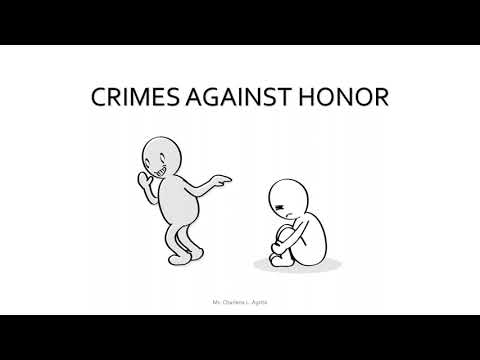
crimes against honor
Introduction to Crimes Against Honor
Overview of Title 13
- Title 13 addresses crimes against honor, focusing on the protection of a person's name, honor, and reputation.
- These elements are considered sacred in people's lives, necessitating legal protection against acts that harm them.
- The title defines specific acts as injurious to a person's reputation and assigns penalties for these actions.
Character Assassination
- Crimes under Title 13 are classified as forms of character assassination.
- This classification is based on how the acts are committed, leading to different types of character assassination.
Classifications of Crimes Against Honor
Types of Character Assassination
Libel
- The first classification is libel, which involves defamation through mass media or literary outlets.
- Libel is defined as defamation in written form, often disseminated via various media channels.
Oral Defamation
- The second classification is oral defamation, characterized by the use of spoken words to damage someone's reputation.
- This includes spreading rumors or gossip about an individual.
Slander by Deed
- The third type is slander by deed, which refers to actions intended to cast dishonor upon someone without using words.
- Examples include public humiliation or actions designed to embarrass another person.
Incriminatory Machination
- The fourth classification involves incriminatory machination—schemes aimed at making someone appear guilty.
Sub-classifications:
- Incriminating an Innocent Person
- This involves framing an innocent person for a crime by planting false evidence.
- Intriguing Against Honor
- This entails creating plots or schemes specifically designed to destroy another's reputation.
Common Elements in Crimes Against Honor
Defamatory Matters
- All crimes under this title share common elements; primarily they involve matters defamatory to another person.
- Such matters can be oral or written and may take various forms including direct acts that assassinate someone's character.
Crimes Against Honor: Key Elements
Defining Defamation
- Defamation can occur through various forms, including spoken words, written statements, or actions that harm another's reputation.
- It is characterized by damaging the name, honor, and reputation of the victim.
Publicity of Defamatory Matter
- The defamatory statement must be made public; it should be known or accessible to others.
- Public awareness is crucial for establishing defamation as a crime against honor.
Malice in Defamation
- Malice refers to the offender's evil intent when making the defamatory statement.
- This implies that there was a deliberate intention to harm the victim’s reputation.
Identifiability of Victim
- The victim does not need to be explicitly named; they can still be identifiable through context.
- If a reasonable person can deduce who is being referred to from the statement, it qualifies as defamation.
Negligence and Crimes Against Honor
Can Negligence Lead to Defamation?
- Crimes against honor cannot be committed through negligence; malice is an essential element.
- All crimes against honor require malicious intent, ruling out accidental defamation.
Freedom of Speech vs. Libel
Limitations on Freedom of Speech
- Laws regarding libel impose restrictions on freedom of speech and press when used to damage innocent individuals' reputations.
- Such limitations are necessary to prevent misuse of rights that could harm others unjustly.
Understanding Libel: Article 353
Definition and Characteristics
- According to Article 353, libel involves public and malicious imputation intended to harm someone’s reputation.
- The term "public" indicates that the defamatory content must be accessible or known by people at large.
Nature of Malicious Imputation
- A malicious imputation carries an evil intent aimed at causing harm.
- An imputation refers specifically to an accusation made against someone.
Types of Accusations in Libel
Scope of Malicious Imputations
- Libel includes accusations related to crimes, vices, or defects—whether real or imaginary.
- Real accusations are based on true events while imaginary ones stem from falsehood but still carry harmful implications.
Impact on Reputation
- Any act or condition that tends toward dishonor or discrediting a person falls under potential libelous statements.
Libel: Understanding Its Definition and Forms
What Constitutes Libel?
- The act of dishonoring or discrediting an individual is a key aspect of libel, aiming to provoke societal anger against the person.
- A more severe form of libel occurs when false information about someone's marital status is spread, such as claiming a single person is married and unfaithful.
- Libel can tarnish the memory of deceased individuals by spreading damaging claims that alter public perception negatively.
Legal Framework Surrounding Libel
- Article 353 defines libel as a public and malicious imputation of real or imaginary crimes, vices, or defects.
- It also includes any act or condition that causes dishonor or contempt towards a natural (individual) or juridical (legal entity) person.
Methods of Committing Libel
Through Mass Media Facilities
- Libel can be committed via mass media facilities, which include print and broadcast media like newspapers, magazines, television, and radio.
- Articles, news items, editorials, caricatures, and commentaries published in these formats are potential vehicles for libelous statements.
Modern Communication Facilities
- The rise of modern communication tools such as the internet and mobile devices has introduced new avenues for committing libel.
- Cyber libel has become prevalent due to social media platforms where harmful posts can easily reach the public.
Literary Outlets
- Libel may also occur through literary outlets including letters, books, songs, movies, paintings, and other artistic expressions.
Key Elements of Libel
Defamatory Imputation Requirement
- For an accusation to qualify as libelous, there must be a defamatory imputation present in the statement made against an individual.
- This imputation must involve claims related to crime, vice, defect or any circumstance that could cause dishonor to either natural persons (humans) or juridical persons (organizations).
By understanding these elements and forms of libel discussed in this transcript segment on legal definitions and implications surrounding defamation laws in various contexts—mass media to modern communication—we gain insight into how reputations can be affected legally.
Understanding Libel: Key Elements and Defamatory Imputation
The Concept of Defamatory Imputation
- Juridical persons can be victims of libel, highlighting the broad applicability of defamation laws.
- The primary element of libel is a defamatory imputation aimed at lowering an individual's esteem or honor.
- The intent behind such imputations is to diminish how others perceive the victim in society.
Examples of Defamatory Imputation
- Public humiliation or embarrassment serves as a clear example of how defamatory statements can affect a victim's reputation.
- Victims may become subjects of gossip, vilification, or public disdain due to defamatory remarks.
- A person may feel ashamed and become a laughingstock, illustrating the social consequences of libel.
Mechanisms and Mediums for Defamation
- Mass media, modern communication tools, and literary outlets are common channels through which defamatory statements are disseminated.
- The goal is often to incite public anger or suspicion towards the victim, further damaging their standing in the community.
Rules for Determining Defamatory Language
Assessing Language in Context
- To determine if language is defamatory, one must consider what it conveys to a fair and reasonable person rather than focusing on the author's intention.
- The understanding should reflect that of an average reasonable person who interprets the statement as it stands.
Holistic Interpretation
- Statements should not be dissected word by word; instead, they must be understood in their entirety to grasp their full meaning accurately.
Ordinary Meaning vs. Technical Meaning
- Words used in potentially defamatory statements should be interpreted based on their ordinary meanings as commonly understood by people.
- Technical meanings do not apply; idiomatic expressions must also be considered within their plain context when assessing defamation.
Implications of Idiomatic Expressions in Defamation
Case Studies on Idiomatic Expressions
- Phrases like "babae ng bayan" (woman of the town), while idiomatic might imply negative connotations when viewed through a lens focused on ordinary meaning rather than technical definitions.
Contextual Sensitivity
- Courts will interpret idiomatic expressions based on context and overall statement content; thus, each case may vary significantly depending on circumstances.
Defamatory Imputation and Its Forms
Direct and Express Defamatory Words
- Defamation can occur through direct and express defamatory words, descriptions, or accusations.
- Examples of such words include "He's a thief!" or "He is a swindler," which are clear accusations against the victim.
- These statements are categorized as direct and express defamatory imputations.
Descriptions as Defamatory
- Descriptions can also be defamatory; for instance, drawing a caricature that depicts someone negatively (e.g., as a crocodile).
- Such illustrations serve to convey derogatory meanings about the individual being depicted.
Use of Figures of Speech
- Figures of speech like hyperbole, irony, sarcasm, and metaphor can lead to defamatory implications.
- An example includes calling someone part of "kalapating mababa ang lipad," implying they are involved in prostitution.
- Phrases like "he has a face only a mother could love" suggest negative attributes about someone's appearance.
Double Meanings in Language
- Words or phrases with double meanings can also imply defamation.
- For example, saying someone will be a good husband while implying they are overly dependent on their mother conveys an underlying derogatory meaning.
Court Interpretations of Libelous Statements
Handling Multiple Interpretations
- Courts may interpret libelous statements that have multiple meanings by considering the worst possible interpretation.
- This approach assumes that the writer intended for the public to understand their statement negatively.
Publicity Requirement for Libel
- For something to be considered libelous, it must be made public; this means it should be seen or heard by others besides the victim.
- If only the victim is aware of the statement without any external audience, there is no publicity established.
Distinguishing Insulting Words from Libel
Common Expressions Not Considered Libelous
- Certain commonly used insulting words (e.g., “putang tutut,” “ulul”) do not automatically qualify as libel due to their nature as expressions rather than serious allegations.
Need for Demonstrable Damage
- Insulting words must show evidence of damage caused to be actionable as libel; mere insults without proven harm do not constitute grounds for legal action.
Understanding Libel: Key Elements and Implications
The Nature of the Poem and Libel
- The speaker discusses creating a poem that is considered libelous, specifically targeting an individual named Kulasa.
- The poem was only read by the victim (Kulasa), raising questions about whether it constitutes libel due to lack of publicity.
Publicity Requirement for Libel
- For libel to exist, there must be publicity; if only the victim knows about the defamatory material, it does not meet this criterion.
- If the victim shares the poem with others, they are responsible for its public knowledge, not the accused. Thus, no liability arises for the accused in such cases.
Identifying the Victim in Libel Cases
- The third element of libel requires that the person being libeled must be identifiable as per legal standards. This means that victims need to prove they are indeed referenced in the defamatory material.
- If a victim is not directly named in a libelous statement, their identity can still be established through witness testimony from those who recognize them based on context or description.
Establishing Identity Through Witness Testimony
- Witnesses play a crucial role when a victim's name isn't mentioned; they can affirm that certain descriptions or contexts point to the complainant as being targeted by the libelous content.
- Various methods can establish identity: direct naming, descriptive characteristics (like appearance or occupation), or likeness in drawings associated with defamatory statements.
Malice as an Element of Libel
- Malice refers to ill intent on part of the accused and is essential for establishing liability in libel cases; it can be presumed under certain conditions without needing explicit proof from victims.
- When malice is presumed (malice in law), it's up to the accused to disprove this presumption rather than requiring victims to prove malice exists against them. This often applies when materials are evidently defamatory on their face.
Malice in Law: Understanding Defamation
Presumed Malice in Defamation
- The act of reading a defamatory statement can lead to the presumption of malice, indicating that the intent to harm is assumed without needing proof from the victim.
- A defamatory imputation is considered severe and damaging, contributing to the classification of malice in law.
- In cases where an article is clearly defamatory on its face or contains grossly harmful statements, malice is presumed.
- Examples include public announcements labeling individuals or families as criminals without evidence, which are inherently malicious.
Illustrative Examples of Defamatory Statements
- An example involves a radio announcement claiming a family belongs to criminal activities, showcasing obvious malicious intent.
- Another scenario describes an article detailing a woman's sexual activities with explicit descriptions and photographs, further illustrating grossness in defamation.
Types of Malice: Malice in Fact
- Malice can also be categorized as "malice in fact," which requires proof from the plaintiff regarding the accused's intention to harm their reputation.
- Unlike presumed malice, this type necessitates demonstrating that the accused intended to injure or malign through ambiguous statements or articles.
Ambiguity and Its Implications
- Articles that are not evidently defamatory but contain ambiguous language may fall under malice in fact; thus requiring victims to prove malicious intent.
- Social media posts can exemplify ambiguity; for instance, a resignation post implying dissatisfaction with management could be interpreted variously regarding intent.
Proving Malicious Intent
- If an article lacks clear defamation or remains ambiguous, it falls under malice in fact. The burden lies on the victim to establish that there was indeed malicious intent behind such statements.