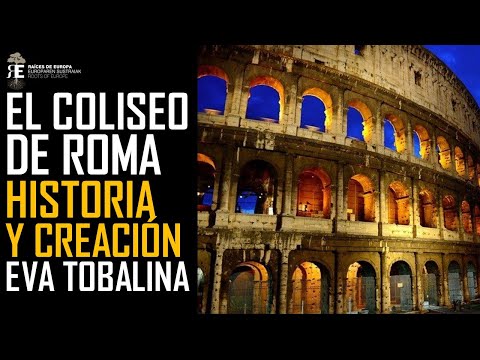
El Coliseo de Roma: su apasionante historia y creación. Eva Tobalina
New Section
In this section, the speaker discusses the significance of the Colosseum in Rome and its historical context.
The Significance of the Colosseum
- The Colosseum is considered a significant monument representing Roman culture and antiquity.
- Despite being an entertainment venue, it is one of the most iconic architectural works in human history.
- Built around the mid-1st century AD during Emperor Nero's reign, it was part of a period known as the "Golden Six Years."
New Section
This section delves into Emperor Nero's reign and his actions leading up to the Great Fire of Rome.
Emperor Nero's Reign
- Nero began his rule around 54 AD under the guidance of Seneca and his mother Agrippina.
- Over time, Nero grew more confident and started eliminating political advisors, including his mother and Seneca.
- He shifted towards a more extravagant ruling style inspired by Hellenistic monarchs, culminating in the Great Fire of Rome in 64 AD.
New Section
This section explores the aftermath of the Great Fire of Rome and Nero's construction projects.
Aftermath of the Great Fire
- The Great Fire caused significant destruction in Rome, leading to various urban legends about its origin.
- Following the fire, Nero utilized the cleared land to build Domus Aurea, a lavish palace complex spanning 50 hectares with luxurious amenities.
Governing Styles of Roman Emperors
The transcript discusses the governing styles of Roman emperors, focusing on Neron's attempt to emulate Hellenistic rulers and the subsequent rise of new emperors after his suicide.
Neron's Emulation of Hellenistic Rulers
- Neron sought to imitate Hellenistic rulers by living lavishly, constructing grand palaces, commissioning statues resembling the Colossus of Rhodes, engaging in literary competitions, and showing interest in music and chariot races.
Unsuccessful Public Image of Neron
- Neron's desire to portray himself as an Eastern sovereign rather than a traditional Roman magistrate like previous emperors did not resonate well with the public.
Succession After Neron's Suicide
- Following Neron's suicide in 68 AD, Galva, governor of Spain Ulterior, briefly became emperor before being assassinated by one of his associates.
- Autón succeeded Galva but was overthrown by Viterio after a few months. Viterio then faced opposition from Vespaciano who eventually seized power.
Vespaciano: Rise to Power and Rule
This section delves into Vespaciano's ascent to power after a series of short-lived emperors in 69 AD and his actions as emperor.
Year of the Four Emperors
- In 69 AD, known as the "Year of the Four Emperors," Galva, Autón, Viterio, and finally Vespaciano successively held power.
Background and Actions of Vespaciano
- Vespaciano rose through military prowess rather than noble lineage. He subdued rebellious Hebrews with his son Tito's assistance, looting Jerusalem for wealth and slaves.
- With funds from Jerusalem's plunder and cheap labor from Hebrew captives, Vespaciano aimed to enhance his reputation among Romans. He demolished Nero's extravagant palace for public enjoyment.
Tumultuous Reign under Tito
This part explores Tito's reign marked by initial popularity but marred by calamities such as epidemics and natural disasters.
Tito’s Popularity and Challenges
- Tito succeeded his father Vespaciano as emperor amid high regard for his character traits like generosity. However, catastrophes including a plague outbreak and volcanic eruption near Rome tarnished his early rule.
Inauguration of an Amphitheater
The discussion centers on Tito’s response to ominous beginnings through the inauguration of an amphitheater during his reign.
Response to Adversity
Construction of the Colosseum
This section discusses the construction of the Colosseum by Emperor Titus, including the decision to accelerate its completion for political reasons.
Construction Acceleration
- Emperor Titus accelerated the construction of the Colosseum before it was completed due to political motivations during an election year.
- The Flavian Amphitheatre, later known as the Colosseum, was inaugurated by Titus while underground parts were unfinished.
Purpose and Significance of the Colosseum
This part delves into the significance of the Colosseum in repairing Tito's reign's image and strengthening ties between emperors and citizens.
Symbolism and Purpose
- The Colosseum was built over Nero's lake to improve Tito's reign perception and enhance connections between emperors who rose to power after a civil war and their people.
- During imperial times, public games like those held in amphitheaters served to bond emperors with citizens through free entertainment.
Role of Public Games in Imperial Rome
Explores how public games at venues like the Colosseum were used by emperors to maintain loyalty and connection with Roman citizens.
Public Games Importance
- Public games such as those at amphitheaters were crucial for fostering loyalty from Roman citizens towards emperors.
- Emperors funded these spectacles as a gesture of goodwill towards citizens, solidifying their support in return.
Architectural Features of the Colosseum
Details key architectural aspects of the Colosseum, highlighting its impressive design elements and structural durability.
Architectural Design
- The Colosseum was constructed in just 8 years, standing strong for almost 2,000 years with a height of about 50 meters.
The Colosseum: Architecture and Spectacles
The speaker delves into the architectural features of the Colosseum, discussing the presence of ice within its structure and the strategic design elements that facilitated smooth audience movement.
Ice in the Colosseum
- The Colosseum contained 300 tons of ice solely in the bolts connecting its stones, a historical detail often overlooked.
Audience Capacity and Entry System
- The Colosseum accommodated between 45,000 to 55,000 spectators who could enter and exit effortlessly due to its well-planned entry system.
- With 80 ground-level entrances for public distribution, each attendee possessed a ticket specifying their designated gate.
Entrances and Special Gates at the Colosseum
Detailed discussion on the various entrances at the Colosseum catering to different groups like emperors, priestesses, senators, and gladiators.
Entrance Distribution
- Normal citizens entered through 76 gates while special doors were reserved for specific groups like emperors, priestesses, senators, and gladiators.
Significance of Special Entrances
- Each special entrance catered to distinct groups such as emperors' families or important Roman figures like senators and authorities.
Gladiator Games: Historical Context
Exploring the origins of gladiator games with religious undertones during Roman times.
Religious Significance
- Gladiator fights initially held religious purposes dating back to Roman Republic times.
Evolution of Gladiatorial Combat
- Gladiatorial combats within amphitheaters like the Flavian Amphitheatre (Colosseum) were considered religious events by Romans.
Spectator Experience at Gladiator Games
Insights into spectator behavior during gladiator games emphasizing respect and cultural norms.
Cultural Etiquette
- Attending games required Romans to show respect by uncovering their heads throughout the day-long events.
Environmental Challenges
- Exposure to prolonged sunlight during games in Rome posed risks of severe sunstrokes for attendees.
Mechanics of Covering the Colosseum
Explanation on how a massive cloth covering was managed over the Colosseum for shade during events.
Sun Protection Mechanism
- A large cloth called Belariú covered the entire seating area when sunny while leaving only the arena exposed.
Operational Details
New Section
In this section, the speaker discusses the practice of "damnatio ad bestias" in ancient Rome, where criminals were condemned to be devoured by wild animals for public entertainment.
Damnatio ad Bestias
- The worst criminals, including murderers who committed heinous crimes against the State, were sentenced to be eaten by wild animals in the amphitheater.
- The condemned individuals would be placed somewhere and left to be attacked by various beasts as a form of public spectacle.
- Executions were often themed around well-known mythological narratives that everyone was familiar with. For instance, a person might be dressed as Hercules and set on fire to mimic his death consumed by flames.
New Section
This section delves into the absence of historical evidence regarding Christian martyrdom in the Colosseum compared to other locations in Rome.
Christian Martyrdom
- While many Christians were martyred in various places in Rome such as Piazza Navona and the Palatine, there is no documented evidence of any Christian martyrdom specifically at the Colosseum.
- Typically, where a martyr had died for their faith, a small shrine or memorial would be erected; however, no such markers exist at the Colosseum indicating Christian martyrdom.
New Section
This part explores the different types of spectacles that entertained Roman audiences at the Colosseum.
Spectacles at the Colosseum
- Morning and late afternoon featured grand shows like "venationes," where wild animals were hunted within elaborate sets mimicking forests or deserts.
- Another popular entertainment involved releasing multiple wild animals to observe their interactions and battles for dominance.
New Section
The focus here is on gladiatorial combat as one of the main attractions at the Colosseum.
Gladiatorial Combat
- Gladiators, whether volunteers or slaves condemned to fight, engaged in combat using different armaments based on their fighting styles.
- Gladiator fights were highly anticipated events drawing large crowds. Gladiators could gain fame, wealth, and admiration akin to modern-day sports stars but faced significant risks of injury or death in combat.
New Section
In this section, the speaker discusses the dynamics of gladiator fights, highlighting the contrast between different types of gladiators and the unequal matches that were staged for entertainment.
Gladiator Fights
- Gladiators faced off in unequal matches where one had an advantage while the other had a disadvantage. This added an interesting element to the fights.
- The preparation and training of gladiators were costly endeavors, involving feeding, housing, and providing weapons. Not all gladiatorial games ended in death; fatalities occurred only during grand events if the organizer could afford it.
New Section
This section delves into the living conditions and relationships among gladiators, as well as safety measures taken during deadly fights.
Gladiator Lifestyle
- Gladiators resided together in Ludus Magnus near the Colosseum, where they trained to put on a good show for spectators. They lived, ate, and trained together, often forming close friendships over years spent together.
- In fights to the death, precautions were taken to ensure that both gladiators did not conspire to fake a death. For instance, a hot iron was used on a fallen opponent to confirm their demise before removal from the arena.
New Section
This part explores naval battles as another form of entertainment in ancient Rome's amphitheaters.
Naval Battles
- Spectacles like naval battles (navmate) were staged by flooding arenas with water and using specially crafted ships for historical reenactments. These events were infrequent due to their elaborate nature and high costs associated with staging them.
Despicable Human Behavior Through History
The speaker discusses how throughout history, individuals have been drawn to inhumane and unethical behaviors despite societal advancements.
San Alipio's Story
- San Alipio, a devout Christian, resisted partaking in the gruesome entertainment of the amphitheater due to his ethical beliefs.
- Despite his convictions, Alipio's friends convinced him to attend a gladiatorial show, challenging his ability to remain unaffected by the violence.
- Initially repulsed by the spectacle, Alipio eventually succumbed to curiosity and found himself drawn into the excitement of the brutal display.
- Overwhelmed by the atmosphere, Alipio could not resist watching despite his initial aversion, experiencing a profound internal conflict.
- Witnessing the violence transformed Alipio as he became enthralled by the bloodshed, losing himself in the frenzy of the crowd.
Endurance of Roman Entertainment
The discussion shifts towards how Roman spectacles like gladiatorial games persisted for centuries despite ethical objections.
Longevity of Gladiatorial Games
- Even with early Christian disapproval and attempts at regulation, gladiatorial shows continued well into the 15th century before declining in popularity.
- The decline of gladiator contests was accompanied by a rise in chariot races as a preferred form of entertainment in later centuries.
- Following various historical events such as invasions and earthquakes, Rome's Colosseum fell into disrepair but was eventually restored in the 19th century.