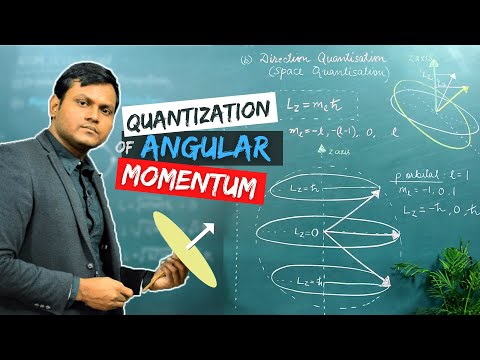
What is Quantization of Angular Momentum? Magnitude & Space Quantization (of subatomic particles)
Introduction to Angular Momentum
In this section, the importance of angular momentum in physics is discussed. Angular momentum is a conserved quantity that remains constant unless acted upon by an external force. It plays a crucial role in classical mechanics, quantum mechanics, and nuclear physics.
Angular Momentum in Physics
- Angular momentum is a conserved quantity that remains constant as long as no external torque acts upon the system.
- It is important in classical mechanics for studying planetary motion and electron orbits.
- In quantum mechanics, both orbital angular momentum and spin angular momentum are quantized in magnitude and direction.
- The confusion surrounding angular momentum arises from its various aspects, including orbital and spin angular momenta.
Quantization of Angular Momentum - Part 1
This section focuses on the quantization of the magnitude and direction of both orbital and spin angular momenta. Understanding these concepts is essential before delving into nuclear spin and angular momentum.
Classical System Example - Solar System
- The example of the Earth revolving around the Sun is used to explain different aspects of angular momentum.
- Orbital angular momentum arises from the revolution of Earth around the Sun.
- Spin angular momentum arises from the rotation of Earth on its own axis.
Orbital Angular Momentum
- Orbital angular momentum (L) can be calculated using L = R x P, where R represents the position vector from the axis of rotation and P represents linear momentum associated with Earth's motion.
- The direction of orbital angular momentum is perpendicular to the plane of motion.
Visualizing Angular Momentum
- A 3D model is used to visualize Earth's orbit around the Sun.
- The yellow plane represents the orbit, while an arrow indicates the direction of angular momentum perpendicular to this plane.
Magnitude and Direction of Angular Momentum
- Angular momentum is a vector quantity with magnitude and direction.
- The magnitude depends on the distance from the axis of rotation and the orbital velocity.
- In the solar system example, there are no restrictions on the magnitude or direction of angular momentum.
Conclusion
This section concludes the discussion on angular momentum quantization in classical systems. The magnitude of angular momentum is not restricted by the nature of the system or physical laws.
Recap
- Angular momentum has both magnitude and direction.
- The magnitude depends on factors such as distance from the axis and orbital velocity.
- In classical systems like the solar system, there are no limitations on angular momentum's magnitude or direction.
The transcript does not provide timestamps for further sections.
Angular Momentum in Classical Physics
This section discusses the concept of angular momentum in classical physics and its properties.
Orbital Angular Momentum
- The magnitude and direction of orbital angular momentum are not restricted.
- The direction of the angular momentum is perpendicular to the revolution taking place.
- Different planets can have different directions of angular momentum.
Spin Angular Momentum
- Similar to orbital angular momentum, spin angular momentum has no restrictions on magnitude or direction.
- Planets can rotate in different directions with different axes.
- The solar system evolution allows for various planets spinning on different axes.
Distinction from Classical Physics
- In classical physics, both orbital and spin angular momenta have continuous ranges of values and unrestricted directions.
- However, in quantum mechanics, there are restrictions on the magnitude and direction of angular momenta.
Quantization of Electron's Angular Momentum
This section focuses on the quantization of electron's angular momentum in quantum mechanics.
Orbital Angular Momentum
- The solution to Schrödinger's equation for an electron in an atom results in certain quantum numbers that restrict the magnitude and direction of orbital angular momentum.
- The magnitude of L is given by √(L(L+1)ħ), where L is the azimuthal quantum number (0, 1, 2...n-1).
- Different values of L correspond to different types of orbitals (s, p, d...).
Quantization
- The equation for the magnitude of orbital angular momentum leads to quantization because it restricts the allowed values.
- For example, an s orbital has L = 0, resulting in zero magnitude for the orbital angular momentum.
Summary
In classical physics, both orbital and spin angular momenta have unrestricted magnitudes and directions. However, in quantum mechanics, the angular momentum of an electron is quantized, meaning it can only take certain allowed values determined by quantum numbers. The magnitude and direction of orbital angular momentum are restricted by the azimuthal quantum number, leading to different types of orbitals.
Quantization of Angular Momentum
In this section, we will discuss the quantization of angular momentum in quantum mechanics. The magnitude and direction of the angular momentum of an electron are restricted to certain discrete values.
Quantization of Magnitude
- The magnitude of the angular momentum for an electron is quantized, meaning it can only possess certain discrete values.
- Examples include values of zero, √2h cross, √6h cross, and so on.
- This quantization is known as the quantization of the magnitude of orbital angular momentum.
Direction Quantization or Space Quantization
- The direction in which the electron revolves around the nucleus is also restricted by quantum mechanics.
- This restriction is known as direction quantization or space quantization.
- The direction is determined by the Z component of the angular momentum.
Quantization Rule for Direction
- The Z component of the angular momentum (LZ) is given by LZ = mLh cross.
- mL is another quantum number that can take values from -L to L with a difference of ±1.
- This equation puts restrictions on the orientation of a particular electron orbital plane in space.
Example: P Orbital
In this section, we will explore an example using p orbitals to understand space quantization better.
Azimuthal Quantum Number for P Orbital
- For a p orbital, the azimuthal quantum number (l) has a value of 1.
- The magnetic quantum number (mL) can have values -1, 0, and 1 for l = 1.
LZ Component Values for P Orbital
- The LZ component of the angular momentum can have values -h cross, 0, and +h cross for a p orbital.
- These correspond to the three possible orientations of the p orbital in space.
Motion of Electron in Three-Dimensional Space
In this section, we will discuss the motion of electrons in three-dimensional space and how it relates to angular momentum quantization.
Z Axis as a Reference
- The Z axis is used as a reference for determining the Z component of the angular momentum.
- When an electron system is placed in an external magnetic field, the magnetic field direction becomes the Z axis.
- The electron orbit will orient itself in such a way that its Z component of angular momentum has specific values.
LZ = +h cross Orientation
- When LZ = +h cross, the electron's orbital plane is oriented in a specific direction.
- The direction of angular momentum corresponds to the orientation of the orbital plane.
Conclusion
In quantum mechanics, both magnitude and direction of angular momentum are quantized. The magnitude can only take certain discrete values, while the direction is determined by the Z component of angular momentum. This quantization has implications for understanding electron motion and orbital orientations in three-dimensional space.
Precession of Electron Orbit
This section explains the precession of the electron orbit and how it can be in different directions while maintaining the same Z component.
Precession of Electron Orbit
- The electron orbit can process along with respect to the z-axis, resulting in a conical section.
- The Z component of the angular momentum remains constant during precession.
- There are three possible values for LZ (Z component of angular momentum): H cross, 0, and -H cross.
- When LZ is zero, it means that the angular momentum is perpendicular to the z-axis.
- The electron orbit processes in a conical section when LZ is -H cross.
Quantization of Spin Angular Momentum
This section discusses the quantization of spin angular momentum and its relationship with orbital angular momentum.
Spin Angular Momentum
- In addition to orbital motion, electrons also have spin angular momentum associated with their own axis.
- The analogy between electron spin and planetary rotation is not entirely accurate due to quantum behavior.
- Spin angular momentum is quantized in terms of magnitude and direction.
- The expression for quantization is s = √(s(s+1)H cross), where s represents a quantum number (e.g., 1/2).
- Electrons always have spin angular momentum regardless of whether they are bound or free.
Conclusion
The transcript covers two main topics: precession of electron orbit and quantization of spin angular momentum. It explains how the electron orbit can precess around different directions while maintaining certain components. Additionally, it discusses how spin angular momentum is quantized and has an intrinsic value associated with electrons.
New Section
This section discusses the Z component of spin angular momentum and its relationship with the quantum number Ms. It explains that the Z component can have values of plus or minus h cross by 2, leading to two possible orientations in space.
Z Component of Spin Angular Momentum
- The Z component of spin angular momentum is given by Ms * h cross, where Ms is the quantum number.
- Ms can have values of plus or minus small s (for example, plus or minus 1/2).
- The Z component can have values of plus h cross by 2 and minus h cross by 2.
- These two values represent two orientations in space around the z-axis.
New Section
This section further explores the quantization of spin angular momentum and its implications for electron systems. It emphasizes that while spin and orbital angular momenta are not conserved separately, the total angular momentum is conserved as a vector sum of both types.
Conservation of Angular Momentum
- Spin and orbital angular momenta are not individually conserved quantities.
- The total angular momentum (J) represents the vector sum of orbital (L) and spin (s) angular momenta.
- The conservation law applies to the total angular momentum in an electron system.
- Quantization rules for magnitude and direction also apply to the total angular momentum.
New Section
This section summarizes the key points discussed so far regarding orbital and spin angular momenta. It highlights that electron systems have both types of angular momenta, which are quantized in terms of magnitude and direction.
Recap: Orbital vs Spin Angular Momenta
- Electron systems in atoms possess both orbital and spin angular momenta.
- Orbital angular momentum has quantized magnitude and direction.
- Spin angular momentum also has quantized magnitude and direction.
- The total angular momentum (J) is the conserved quantity in a system, obtained by vector addition of L and s.
New Section
This section provides a recap of the electron in an atom system, focusing on the two types of angular momenta: orbital and spin. It explains how these momenta are quantized in terms of magnitude and direction.
Electron in an Atom System
- The electron in an atom has orbital and spin angular momenta.
- Orbital angular momentum is quantized in terms of magnitude and direction.
- Spin angular momentum is also quantized with specific values for magnitude and directions.
- The total angular momentum (J) represents the vector sum of L and s, which is conserved.
New Section
This section discusses the quantization rules for the total angular momentum. It explains that the magnitude of J can be calculated using a formula involving small J, which depends on the quantum numbers L and s.
Quantization Rules for Total Angular Momentum
- The magnitude of the total angular momentum (J) follows a quantization rule: J = √(small J * (small J + 1) * h cross).
- Small J can have values determined by combining L (+/- s) or L (-/+ s modulus).
- For example, in a p orbital with L = 1, small J can be 3/2 or 1/2.
- Corresponding to these small J values, we obtain magnitudes for J: √(15/2) or √(3/2).
New Section
This section uses an example to illustrate how to determine values for the magnitude and direction of total angular momentum. It focuses on a p orbital and calculates the possible values for J.
Example: P Orbital
- In a p orbital (L = 1), small J can be 3/2 or 1/2.
- For small J = 3/2, the magnitude of J is √(15/2) * h cross.
- For small J = 1/2, the magnitude of J is √(3/2) * h cross.
- These values represent the possible magnitudes of total angular momentum in a p orbital system.
New Section
This section explains the quantization of the direction of total angular momentum. It states that the Z component of total angular momentum can be calculated using MJ * h cross.
Quantization of Direction
- The Z component of total angular momentum is given by MJ * h cross.
- The quantization rule for direction applies to the Z component.
- MJ represents different values depending on L and s quantum numbers.
New Section
In this section, the speaker discusses the quantization of angular momentum and its relationship to orbital and spin angular momenta. The concept of precession around the z-axis is introduced.
Quantization of Angular Momentum
- The total angular momentum vector in three-dimensional space corresponds to certain orientations.
- The direction of the total angular momentum precesses around the z-axis.
- The z-component of the total angular momentum has a specific relationship given by an equation.
- Only quantized directions are allowed for the total angular momentum in space.
New Section
This section concludes the discussion on orbital and spin angular momenta and introduces their relevance in nuclear physics.
Relevance in Nuclear Physics
- Similar quantization rules apply in nuclear physics due to particles like protons and neutrons having spin 1/2.
- The total angular momentum of a nucleus is the vector sum of all individual nuclear particle's spin and orbital angular momenta.
- The total angular momentum in nuclear physics also follows certain quantization rules.
New Section
In this final section, it is mentioned that further discussions on different aspects of angular momentum are possible but not covered here. The next video will focus on nuclear spin and nuclear angular momentum.
Conclusion
- Understanding the quantization of angular momentum will aid in tackling various aspects related to it.
- Next video will cover nuclear spin and nuclear angular momentum, which also exhibit similar magnitudes and directional quantizations.
Timestamps have been associated with relevant bullet points as requested.
Turn any video into a summary like this
YouTube links, meetings, lectures. With transcripts, search, and chat.