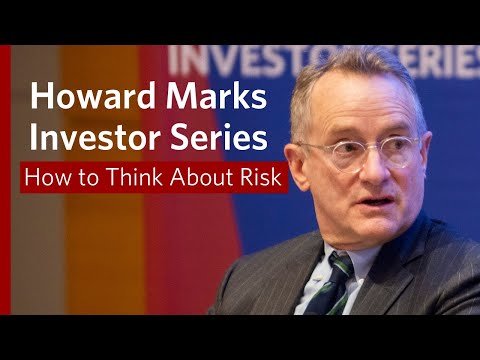
Howard Marks, @oaktreecapital Co-Chairman, on Investing Risk – Wharton School Investor Series
New Section
This section introduces the speaker, Howard Marks, and provides background information about his career and contributions to the lecture series.
Introduction of Howard Marks
- Howard Marks is an alumnus of the university and a benefactor of the lecture series. He has delivered invaluable advice and thought leadership to thousands of students.
- He is the co-chairman of Oak Tree Capital Management since 1995, responsible for ensuring adherence to the firm's investment philosophy.
- Previously, he held positions at TCW Group and Citicorp Investment Management.
- Howard holds a bachelor's degree in economics from Wharton and an MBA from the Booth School at the University of Chicago.
- He is also an author of several books and serves as a professor at King's Business School in London.
New Section
This section introduces Professor Chris Geczy as the moderator for today's event.
Introduction of Professor Chris Geczy
- Professor Chris Geczy is an adjunct professor of finance at Wharton.
- He is also the academic director of the Wharton Wealth Management Initiative and the Jacob Levy Equity Management Center for Quantitative Financial Research.
New Section
The speaker expresses gratitude for being invited to speak and acknowledges that masks are optional during this session.
Acknowledgment and Mask Policy
- The speaker thanks Dean James for inviting him to speak.
- Masks are optional during this session, but attendees are encouraged to wear them between sessions or when moving around.
New Section
The speaker acknowledges his long-standing relationship with Penn and Wharton, including their support as graduates. He highlights how this lecture series has brought prominent names in investing to campus.
Relationship with Penn and Wharton
- The speaker and his family have been friends, supporters, and graduates of Penn and Wharton for many decades.
- They have established impactful initiatives, including the speaker series that has brought prominent names in investing to campus.
- The series has benefited thousands of students and observers, featuring speakers like Stan Druckenmiller, Bruce Karsch, Seth Clarman, Steve Schwarzman, and Howard Marks himself.
New Section
The speaker highlights Oaktree Capital Management's reputation as a leader in various investment areas. He also mentions the widespread readership of Oaktree memos.
Oaktree Capital Management
- Oaktree Capital Management is well-known as the most prominent manager of distressed debt globally.
- They are also leaders in credit, private equity, real assets, and listed equities.
- The speaker encourages exploring Oaktree memos as required reading. These memos now reach over 180,000 recipients.
New Section
The speaker introduces the topic of risk that will be covered in today's presentation. He mentions the importance of defining risk and its potential relationship with reward.
Introduction to Risk
- Today's presentation will focus on the topic of risk.
- Key subtopics include defining risk, understanding its origins, measuring it if possible, and considering its implications for investors.
- There will also be a discussion on the potential relationship between risk and reward.
Timestamps may not align perfectly due to differences in transcription length.
Women Wharton Women in Investing Conference
Howard Marks served as one of the keynote speakers at the inaugural Women Wharton Women in Investing Conference. He was virtually present at the event and received a token of appreciation from the conference co-chairs Bonnie Wang and Sophia Kim.
Token of Appreciation
- Howard Marks was thanked for his presence at the conference.
- Bonnie Wang and Sophia Kim presented him with a token of appreciation.
Importance of Risk in Investing
Howard Marks discusses the importance of risk in investing and how it is often overlooked but extremely important. He shares that he will be talking about risk in his presentation.
Risk as an Important Aspect
- Risk is considered extremely important for practitioners in investing.
- It is often overlooked but plays a crucial role.
- Howard Marks believes that risk is the most interesting aspect of investing.
The Most Important Thing - Understanding Risk
Howard Marks mentions his book "The Most Important Thing" which dedicates three chapters to risk. He highlights the significance of understanding, recognizing, and controlling risk in investing.
The Most Important Thing - Understanding Risk
- Howard Marks wrote a book called "The Most Important Thing" which emphasizes various important aspects of investing.
- Three chapters are dedicated to understanding risk.
- Recognizing and controlling risk are crucial for successful investing.
Making Money vs Controlling Risk
Howard Marks explains that making money is relatively easy when the market goes up, but controlling risk is equally important. He discusses how investing involves both making money and managing risk.
Making Money vs Controlling Risk
- Making money is relatively easy when the market goes up.
- The market has a natural upward trend due to the growth in the economy and corporate profits.
- However, controlling risk is often overlooked but essential in investing.
How to Think About Risk
Howard Marks introduces his presentation titled "How to Think About Risk." He emphasizes that it is not a how-to book or algorithm, but rather focuses on developing a mindset for understanding and managing risk.
How to Think About Risk
- The presentation is titled "How to Think About Risk."
- It aims to develop a mindset for understanding and managing risk.
- Learning how to think, rather than what to think, is crucial for investors.
Risk as the Ultimate Test of Investor Skill
Howard Marks states that risk is the ultimate test of investor skill. He highlights the importance of achieving returns while taking less than proportionate risk.
Risk as the Ultimate Test
- Risk serves as the ultimate test of investor skill.
- Achieving returns with below-average risk is equally significant but often overlooked.
- The focus should be on achieving asymmetry, where gains outweigh losses in favorable settings.
Achieving Asymmetry in Investing
Howard Marks discusses achieving asymmetry in investing, which involves either being defensively superior or aggressively superior while managing risk effectively.
Achieving Asymmetry
- Asymmetry refers to making more gains in favorable settings and losing less in unfavorable settings.
- Defensive investors can outperform during bad times while participating in most gains during good times.
- Aggressive investors can capture outsized gains during good times while minimizing losses during bad times.
Return vs Risk Control
Howard Marks emphasizes the importance of achieving an average return with below-average risk. He mentions that while returns are evident, risk control can be obscured.
Achieving Return vs Risk Control
- Achieving an average return with below-average risk is a significant accomplishment.
- Risk control is often overlooked as only returns are evident.
- The tabulation of returns in the market does not consider the amount of risk taken.
The transcript provided does not contain any timestamps beyond this point.
New Section
This section discusses the performance of different investors in relation to market fluctuations and the concept of asymmetry.
Performance of Different Investors
- When the market is down 10%, Investor A loses 20% and Investor B loses 10%. Both investors show no value added, just a beta of two for Investor A and a beta of half for Investor B. No personal skill is evident.
- When the market is up 10%, Investor A gains 5% and Investor B gains only 2.5%. Again, no value added or asymmetry is observed.
New Section
This section continues discussing the performance of different investors in relation to market fluctuations and highlights the importance of asymmetry.
Performance Comparison
- When the market is up 10%, Investor C gains 15% while when the market is down 10%, they only lose 10%. This demonstrates value-added through asymmetry.
- The key question in assessing investment performance is how much return was achieved relative to the risk taken.
New Section
This section explores another investor's performance in relation to market fluctuations and emphasizes the significance of achieving asymmetry.
Value-added Asymmetry
- When the market is up 10%, Investor E gains 10% while when the market is down 10%, they only lose 5%. This shows value-added through asymmetry.
- Achieving consistent asymmetry in investment results is considered significant.
New Section
The speaker reflects on achieving consistent asymmetry as a measure of adding value in investments.
Significance of Asymmetry
- Consistently achieving asymmetry in investment results indicates skillful management.
- Volatility serves as an essential consideration in assessing investment performance.
- The return alone does not provide a complete picture; the key question is how much risk was taken to achieve that return.
New Section
The speaker emphasizes the importance of considering risk when evaluating investment performance and highlights the need to assess performance under different circumstances.
Evaluating Risk
- Assessing investment performance requires considering how it would have held up in different market conditions.
- Volatility is often used as a measure of risk, but it is not synonymous with risk itself.
- Risk includes the probability of a bad event and can result in permanent loss of capital.
New Section
The speaker discusses volatility as a measurable indicator of risk but emphasizes that it is not the only form of risk.
Volatility vs. Risk
- Volatility, measured by standard deviation, can indicate the presence of risk but does not encompass all forms of risk.
- Academics adopted volatility as a measure of risk due to its quantifiability, but it does not capture all aspects of risk.
New Section
The speaker explains how practitioners consider expected return and expected risk when assessing investments.
Expected Return and Risk
- Practitioners compare expected return with expected risk to determine an appropriate level of compensation for bearing risks.
- Investors demand higher returns for riskier investments rather than solely focusing on volatility.
New Section
The speaker quotes Einstein to highlight that not everything that counts can be counted, including true measures of risk.
Quantifying Risk
- While volatility is measurable, it does not fully capture the concept of risk.
- Risk involves factors beyond quantifiable measures and includes various forms that should be considered when evaluating investments.
New Section
The speaker explains that volatility can indicate the presence of risk but is not risk itself.
Risk Definition
- Risk is defined as the probability of a bad event, with the permanent loss of capital being a significant form of risk.
- There are multiple forms of risk to consider when evaluating investments.
New Section
The speaker highlights the importance of considering opportunity cost and avoiding missed opportunities in portfolio management.
Opportunity Cost
- Missing out on opportunities represents a significant shortcoming in portfolio management.
- Unduly cautious approaches may result in lower returns compared to market performance, potentially leading to negative consequences.
Summary
This transcript section discusses the performance of different investors in relation to market fluctuations. It emphasizes the concept of asymmetry and how achieving consistent asymmetry can add value to investments. The importance of considering risk, beyond just volatility, is highlighted. Risk is defined as the probability of a bad event, with permanent loss of capital being a key concern. Additionally, opportunity cost and missed opportunities are discussed as important factors in portfolio management.
New Section
In this section, the speaker discusses the risk of being forced out at the bottom in the market and how investors may react to declines.
Risk of Being Forced Out at the Bottom
- The underlying trend line in the market is upward, but there are oscillations around it.
- Investors may not always be able to tell if they are in a big up or down cycle.
- Over the last 90 years, investors have made an average annual return of 10.5%.
- Declines in the market can make people sell due to loss of confidence, margin calls, or cash requirements.
- Selling low and missing out on future gains is considered a cardinal sin of investing.
New Section
In this section, the speaker shares examples of how declines in the market can impact different institutions and emphasizes the importance of having access to cash during tough times.
Impact on Institutions
- During a financial crisis, institutions with aggressive portfolios may face difficulties.
- Lack of access to cash can lead to freezing hiring, wages, and construction.
- Selling assets at depressed prices can prevent participation in future upswings.
New Section
In this section, the speaker explains that buying high and experiencing a decline is not as detrimental as selling low and missing out on future recoveries. They also discuss how risk cannot be quantified accurately in advance.
Buying High vs Selling Low
- Historically, each high point in the market has been higher than its preceding high.
- Buying high may result in temporary declines but eventually leads to being ahead when markets recover.
- Selling low takes investors out of the game and prevents them from benefiting from future upswings.
Unquantifiable Nature of Risk
- Risk cannot be accurately quantified in advance.
- Historical volatility and standard deviation are not reliable indicators of risk.
- The future can differ from the past, making it challenging to extrapolate past volatility.
- Different experts may have varying opinions and quantifications of risk.
New Section
In this section, the speaker discusses the limitations of quantifying risk and shares an example of a portfolio with predetermined maximum decline percentages.
Limitations of Quantifying Risk
- Risk cannot be measured or expressed as a definitive number for future possibilities.
- Subjective opinions play a significant role in quantification attempts.
- A sovereign wealth fund's advisory committee faced challenges in determining maximum possible returns and declines for their portfolio.
New Section
In this section, the speaker argues against using numbers to quantify risk and highlights the uncertainty surrounding predictions.
Subjectivity in Quantification
- Expressing risk as a number does not equate to accurate quantification.
- Numbers assigned to risk are subjective opinions disguised as objective measurements.
- Predicting the extent of maximum possible returns or declines is uncertain and cannot be determined with certainty.
The transcript provided is already in English.
New Section
In this section, the speaker discusses the concept of risk in investment decisions and challenges the idea that the outcome of an investment can accurately indicate its level of risk.
Understanding Risk in Investment Decisions
- The speaker highlights that it is difficult to determine whether an investment was risky or not based solely on its outcome.
- They mention reading a book about making investment decisions under uncertainty when they first arrived 59 years ago.
- The speaker learned from the book that the quality of a decision cannot be judged solely by its result, as there are many factors other than merit or reasoning that influence outcomes.
- It is emphasized that even smart individuals with hard work and insight cannot consistently make successful investments.
- The speaker shares their experience of sending their portfolio to Gene Farmer, an expert in investment models, who suggested hidden risks might explain their good return.
- They argue against the notion that high returns are only possible through high-risk investments and state that it does not align with real-world observations.
- The speaker asserts that it is impossible to quantify risk, even in hindsight, as multiple factors come into play.
New Section
In this section, the speaker explores the nature of risk and quotes Peter Bernstein's perspective on whether risk can be reduced to a number. They also introduce G.K. Chesterton's quote about the nearly reasonable but not quite nature of life.
The Character of Risk
- Risk is defined as not knowing what will happen in the future and walking into the unknown with a range of potential outcomes.
- While we may enumerate possible outcomes and assess their likelihoods, it still does not guarantee knowing which specific outcome will occur.
- A quote from G.K. Chesterton emphasizes how life appears logical and mathematical but contains hidden unpredictability and illogicality.
- The speaker summarizes their understanding of risk and quotes from Bernstein's memo, highlighting two key points:
- Risk means more things can happen than will happen.
- The future should be viewed as a range of possibilities, represented by a probability distribution.
New Section
In this section, the speaker provides their take on how risk should be considered and offers insights from Elroy Dempsey regarding the multiple potential outcomes in investment decisions.
Considering Risk
- Risk is defined by Elroy Dempsey as the possibility that more things can happen than will happen.
- It is emphasized that investments other than those with certain outcomes, such as 30-day T-bills, involve inherent uncertainty.
- The future should be seen as a range of possibilities rather than a fixed outcome that can be predicted.
- Insight and probability distributions are essential for understanding both investment decisions and various aspects of life.
Understanding Probabilities in Backgammon
The speaker discusses the concept of probabilities in backgammon and how they do not guarantee the outcome of a game. He explains that while we can know the probabilities of rolling certain numbers on dice, we cannot predict which specific outcome will occur.
Probabilities in Backgammon
- In backgammon, there are 36 possible outcomes when rolling two dice (6 sides on each die). The speaker uses the example of rolling a seven, which has six different ways out of 36.
- The speaker mentions that certain numbers are more likely to be rolled than others, such as seven being the most likely number. This creates a bell-shaped curve centered on seven.
- Despite knowing the probabilities, we still cannot predict the exact outcome of rolling dice. We live in a sample where any one of the 36 possibilities could occur.
The Difference Between Probabilities and Outcomes
The speaker emphasizes that knowing probabilities does not guarantee knowledge about specific outcomes. He shares an anecdote about a former football player's comment on predicting game outcomes based on probabilities.
Predicting Game Outcomes
- A former football player stated that Carolina wins eight times out of ten against Denver, but this could be one of the two times they lose. This highlights that even with an 80% probability of winning, there is still a chance for an unexpected outcome.
- The speaker mentions the 2016 U.S. presidential election as another example where Hillary Clinton was favored to win based on probabilities but ended up losing to Donald Trump.
- Quoting Chris Getze, the speaker emphasizes that we live in the sample, not the universe. We can know probabilities but cannot predict specific outcomes.
Expected Value and Decision Making
The speaker discusses expected value as a decision-making tool and highlights its limitations. He explains that expected value alone may not be sufficient to choose a course of action.
Expected Value
- Expected value is often used to compare different courses of action by multiplying possible outcomes by their probabilities and summing them up.
- The speaker presents an example where four possible outcomes (two, four, six, and eight) have equal probabilities. However, the expected value cannot be determined because five is not among these outcomes.
- Choosing a course of action based solely on expected value can be unreliable as it may overlook potential downsides or risks associated with certain outcomes.
Risk Perception and Behavior
The speaker discusses risk perception and how it is influenced by human behavior. He shares examples from traffic accidents and mountaineering to illustrate how risk perception affects our actions.
Risk Perception
- An experiment in Drockton, Holland showed that removing traffic signals and signs led to a decrease in accidents. This counterintuitive result suggests that people drive more carefully when they perceive higher risk.
- In mountaineering, despite advancements in safety gear, fatalities do not decline because people engage in riskier behavior due to perceived safety.
- The speaker argues that risk in investment does not reside in external factors like stock certificates or exchanges but rather in the behavior of participants.
The Belief of No Risk
The speaker highlights the belief that there is no risk as the riskiest mindset. He explains how this belief can lead to risky behavior and make the world a risky place.
The Risk of Believing in No Risk
- When people believe there is no risk, they tend to act in very risky ways, making the world a more dangerous place.
- The speaker mentions the subprime crisis as an example where the belief in no risk led to risky behavior and negative consequences.
The transcript provided does not contain enough content for additional sections.
New Section
In this section, the speaker discusses the concept of reflexivity and its impact on the market. They also emphasize the importance of understanding risk and how it can be hidden and deceptive.
Reflexivity and Impact on the Market
- The speaker introduces the concept of reflexivity, which refers to the impact of players on the game in investing.
- They explain that investors changing the market can lead to a feedback loop where beliefs about an investment's value affect its actual value.
- This reflexivity can cause risks to be hidden and deceptive, as market conditions may appear favorable until negative events occur.
Understanding Risk
- The speaker highlights that risk is not solely determined by asset quality.
- They provide an example of a house with construction flaws that may stand in placid times but become vulnerable during an earthquake.
- Similarly, an investment can be risky even if it doesn't show losses in good times.
- The speaker references Nassim Nicholas Taleb's book "Fooled by Randomness" and his comparison of investing to Russian roulette with multiple chambers in the cylinder.
Importance of Testing Investments in Bad Times
- The speaker explains that investments' true riskiness becomes apparent when they are tested during tough times.
- They mention Warren Buffett's quote about finding out who has been swimming naked when the tide goes out.
- It is crucial to consider both good and bad times when evaluating investments or investors' performance.
New Section
In this section, the speaker shares their experiences at Citibank and highlights how asset quality does not necessarily determine risk. They discuss buying assets at low prices as a key factor in successful investing.
Asset Quality vs. Price
- The speaker recalls their time at Citibank when they invested in what was considered the best companies known as "the nifty 50."
- However, holding these stocks for five years resulted in significant losses due to their high prices.
- They contrast this with their experience in the Ohio bond market, where investing in low-quality assets at cheap prices proved to be safe and profitable.
Buying Things Well
- The speaker emphasizes that successful investing is not solely about buying good things but buying them well.
- They highlight the importance of purchasing assets at prices that underestimate their potential.
- Understanding the difference between asset quality and buying price is crucial for being a good investor.
New Section
In this section, the speaker discusses a graphic they encountered during their time at Chicago University. They question the common interpretation of the graphic and share their own perspective on risk and returns.
Interpreting Risk and Return Graphic
- The speaker describes a graphic commonly seen at Chicago University, showing a positive correlation between risk (horizontal axis) and return (vertical axis).
- Many people interpret this as riskier assets providing higher returns, suggesting that taking more risk leads to more money.
- However, the speaker challenges this interpretation by pointing out that if higher returns can be counted on from risky assets, then they are not truly risky.
Uncomfortable with Linear Relationship
- The speaker expresses discomfort with the linear relationship depicted in the graphic.
- They argue that if there was a dependable relationship between risk and return, it would contradict the definition of risk itself.
- It took some time for them to understand why they were uneasy with this graphic's interpretation.
These sections provide an overview of key concepts discussed in the transcript. Please note that these summaries are concise and may not capture all details mentioned.
New Section
In this section, the speaker discusses the concept of risk and how it relates to investment decisions. They emphasize the importance of understanding that as risks increase, so do the potential negative outcomes. The speaker also highlights the need to review assumptions when finding low-risk investments with high expected returns.
Understanding Risk and Investment Decisions
- The wider the range of potential negative outcomes, the worse the risk becomes.
- Finding a low-risk investment with higher expected returns than a riskier asset is usually missing something, as an efficient market would not permit such conditions.
- When you think you have found a low-risk investment with high returns, it is important to review your assumptions.
New Section
This section focuses on how risk should be handled and what determines investment success. The speaker introduces the concept of pulling one ticket from a bowl full of tickets representing possible outcomes. They highlight that while there may be a sense of probability regarding outcomes, unexpected events or randomness can lead to improbable outcomes.
Handling Risk and Investment Success
- Investment success is determined by pulling one outcome (ticket) from a bowl full of possible outcomes.
- Improbable outcomes can occur due to changes in circumstances or sheer randomness.
- Superior investors have a better sense for the tickets in the bowl (potential outcomes), enabling them to make better decisions in dealing with uncertainty.
- Risk assessment is best done through subjective judgment rather than relying solely on modeling. Expert opinion about the probability of loss is more useful than precise but irrelevant numbers concerning volatility.
New Section
In this section, the speaker discusses risk management and the essence of risk. They emphasize that risk means things will be different from what is expected and highlight the importance of being prepared for adverse outcomes. The speaker also emphasizes the need for consistent risk control rather than sporadic approaches.
Risk Management and Dealing with Uncertainty
- Risk management involves being prepared for situations when things are different from expectations.
- A portfolio's ability to withstand adverse outcomes indicates effective risk control.
- Risk consists of both bad outcomes (permanent loss of capital) and missed opportunities (not participating in gains).
- Balancing the chances of decline with potential rises is crucial in dealing with risk.
- Risk control should be implemented consistently, not just when bad things are expected to happen.
New Section
This section concludes the discussion on risk by emphasizing that good and bad outcomes are uncertain. The speaker suggests that a definition of risk should focus on unfavorable outcomes materializing from a range of uncertain possibilities.
Defining Risk
- Risk encompasses both good and bad uncertain outcomes, but its definition should emphasize unfavorable ones.
- When considering an investment with a one-third chance of decline, it is essential to balance it against the two-thirds chance of growth.
- Risk should be dealt with consistently rather than sporadically.
- An analogy using American football highlights the need for continuous risk control regardless of offensive or defensive positions.
Timestamp accuracy may vary slightly due to limitations in processing natural language.
The Importance of Fluidity in Portfolio Management
In this section, the speaker discusses the concept of fluidity in portfolio management and compares it to soccer, where the same 11 players have to play both offense and defense throughout the game.
Fluidity in Portfolio Management
- Fluidity is a better approach to portfolio management.
- It is similar to soccer, where the same 11 players have to play both offense and defense throughout the game.
- Switching between offense and defense should not be necessary in portfolio management.
Risk-On vs Risk-Off Days
The speaker challenges the notion of risk-on and risk-off days in portfolio management, emphasizing that it is impossible to predict or change market conditions on a daily basis.
Risk-On vs Risk-Off Days
- Trying to determine if it's a risk-on or risk-off day is meaningless.
- There is no way to accurately predict market conditions on a daily basis.
- It is not feasible or practical to make changes based on daily market fluctuations.
The Role of Risk Control in Portfolios
The speaker emphasizes the importance of risk control in portfolios, comparing it to having insurance for a car. While losses may not occur all the time, having risk control measures in place is still essential.
Importance of Risk Control
- Risk control is necessary even when losses don't occur.
- Having risk control measures in place is like having insurance for your car.
- Portfolios at Oak Tree express risk control all the time.
Prudent Bearing of Risk
The speaker discusses prudent bearing of risk and outlines criteria for intelligent risk-taking, including being aware of the risks, analyzing them, diversifying the portfolio, and being well-compensated for bearing the risk.
Prudent Bearing of Risk
- Prudent bearing of risk requires understanding the risks involved.
- Risks should be analyzable rather than guessed at.
- Diversification helps mitigate risks by including other assets in the portfolio.
- Being well-compensated for bearing the risk is crucial.
The Role of Risk Control in Portfolios (Continued)
The speaker emphasizes that risk control should be an integral part of portfolios and compares it to having insurance. While one hopes not to need it, having risk control measures in place is still essential.
Importance of Risk Control (Continued)
- Risk control should be a constant presence in portfolios.
- Having risk control measures is similar to having insurance for unforeseen events.
Superior Portfolios and Intelligent Risk-Taking
The speaker discusses superior portfolios and how skilled investors assemble portfolios that can generate good returns while resisting decline during unfavorable market conditions.
Superior Portfolios and Intelligent Risk-Taking
- Superior portfolios are assembled by highly skilled investors.
- These portfolios aim to produce good returns when things go well and resist decline when things go poorly.
- Asymmetry between potential gains and losses is a critical element in superior investing.
Managing Risk and Achieving Asymmetry
The speaker highlights the importance of managing risk intelligently while investing in risky securities. He believes that outstanding investors achieve asymmetry by understanding the probability distribution governing future events.
Managing Risk and Achieving Asymmetry
- Managing risk intelligently is crucial when investing in risky securities.
- Risk control is indispensable in superior portfolios.
- Outstanding investors have a superior sense of the probability distribution governing future events.
- Achieving asymmetry between potential returns and risks is a key characteristic of outstanding investors.
Limiting Uncertainty and Maintaining Upside Potential
The speaker discusses the challenge of limiting uncertainty while maintaining substantial upside potential in investing. He emphasizes the importance of accurate subjective judgments made by experienced expert investors.
Limiting Uncertainty and Maintaining Upside Potential
- The great challenge in investing is to limit uncertainty while still having significant upside potential.
- Experienced expert investors make accurate subjective judgments to manage risk effectively.
Assessing Portfolios and Managing Risk
The speaker explains that assessing portfolios requires understanding whether they are risky or not, which cannot be determined solely based on short-term results. He emphasizes the need for managing and controlling risk rather than avoiding it.
Assessing Portfolios and Managing Risk
- Assessing portfolios requires evaluating their level of risk.
- Short-term results may not accurately reflect the riskiness of a portfolio.
- Risk should be managed and controlled, not avoided.
Balancing Risk and Return
The speaker highlights that making money in investments requires bearing some level of risk. However, high-risk investments should be accompanied by high potential returns, emphasizing the importance of balancing risk and return.
Balancing Risk and Return
- Making money in investments involves bearing some level of risk.
- High-risk investments should offer high potential returns to justify taking on that risk.
The Role of Expert Investors
The speaker concludes by stating that outstanding investors have a superior understanding of the probability distribution governing future events and whether potential returns compensate for the risks involved.
The Role of Expert Investors
- Outstanding investors possess a superior sense of the probability distribution governing future events.
- They assess whether potential returns adequately compensate for the risks involved.
Incentivizing Managers to Handle Risk
A question is asked about incentivizing managers to handle risk appropriately, considering personal financial situations. The speaker discusses the unclear linkages between personal financial situations and risk management.
Incentivizing Managers to Handle Risk
- Linkages between personal financial situations and risk management are unclear.
- Personal financial situations may not necessarily align with effective risk management strategies.
Alignment of Interests in Fund Investments
The speaker further discusses the alignment of interests in fund investments, highlighting that profit-sharing alone does not guarantee true alignment if managers do not participate in losses.
Alignment of Interests in Fund Investments
- Profit-sharing alone does not ensure true alignment of interests.
- Managers should also participate in losses to demonstrate genuine alignment.
Evaluating Alignment of Interests
The speaker shares his perspective on evaluating alignment of interests, emphasizing that profit-sharing without sharing losses is not a sufficient indicator.
Evaluating Alignment of Interests
- Evaluating alignment of interests requires considering both profit-sharing and loss-sharing.
- Profit-sharing alone is insufficient to determine true alignment.
New Section
In this section, the speaker discusses the potential drawbacks of having a large amount of money in a fund and how it can lead to inaction during market declines.
The Drawbacks of Having Too Much Money in a Fund
- When an individual has a significant amount of money in a fund and the market experiences a decline, they may become worried about their losses and be unable to take action.
- The speaker mentions an example of a mutual fund that closed and liquidated, possibly because the manager wanted to withdraw their own money due to increasing losses.
- It is common for investment professionals to invest their own money in their firm's funds. However, this can lead to being overly exposed to the performance of the fund and potentially being frozen into inaction during market downturns.
- The speaker explains that they do not solely invest all their money in the funds they manage. This diversification allows them to have more flexibility during market downturns and avoid being paralyzed by fear.
- The speaker shares that they personally get excited when markets decline as it presents buying opportunities. They mention Warren Buffett's analogy of liking hamburgers on sale, indicating that they see market declines as an opportunity rather than a threat.
- During the global financial crisis, when others saw it as an existential threat, the speaker's firm swung into action and invested $650 million per week on average for 15 weeks.
New Section
In this section, the speaker addresses whether investors should leave distressed credit investments or if there are still attractive opportunities available.
Evaluating Distressed Credit Investments
- The speaker clarifies that they have only mentioned Annie Duke once in a previous memo, where they compared card playing with investing. They mention Annie's upcoming book titled "Quit: The Power of Knowing When to Walk Away."
- The speaker reflects on the distressed debt business, which their firm pioneered in 1988. They acknowledge that while it was highly profitable in the early years and during crises, it has become more efficient over time.
- The speaker believes in market efficiency and states that if a strategy consistently generates good returns, others will notice and invest, eventually eliminating the bargains.
- They emphasize the importance of respecting competition and acknowledging that markets tend to become more efficient over time.
- The speaker mentions their belief in luck and how it played a role in finding easy markets with high yield bonds in 1978, distress in 1988, and emerging market equities in 1998. However, they note that these opportunities have also become more efficient as knowledge accumulates.
- Most inefficiency is due to ignorance, but as knowledge spreads and access to information becomes widespread, it becomes harder to beat the markets.
- Investing is a relative decision. While markets may become more efficient overall, there will always be opportunities for those who are diligent and knowledgeable.
Due to the limited content available from the transcript provided, this summary may not capture all aspects of the video.
Strategies for Finding and Selecting the Best Managers
In this section, the speaker discusses strategies for finding and selecting the best managers in investment strategies.
Finding the Best Managers and Strategies
- Identifying the best managers in the best strategies is crucial for better investment performance.
- However, this alone may not be enough to achieve high returns compared to previous years.
- The speaker emphasizes that investors need to accept and understand the current market environment instead of expecting a different one.
Challenges of Growth Investing
This section focuses on the challenges of growth investing and timing growth stage companies.
Timing Growth Investments
- It is difficult to time growth investments accurately due to uncertainties about future performance.
- Determining whether a growth company is overpriced or not can be challenging, especially when considering its potential long-term profitability.
- Growth investing relies more on conceptual analysis, while value investing focuses on present factors such as low price ratios.
Insightful Investing vs. Quantitative Analysis
Here, the speaker highlights the importance of insightful investing and how it differs from quantitative analysis.
Insightful Investing
- Successful investing requires insight and intuition rather than relying solely on quantitative analysis.
- Understanding bargains and having a better feeling for investment opportunities are key qualities of superior investors.
- There is no algorithm for guaranteed investment success; it comes down to individual insights and understanding.
Learning from Negative Outcomes
This section explores how investors can learn from negative outcomes and improve their strategies.
Post-Mortem Analysis
- When faced with negative outcomes, conducting a post-mortem analysis helps identify reasons for failure and learn from them.
- Quantifying risk after the fact is challenging, but examining failures can provide insights and possibilities for improvement.
- Learning from past investments, especially failures, is crucial for refining investment strategies.
The transcript provided does not include timestamps for all sections.
Importance of Post-Mortem and Market Evolution
In this section, the speaker emphasizes the importance of post-mortem analysis in a constantly evolving market.
The Significance of Post-Mortem Analysis
- Post-mortem analysis is crucial in adapting to evolving markets.
- Continuous learning is necessary to avoid being outdated.
- The speaker mentions that if they were still using strategies from 50 years ago, they would be at a disadvantage.
Reflexivity vs Efficient Market Hypothesis
A question is asked about reflexivity and its relationship with the efficient market hypothesis.
Reflexivity and Efficient Market Hypothesis
- The questioner asks for the speaker's opinion on reflexivity and its validity compared to the efficient market hypothesis.
- They mention economists bringing up concepts like Modern Monetary Theory (MMT) based on efficient market hypothesis.
- The questioner seeks clarification on which concept holds more validity.
Understanding Market Efficiency
The speaker delves into the concept of market efficiency and its implications.
Market Efficiency
- Efficient market hypothesis suggests that everything is priced right due to numerous intelligent investors seeking bargains.
- Higher expected returns are associated with higher risk potential.
- According to strong form efficient market hypothesis, there are no opportunities for skillful investing as everything is already priced correctly.
- While no markets are completely efficient, understanding market efficiency is crucial.
Balancing Efficiency and Talent
The speaker discusses how one should approach market efficiency while acknowledging talent in investing.
Balancing Efficiency and Talent
- Ignoring market efficiency can lead to trouble, but fully accepting it may limit opportunities for talent.
- The speaker suggests finding a balance between acknowledging market efficiency and recognizing the importance of skill in investing.
Reflexivity and Market Behavior
The speaker explains reflexivity and its impact on market conditions.
Reflexivity and Market Behavior
- Reflexivity refers to the idea that market conditions are influenced by the behavior of participants.
- The actions of investors can change market dynamics, leading to feedback loops.
- Both reflexivity and efficient market hypothesis have some validity, but they are not mutually exclusive.
Importance of Risk and Understanding Market Conditions
The speaker emphasizes the significance of risk assessment and understanding market conditions.
Risk Assessment and Market Conditions
- Risk assessment is crucial in investment decision-making.
- Understanding both market efficiency and reflexivity helps in navigating investment landscapes effectively.
- Balancing attitudes towards these concepts is essential for successful investing.
Insights from Cross-Asset Investing
In this section, the speaker discusses their experience as both an equity investor and a credit investor, highlighting the differences between the two asset classes.
Equity Investing vs. Credit Investing
- The speaker started their career as an equities investor before transitioning to debt investing.
- As an equity investor, they were responsible for researching and analyzing a large number of companies, which they found overwhelming and unfulfilling.
- They expressed skepticism about the efficiency of well-known markets for big stocks, leading them to seek a different path in their career.
- Transitioning to fixed income investing provided a new perspective, where bonds are contractual with fixed returns and limited upside potential.
- Bonds offer a predictable cash flow stream based on contractual agreements with issuing companies.
- Stock ownership lacks contractual guarantees and involves sharing in the residual profits of a company after all obligations are met.
Understanding Bond Investing
This section focuses on the fundamental characteristics of bond investing and its differences from stock investing.
Key Differences in Bond Investing
- Bonds are promissory notes that provide fixed income through contractual agreements with issuing companies.
- Bond investing is often described as a "negative art" because success lies in avoiding defaulting bonds rather than selecting outperforming ones.
- Bond investors prioritize capital preservation by avoiding risky investments that may lead to losses.
- Stock ownership lacks contractual guarantees and involves sharing in the residual profits of a company after all obligations are met.
- Stock investors have the potential for higher returns but also face greater risks and uncertainties compared to bond investors.
The transcript continues with further insights, but this summary covers the main points related to cross-asset investing and the differences between equity and credit investing.