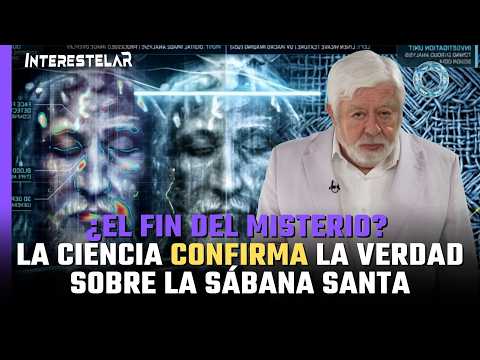
¿El fin del misterio? La ciencia CONFIRMA la verdad sobre la SÁBANA SANTA
Interestelar: La Sábana Santa y su Significado
Introducción a la Investigación
- Jaime Mausán presenta una investigación sobre la Sábana Santa, también conocida como el manto sagrado de Turín, que supuestamente tiene impresa la figura de Jesús.
- Se afirma que la imagen no fue pintada, sino que está "impresa" por un proceso energético extremadamente potente.
Implicaciones de la Resurrección
- Las investigaciones recientes sugieren que esta sábana es evidencia de la resurrección de Jesús, un evento central en la religión católica.
- La resurrección se considera un milagro fundamental que ha sido respaldado por nuevos descubrimientos tecnológicos.
Avances Científicos en el Estudio
- Investigadores del ENA han llevado a cabo estudios avanzados sobre la Sábana Santa, sugiriendo que su imagen es una manifestación física auténtica.
- Los análisis concluyen que no hay pigmentos ni trazos artísticos en la tela; solo alteraciones superficiales en las fibras del lino.
Experimentos y Resultados
- Se realizaron experimentos con láseres de exímero para replicar el efecto observado en el lienzo bajo condiciones controladas.
- Para reproducir una imagen similar a la Sábana Santa se requeriría un pulso energético extremadamente alto, fuera del alcance tecnológico medieval y actual.
Nuevas Hipótesis y Descubrimientos
- La ausencia de distorsión en la imagen sugiere que no hubo contacto físico convencional; podría haber sido generada por interacción energética.
- Algunos científicos proponen teorías sobre emisión de fotones o interacciones desconocidas entre energía y tejido biológico como posibles explicaciones.
Evidencias Históricas Recientes
- Análisis recientes confirman que la Sábana Santa pasó por Oriente Medio, aportando datos clave a su historia.
- Estudios mineralógicos y botánicos identifican partículas características del suelo de Jerusalén, reforzando su conexión histórica con los últimos momentos de Jesucristo.
The Shroud of Turin: New Discoveries and Technologies
Historical Context and Significance
- The Shroud of Turin is believed to be over 2,000 years old, with blood stains present on the fabric before the image formation, indicating extraordinary historical significance.
- In 1988, three laboratories dated a fragment of the shroud to the Middle Ages; however, subsequent investigations revealed that these labs communicated and reached a consensus improperly.
- Recent advancements in carbon dating have confirmed that the shroud dates back 2,000 years and that blood was absorbed into the fabric prior to any image formation.
Technological Advancements in Research
- Recent research has provided compelling evidence supporting that the Shroud wrapped Jesus' body, challenging previous conclusions drawn from outdated methods.
- Between 2022 and 2026, new technologies have emerged that re-examine earlier findings from the controversial carbon dating tests conducted in 1988.
- Italian researcher Liberato De Caro's team introduced a technique called wide-angle X-ray scattering (WAXS), which analyzes cellulose aging in linen fibers with unprecedented accuracy.
Findings from Advanced Analysis
- Unlike carbon dating, WAXS directly examines internal material degradation without contamination risks. Results indicate an aging pattern consistent with fabrics from around 2,000 years ago.
- This finding not only refutes medieval dating but also shifts focus towards understanding physical and environmental factors affecting preservation over centuries.
Microscopic and Biochemical Insights
- Microscopic analysis of blood stains on the shroud reveals protective fiber characteristics indicating no image was painted after blood application—suggesting direct contact with a real body.
- Forensic chemist Raymond Rogers identified high levels of creatinine and ferritin in blood samples—biomarkers associated with severe physiological stress during events like crucifixion.
Environmental Evidence Supporting Authenticity
- Pollen analysis by Max Frey detected grains from species native to the Near East, while mineralogical studies found particles typical of Jerusalem soil—reinforcing claims about its geographical authenticity.
- Collectively, these findings bolster arguments for the shroud's connection to a real individual who experienced violent death.
Role of Artificial Intelligence in Research
- AI technology is becoming crucial for reconstructing images related to Christ’s face based on data derived from the shroud—a significant leap forward in historical research methodologies.
- The integration of advanced digital processing tools allows researchers to uncover details previously hidden for centuries, reshaping discussions surrounding this ancient artifact.
Reconstruction of Historical Faces Using AI
The Role of Artificial Intelligence in Facial Reconstruction
- The use of artificial intelligence, including convolutional neural networks and generative systems like Mid Journey, has enabled the reconstruction of faces from historical artifacts.
- Recent reconstructions have revealed a face with Semitic features consistent with populations from 1st century Judea, contrasting sharply with idealized medieval European art representations.
- AI technology has identified signs of physical trauma on the reconstructed face, such as a fractured nasal septum and swollen cheekbones indicative of severe blows.
New Discoveries in Dental Imaging
- Dental surgeon John Sotosanti utilized high-resolution digital processing techniques to identify visible lower front teeth through the lips in the image.
- This suggests that the imaging process captured not only external facial features but also internal anatomical structures, possibly involving radiation similar to X-ray technology.
Implications for Historical Understanding
- If confirmed, these findings would indicate an unprecedented physical phenomenon beyond known medieval artistic techniques, suggesting a highly unusual process at work.
- A new digital platform launched in January 2026 allows global researchers access to ultra-high-resolution images of the shroud, facilitating advanced AI-assisted analysis.
Visual Analysis Findings
- Analyses reveal a complete absence of defined contours in the image; figures fade gradually rather than being outlined by lines typical in paintings.
- Blood stains on the shroud show elevated bilirubin levels, indicating extreme physical stress and explaining their persistent reddish hue over centuries.
Broader Context and Reflections
- This research provides authentic evidence of a burial cloth associated with an individual who died and reportedly returned to life—highlighting extraordinary suffering endured by Jesus Christ.
- The speaker emphasizes reflection during Holy Week on Jesus' teachings and sacrifices rather than merely engaging in leisure activities.
- The hope is that this investigation encourages deeper contemplation about humanity's values and kindness towards others inspired by Jesus’ messages.