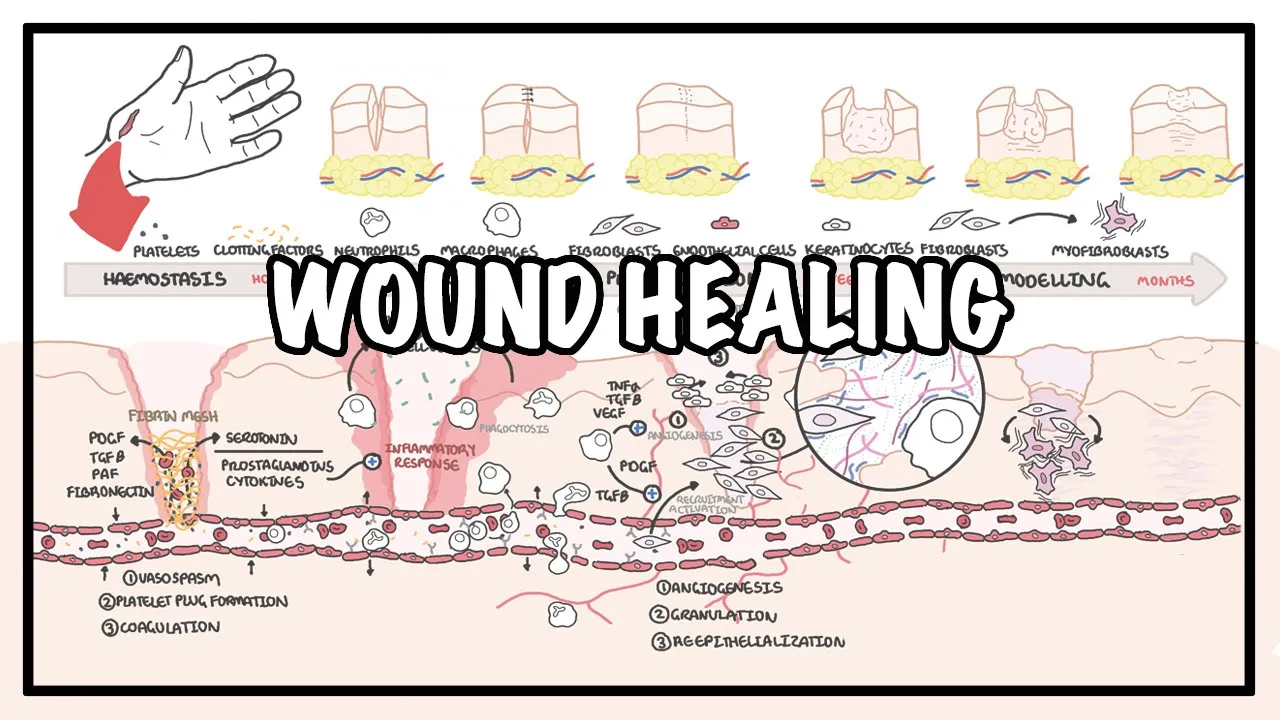
Wound Healing - Stages of healing and pathology
Detailed Overview of Wound Healing Phases
The process of wound healing involves distinct phases, each with specific cellular and biochemical activities. This summary delves into the phases of wound healing, starting with hemostasis.
Hemostasis Phase
- Hemostasis is initiated immediately after injury, involving platelets and clotting factors in processes like vasospasm, vessel constriction, and coagulation system activation.
- Platelets release substances such as growth factors and fibronectin to initiate wound repair.
Inflammation Phase
- Inflammation follows hemostasis, characterized by neutrophils and macrophages playing key roles in phagocytosis and regulatory functions.
- Macrophages are crucial for various activities including phagocytosis, recruitment of cells, angiogenesis, and extracellular matrix synthesis.
Proliferation Phase
- During proliferation, a new vascular bed forms to supply oxygenated blood to the wound. Fibroblasts, endothelial cells, and keratinocytes play essential roles in this phase.
- Angiogenesis, granulation tissue formation facilitated by growth factors attract fibroblasts for matrix production.
Remodeling Phase
- The final phase involves maturation or remodeling where fibroblasts transform into myofibroblasts for scar tissue formation over months post-injury.
- Scar remodeling continues with cell apoptosis resulting in a mature scar. Factors affecting healing include local (wound type) and systemic (age, medications) aspects.
Healing by Secondary Intention Process
This section discusses the process of healing by secondary intention, which occurs when wound edges are not opposed, leading to healing from the bottom upwards through granulation tissue formation and re-epithelialization.
Healing Process Details
- Healing by secondary intention occurs when wound edges are not opposed, necessitating healing from the wound's base upwards.
- The process involves granulation tissue formation and re-epithelialization for wound closure.
Factors Affecting Wound Healing
This part delves into factors influencing wound healing, including local and systemic factors that could impair the process.
Factors Impacting Wound Healing
- Secondary intention wound healing is common after significant soft tissue loss like major trauma or severe burns.
- Myofibroblasts play a crucial role in this type of wound healing.
- Wound healing comprises four phases: hemostasis, inflammation, proliferation, and remodeling.