1 PP 11 Newtons Laws Part 1
Newton's First Law of Motion: Understanding Forces
What is a Force?
- A force is defined as a push or pull and is considered a vector quantity, represented by the symbol F. The unit of force is the Newton (N), named after Isaac Newton.
- Forces possess both magnitude and direction, which are essential for vector addition and subtraction in physics.
Objects and Agents
- In any force interaction, there are two entities: the object (the entity being pushed or pulled) and the agent (the entity applying the force). For example, in a scenario where a person pushes a cart, the cart is the object while the person is the agent.
- Other items within an object do not influence its motion unless they exert forces themselves; for instance, a watermelon in a cart does not act as either an object or an agent when only considering who pushes the cart.
Types of Forces
Contact Forces
- Contact forces occur when there is physical interaction between objects. Examples include:
- Applied Force
- Spring Force
- Frictional Force
- Normal Force
- Drag Force (though less emphasized in this context)
Long Range Forces
- Long-range forces act over distances without direct contact and are often described mathematically through field equations. Key examples include:
- Gravitational Force
- Electric Field
- Magnetic forces exist but are outside this introductory curriculum scope.
Analyzing Systems: Object vs System Perspective
- Depending on problem requirements, one may focus on either an individual object or treat multiple objects as one system.
- Example: When analyzing pressure exerted by a person on an elevator floor, only that person needs to be considered as the object of interest.
- Conversely, if assessing stress on an elevator cable due to weight from both person and elevator combined, it’s necessary to view them as part of one system.
Internal vs External Forces
- In systems with multiple forces:
- Internal Forces act within the system itself (e.g., normal force from a person inside).
- External Forces affect the system from outside (e.g., tension in cables). This distinction helps clarify how different forces interact within physical problems.
Understanding Mass and Inertia
Mass vs Inertia
- Mass refers to how much matter an object contains; however, in physics contexts like inertia plays a crucial role.
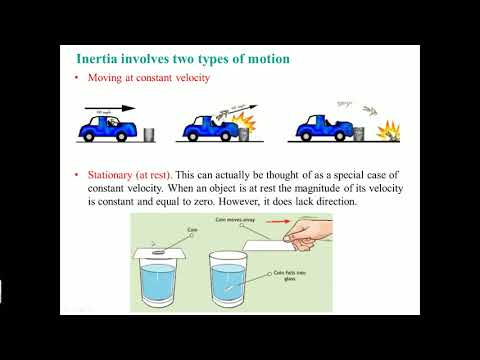
- Inertia describes an object's resistance to changes in its state of motion—whether at rest or moving at constant velocity—and correlates directly with mass; greater mass means greater inertia.
Characteristics of Inertia
- An object at rest will remain at rest unless acted upon by another force; similarly, an object moving will continue moving unless influenced otherwise.
- The likelihood of change in motion increases with lower mass/inertia—smaller objects require less effort to start moving or stop compared to larger ones due to their reduced inertia impact.
Practical Examples of Inertia Effects
- A large vehicle requires more energy to initiate movement or deceleration than smaller vehicles because it has higher inertia.
- Smaller cars feel more significant effects from external factors like wind due to their lower inertia compared to larger vehicles that resist such changes more effectively.
Understanding Newton's Laws of Motion
The Importance of Seat Belts and Inertia
- When a car stops suddenly, the passenger continues moving forward due to inertia, potentially leading to injury. This highlights the necessity of wearing seat belts.
- Inertia is defined as an object's tendency to remain at rest or in uniform motion unless acted upon by an external force, which is crucial for understanding motion dynamics.
Practical Examples of Inertia
- A coin placed on top of a cup will fall when the cup is pulled away, demonstrating that objects at rest stay at rest until acted upon.
- This principle also explains how a magician can swiftly remove a tablecloth without disturbing dishes on it; the dishes remain in place due to inertia.
Newton's First Law Explained
- Newton's first law states that every object remains in its state of rest or uniform motion unless influenced by an unbalanced force. Understanding this requires recognizing different reference frames.
- An example illustrates that from inside a moving car, an object may appear to move without any apparent force acting on it; however, from outside the car, it's clear that external forces are at play.
Questions to Understand Inertia Better
- Question 1: If a spaceship loses power in space, it will not slow down immediately because there are no external forces acting on it—this statement is true.
- Question 2: Observing luggage sliding towards you on a slowing train indicates that the train is decelerating while the luggage continues moving forward due to inertia.
- Question 3: When standing in a bus and sliding forward during an abrupt stop, it's not caused by any new force but rather your continued motion as the bus halts.
Introduction to Newton's Second Law
- Newton’s second law states that an object with mass (m) will accelerate (a) when subjected to net force (F). The relationship can be expressed mathematically as F = ma .
- Acceleration is directly proportional to net force and inversely proportional to mass. Thus, increasing mass decreases acceleration while increasing force increases acceleration.
Force Units and Proportionality Concepts
- The unit for measuring force is Newton (N), where mass must be measured in kilograms and acceleration in meters per second squared for accurate calculations.
- Understanding proportional relationships: if mass increases, acceleration decreases; conversely, if mass decreases, acceleration increases. This inverse relationship emphasizes how changes affect overall motion dynamics.
By structuring these notes around key concepts related to Newton's laws of motion and their practical implications through examples and questions, learners can better grasp fundamental physics principles.
Understanding Mass and Weight
The Difference Between Mass and Weight
- Mass is a property of an object that refers to its inertia, while weight is the force exerted by gravity on that mass.
- When you step on a scale, the reading (in pounds) reflects weight, not mass; mass is measured in kilograms.
- An example illustrates this: if you weigh 100 pounds on Earth, you would weigh only 16 pounds on the Moon due to lower gravitational pull, but your mass remains unchanged.
Newton's Third Law of Motion
- Newton's third law states that for every action (force), there is an equal and opposite reaction (force). This means action and reaction forces are equal in magnitude but opposite in direction.
- For instance, if a hand exerts a force of 50 newtons downward onto a table, the table exerts an equal force of 50 newtons upward onto the hand.
Acceleration Differences Despite Equal Forces
- Although action and reaction forces are equal, their effects can differ due to varying masses. For example, if a hand weighs less than a table, they will experience different accelerations when subjected to the same force.
- Using F = ma (Force = mass × acceleration), one can calculate differing accelerations based on respective masses when both experience the same force.
Real-world Applications of Newton's Laws
- In collisions between vehicles (e.g., an SUV vs. a hybrid car), both exert equal forces upon each other despite differences in size or impact; this aligns with Newton’s third law.
- A scenario involving pushing boxes demonstrates how applied forces result in reactions; understanding these interactions helps clarify fundamental physics principles.
Turn any video into a summary like this
YouTube links, meetings, lectures — with transcripts, search, and chat.