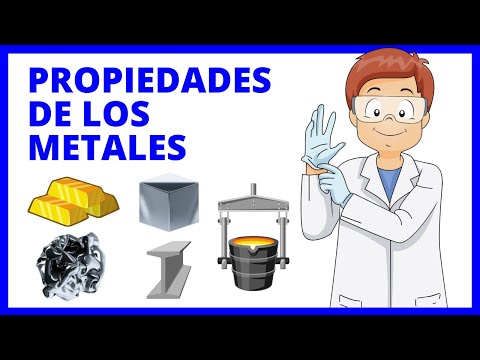
Propiedades físicas y químicas de los metales (ejemplos)👩🔬
Understanding the Physical and Chemical Properties of Metals
Physical Properties of Metals
- Definition: Physical properties define and differentiate metals as materials without needing transformation from other substances, only through physical actions like heating or deforming.
- Brilliance: Most metals exhibit a bright appearance with grayish or silvery colors; exceptions include mercury (black), copper (reddish), gold (golden), and osmium (bluish hues). This brightness results from photon interactions with delocalized electrons.
- Hardness: Metals are generally hard, capable of scratching surfaces. Alkali metals like rubidium are exceptions, being soft enough to be scratched by a fingernail.
- Malleability and Ductility: Metals can be malleable (deformed without breaking) and ductile (stretched into wires). Examples include copper and gold, which can be made into cables.
- Conductivity: Metals are excellent conductors of heat and electricity. Notable conductors include aluminum and copper for heat, while silver, copper, and gold excel in electrical conductivity.
Additional Physical Characteristics
- Sound Production: When struck together, metal pieces produce characteristic sounds that experts can distinguish between different types of metals.
- Melting Points: Most metals have high melting points; tungsten melts at 3422 ºC while cesium melts at just 28.44 ºC. All but mercury are solid at room temperature.
- Alloys Formation: Metals can mix to form alloys—solid mixtures that combine desirable characteristics from different metals. For example, bronze is an alloy of copper and tin.
Chemical Properties of Metals
Reactivity and Bonding
- Chemical Interactions: The chemical properties involve how metallic atoms interact with external molecules to form compounds such as oxides or salts.
- Metallic Bonds: Metallic atoms bond through a "sea of electrons," leading to orderly structures known as metallic crystals responsible for their physical properties like conductivity.
Corrosion Resistance
- Corrosion Susceptibility: Many metals corrode over time due to oxidation; noble metals resist corrosion better than others. Iron is particularly prone to rusting.
Reducing Agents
- Electron Donation: Some metals act as reducing agents by donating electrons during reactions, forming cations in the process. Alkali metals like sodium lose one electron while alkaline earth metals like calcium lose two during these reactions.
Summary on Reactivity
Chemical Reactions of Metals
Reactions with Water and Oxygen
- Metals react explosively with water to form hydroxides, showcasing their reactivity.
- When metals are exposed to high temperatures, they react with oxygen in the air to form oxides; nitrogen can also contribute to the formation of nitrides.
- The presence of oxygen and nitrogen in the atmosphere influences the types of compounds formed during metal reactions.
Interaction with Acids and Bases
- Strong acids can attack metals, resulting in the formation of salts, while strong bases lead to hydroxides or basic complexes.
- An oxide layer on some metals acts as a protective barrier, preventing further reaction with acids.
- Hydrochloric acid does not dissolve all metals; only those that can form soluble metal chlorides are affected.
Conclusion