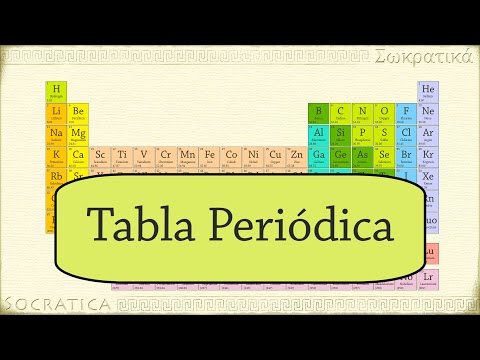
Química: Introducción a la Tabla Periódica
The Periodic Table: A Powerful Tool for Chemists
Importance of the Periodic Table
- The periodic table is described as the most powerful tool for chemists, essential for organizing chemical information. Without it, chemistry would be chaotic and confusing.
- Its true value lies in its predictive capabilities, allowing predictions about an element's chemical behavior based on its position in the table.
Structure of the Periodic Table
- Each element is represented by a square containing a one or two-letter chemical symbol, primarily derived from English names but some from other languages (e.g., silver's symbol Ag comes from Latin "argentum").
- Above each symbol is the atomic number (number of protons), while below are the full name and atomic mass. Most elements are metals located in the middle and left side of the table.
Classification of Elements
- Nonmetals are found at the top right, with hydrogen being an exception. Nonmetals generally lack luster and are poor conductors of heat and electricity.
- A thick line resembling a staircase divides metals from nonmetals; elements adjacent to this line are called metalloids, exhibiting properties of both categories.
Organization Patterns
- Elements are arranged in increasing order of atomic number, revealing patterns or periodicity in their characteristics—this repetition is known as the periodic law.
- Vertical columns (groups or families) contain elements with similar chemical properties due to comparable valence electron configurations.
Groups and Periods Explained
- There are seven horizontal rows (periods), each corresponding to different energy levels occupied by electrons.
- The leftmost groups include alkali metals and alkaline earth metals; on the right side lie noble gases with complete valence shells.
Historical Context and Evolution
- The lower part contains two rows (lanthanides and actinides), which have completed outer orbitals. Over time, various systems have been used to list groups within the periodic table.
- Different numbering systems exist for groups; IUPAC proposed a standardized system that avoids confusion caused by previous arbitrary designations.
Development of Mendeleev’s Table
- Dmitri Mendeleev developed his version of the periodic table in 1869 by ordering elements according to increasing atomic mass while advocating for grouping similar properties together.
- His work revealed gaps for undiscovered elements, predicting their existence based on observed trends—a significant advancement over earlier methods that lacked systematic organization.
The Evolution of the Periodic Table
Mendeleyev's Predictive Power
- Mendeleyev's periodic table effectively predicted the existence and properties of elements like aluminum and silicon, which were later discovered, confirming his predictions.
- This demonstrated the utility of Mendeleyev's table as a predictive tool in chemistry, filling a gap that existed prior to its introduction.
Mosley's Contribution to Atomic Theory
- In 1913, physicist Henry Moseley introduced significant modifications to the periodic table while experimenting with X-rays on metallic elements.
- Moseley established a mathematical relationship between X-ray wavelengths emitted by different elements and their atomic numbers, suggesting atomic number is more crucial than atomic mass for predicting chemical behavior.
Reorganization of Elements
- Moseley reorganized the periodic table based on increasing atomic number rather than atomic mass, correcting inconsistencies found in Mendeleyev’s original arrangement.
- He identified discrepancies such as argon having a higher atomic mass than potassium but a lower atomic number, leading to better alignment within the table.
Future Implications
- Moseley proposed spaces in the periodic table for undiscovered elements with specific atomic numbers (43, 61, 72, and 75), many of which have since been discovered.