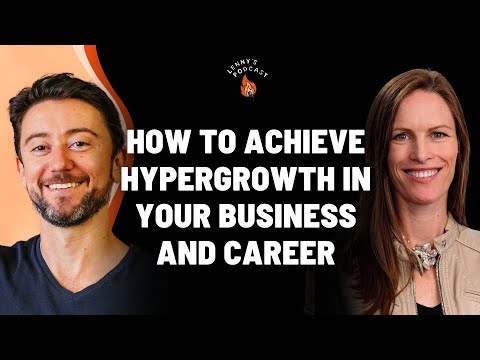
How to achieve hypergrowth in your business and career | Carilu Dietrich (Atlassian)
Achieving Hyper Growth
In this section, the speaker discusses the key factors that contribute to achieving hyper growth.
Factors for Hyper Growth
- To achieve hyper growth, a company needs organic inbound and viral word of mouth. Paying for growth is not sustainable.
- Companies experiencing hyper growth go through stages of growth that would take other companies five or ten years. They need to keep hiring 2X and 3X leaders who have seen the next stage of growth because it's going to be here before you know it.
- The biggest thing for achieving hyper growth is having an amazing product that people love to use. Chat GPT is an example of a product with hyper growth potential.
Interview with Carrie Lou Dietrich
In this section, Lenny interviews Carrie Lou Dietrich about her experiences building and growing successful products.
Commonalities Among Hyper Growth Companies
- Hyper growth companies have an amazing product that people love to use.
- These companies are able to make big changes to their growth strategy in order to unlock new channels of growth.
- They also ride the lightning by going through stages of growth quickly.
Challenges Faced by CMOs and CPOs
- CEOs often don't trust CMOS, which can lead to them getting fired.
- Similarly, CPOs often get fired due to challenges in scaling their teams.
Career Advice
- Waiting a long time before hiring your first salesperson can be beneficial.
- Bundling strategy can help increase revenue.
- It's important to be intentional about your career and seek out opportunities that align with your goals.
Building a Career Long Term
In this section, Carrie Lou shares her insights on building a career long term and what it takes to get to the executive level.
Pursuing an Executive Role
- Pursuing an executive role requires trade-offs and sacrifices.
- Working harder, learning more, pushing oneself, taking on more responsibilities and opportunities are important aspects of getting to the executive suite.
- Sacrifices may include working longer hours or sacrificing personal time.
- Learning as much as possible about one's expertise, having a great attitude, and a strategic mind are key factors in getting to the c-suite.
Specific Ways to Train Your Mind
- Success comes from working really hard with self-discipline and insight.
- There are no shortcuts to knowing a lot.
- Think about how your responsibility is tied to revenue. Understand finance and how the finances of the business work.
- Be proactive in seeking out mentors who can help guide you in your career path.
Building a Successful Career
In this section, the speaker talks about building a successful career by exploring different departments, building strong relationships, and working for companies with good momentum.
Exploring Different Departments
- The speaker recommends taking a tour of duty at every function in marketing to get a sense of other departments.
- Exploring different departments helps in understanding how they function and work together.
Building Strong Relationships
- The speaker emphasizes the importance of building strong relationships with people by doing good work and helping them.
- Good relationships can help in accelerating career growth.
Working for Companies with Good Momentum
- The quality of the company you work for affects your career growth.
- Picking the right company with good momentum gives you better chances of getting higher-level experiences and accelerated career growth.
- Working for big name high momentum companies early in your career can be beneficial.
Finding a Phenomenal Company
In this section, the speaker talks about finding a phenomenal company that will transform your entire career.
Identifying Phenomenal Companies
- The speaker advises going to work for a big company that's going to do super well as it is easy to pick winners early in your career.
- Later in your career, it is easier to identify companies' momentum based on their stage.
Evaluating Companies
- To evaluate if it's a phenomenal company, consider factors such as profitability and costs (rule of 40), quality of investors, most recent rounds, net promoter score or customer satisfaction, and net dollar retention.
What to Look for in a Company
In this section, the speaker talks about what to look for in a company when evaluating it.
Evaluating Companies
- The speaker has a Post-it note with ten parts of what to evaluate when looking at companies.
- Factors such as profitability and costs (rule of 40), quality of investors, most recent rounds, net promoter score or customer satisfaction, and net dollar retention are important factors to consider.
Evaluating a Business
In this section, the speaker discusses how to evaluate a business before investing in it.
Key Factors to Consider
- Phenomenal net dollar retention is an indicator of a strong and healthy business.
- Look at the growth rate from the previous year and their burn rate to determine if they are going to run out of money.
- Determine if they are number one in their market or have a Forester or Gartner magic quadrant.
- Check their Glassdoor reviews to see if it's a good place to work.
Life Philosophy Post-it Notes
In this section, the speaker shares some life philosophy post-it notes that she has on her wall.
Life Philosophy Post-it Notes
- "More Yoda less Wonder Woman" - ask better questions.
- "Ask them backwards too" - ask questions backwards.
- "Do or do not there is no try" - reverse order of famous quote from Star Wars.
- "Hell yes or no" - only pursue opportunities that excite you and give you energy.
- "Worrying is wasted energy" - take fear and uncertainty as urgency and make a list of what can be controlled now.
Career Advice During Tough Times
In this section, the speaker gives advice for people trying to find jobs during tough economic times.
Advice for Unemployed Individuals
- Endurance and grit are important during tough times. Don't lose hope because another job will come eventually.
- Don't settle for a crappy job or company. Each job prepares you for the next one, so choose wisely.
Advice for Employed Individuals
- Pick your industry carefully as it will propel your career forward.
- Choose the right company as well since each logo prepares you for the next job.
- Do a good job and continue to grow your skills.
Advancing Your Career During a Downturn
In this section, the speaker discusses how to advance your career during a downturn by taking on new roles and responsibilities at your company.
Taking on New Roles and Responsibilities
- You can advance your career during a downturn by learning new skills and taking on new roles or responsibilities at your company.
- Open projects are available where you can raise your hand and grow.
- Focusing solely on title and salary is not enough.
Lessons Learned from Running Expensive Ad Campaigns
In this section, the speaker shares their experience running expensive ad campaigns and what they learned from it.
Approach to Marketing Spend
- The speaker has spent hundreds of millions of dollars on advertising campaigns for companies like Oracle and Atlassian.
- Advertising is sexy but super expensive for the benefits it provides.
- Quality of product is more important than spending money on advertising.
- Good brand advertising needs to be sustained over a long period of time.
- A smaller amount spent consistently over time can be effective.
Targeted Spending vs Blanketing Ads
- Sometimes one very targeted spend is worth more than blanketing a bunch of ads.
- The best advertising has humor, personality, or truth that sticks in people's brains.
- Highlighting customers in ads can also be effective.
Characteristics of Successful Campaigns
In this section, the speaker discusses what makes a campaign stand out and mentions some successful campaigns.
Key Points:
- Successful campaigns are funny, unexpected, and true to the product.
- Salesforce has done a great job highlighting customers in their campaigns.
Companies Going Through Hyper Growth
In this section, the speaker talks about working with companies going through hyper growth and mentions some examples.
Key Points:
- The speaker specializes in working with companies going through hyper growth such as Miro, Segment, Bill.com, and One Password.
- One Password has been growing rapidly according to a report from OCTA.
- One Password is one of six companies that have been getting the most new customers according to OCTA's report.
Common Traits of Hyper Growth Companies
In this section, the speaker discusses what contributes to a company's success during hyper growth.
Key Points:
- An amazing product that people love to use is crucial for hyper growth. Chat GPT is an example of a product that has seen hyper growth because people are excited to use it. Miro's whiteboards were also popular because they brought an existing concept to life in an interesting way.
- Organic inbound and viral word-of-mouth marketing are essential for hyper growth since paid advertising cannot sustain those rates. Figma, Miro, Snowflake, Sentry HubSpot and One Password are examples of products/companies that have benefited from natural user referrals/sales rather than salespeople selling them directly.
- Hyper growth companies go through stages of growth that would take other companies years to achieve. They need to keep hiring 2X and 3X leaders who have seen the next stage of growth, while also developing homegrown talent. Mentors and advisors can help leaders navigate the challenges of hyper growth.
Opportunities for Company Growth
In this section, the speaker discusses different ways companies can grow beyond word of mouth and organic growth engines.
Paid or SEO Growth
- SEO is the number one marketing motion that they used at Atlassian.
- Between 15 and 25 of their leads came from paid search marketing at the time.
- Getting to virality and hyper-growth is not a Magic Bullet. It requires consistency, customer obsession, and incremental improvements across all parts of the business.
Importance of Differentiation
- Founders need to double down on having products that are differentiated and do something that their customers really love.
- Coda puts data in one centralized location regardless of format, eliminating roadblocks that can slow your team down.
Accelerating Word-of-Mouth Growth
- Empowering people in your company to be thought leaders can create word-of-mouth growth.
- Hiring the right people who are deeply engaged as super experts can drive thought leadership.
- Having a strong content strategy in communities that already exist online or open-source communities can also drive word-of-mouth growth.
The Importance of User Groups and Communities
In this section, the speaker discusses the importance of user groups and communities in building a successful product.
Atlassian's User Group Community
- Atlassian had an amazing user group community where they facilitated local in-city leaders to meet up and talk about their products.
- The community was built around paying for beer and pizza, which helped people grow their careers and networks.
- Bringing customers together to talk to each other while prospects listened created more buzz than just inviting prospects alone.
Learning from Customers
- Gusto's founder sat with the first 200 customers, watching how they reacted to every step of the payroll process.
- This helped them build a product that people continued using, loving, and sticking with.
- Insight into daily struggles and experiences of customers is harder to get as companies get bigger.
Atlassian's Product-Led Growth Strategy
In this section, the speaker talks about Atlassian's unique approach to product-led growth.
Plowing Money into Engineering and Product
- Atlassian never took outside money except for one late-stage financing round.
- Founders took all the money they would have spent on a sales organization and put it into engineering and product instead.
- Spending two or three times as many dollars in R&D as other companies allowed them to make a product that really sold itself.
Sales Organization at Atlassian
- Atlassian had almost no sales organization or a sales org that was really focused on renewals or assisting enterprise sales.
- Relative to other companies, they had a much smaller, much more efficient sales org.
When is the Right Time to Start Leading into Sales?
In this section, the speaker discusses when is the right time to start leading into sales and hiring sales.
Atlassian's Unique Situation
- Atlassian was a unique company in a unique point in time because the founders never took outside money except for one late-stage financing round.
- The founders were going through an experiment that turned out to be really successful where they took all the money they would have spent on a sales org and put it into engineering and product.
Trade-offs of Waiting Longer or Doing It Earlier
- There are trade-offs to waiting longer or doing it earlier when it comes to leading into sales and hiring sales.
- Some early stage startup advisors say that you should build processes that don't scale first because when you're in the super early stage seed under 10 million, you've really got to go deep at that stage.
Sales Strategy for Product-Led Growth
In this section, the speaker discusses the real strategy in sales and how it relates to product-led growth. The Atlassian model is used as an example of selling only to existing customers, while larger enterprise companies require more cross-selling and upselling. The speaker also talks about account-based marketing and intent-based signals.
Sales Strategy for Product-Led Growth
- Sales is the most expensive vehicle, so try to sell only to people who are already customers.
- Atlassian's model was to sell only to people who were already customers, helping them with their renewals.
- Prospecting net new customers is a really expensive way to get new customers.
- Adding an SDR or AAE will add a predictable amount of revenue but can be a huge cost if the product isn't getting that kind of resonance.
- Account-based marketing and intent-based signals are trying to engage salespeople with customers that are actually likely to buy.
- Founders should wait as long as they can before hiring their first salesperson because it's a huge cost and drain on the business if the product isn't getting that kind of resonance.
Product-Led Growth Motion
- Product-led growth depends so much on your product and your buying market.
- Some buying markets are less likely to use salespeople, such as HR, whereas dev tool space can use product-led growth because developers both hate salespeople and love researching themselves.
- Get closer to your customers and read the signals; if your product is good enough that people can get time to value in a couple of days instead of weeks or months, you can have a product-led growth motion.
- Sales teams sometimes are expensive services arms to cover over product issues and help customers buy it until it's fixed.
- Try not to hire too fast and too far ahead in sales and inside sales because it seems like it's going to add revenue but actually is a huge cost and drain on the business if the product isn't getting that kind of resonance.
Hybrid Nature
- Retool became sales-led from the beginning even though it feels like a tool that would have a lot of potential to be product-led and self-service.
- People are turning their SDRs into sales engineers/researchers so that the first touch for customers who are trying out a product-led growth is with someone who can help guide them on the path.
- This hybrid nature extends product-led growth but helps people in this case where they need more guidance.
Overcoming Growth Challenges
In this section, the speaker discusses the challenges that companies face when trying to make big changes in their approach to growth. The speaker emphasizes that big growth levers are consistent across companies and that it is a strategy problem rather than an individual departmental problem.
Big Growth Levers
- The big growth levers are consistent across companies.
- Companies can start with one product and then add incremental products or focus on a vertical like finance or go global.
- The biggest issue is when the company hasn't decided to move in a particular direction.
- Big growth levers cannot be an individual department's goal without being a cross-company strategy goal.
Making Big Changes
- To make big changes, it needs to be a cross-company strategy goal.
- It requires everyone coming together just to solve those problems instead of pushing them under the rug.
- It can come from the CEO or C-suite really coming together just to solve those problems instead of pushing them under the rug.
Building Trust Between Marketers and CEOs
In this section, the speaker talks about building trust between marketers and CEOs. They discuss how there is often not enough trust between these two parties and what helps build that trust.
Lack of Trust
- Often, there is not enough trust between marketers and CEOs.
- Sometimes, CEOs don't know if they can trust a marketer's judgment.
Building Trust
- It can come from the CEO or C-suite really coming together just to solve those problems instead of pushing them under the rug.
- Senior marketers need to be critical and build trust with CEOs.
The Role of CMOs in Driving Revenue
In this section, the speaker discusses the challenges faced by Chief Marketing Officers (CMOs) in driving revenue and the importance of having a solid understanding of metrics and growth levers.
Challenges Faced by CMOs
- Many companies struggle with marketing because it is a big spend category, and much of the spend does not convert in a quarter or even a year.
- CMOs need to be running their business well, hire great teams that elevate them and the company, and be thoughtful and strategic about the market space that the company is in.
Importance of Metrics and Growth Levers
- It is important for CMOs to have a handle on metrics, understand what growth levers they can use, and be able to talk in terms of the CEO and board.
- Being good on metrics, strategy, and market helps CMOS spar with CEOs in a way that builds trust.
Why Do Chief c-Suite Roles Fail?
In this section, the speaker discusses why chief product officers (CPOs) and chief marketing officers (CMOs) often get fired from startups.
Reasons for Failure
- Both roles are strategy jobs with difficult-to-measure results because some are direct while others are indirect.
- When companies are not performing well, both roles get swept up. If companies aren't performing well you can swap out heads of product or marketing.
- Both roles require a high bar of excellence, trust, and endurance to keep going and find the next role where you're really a fit.
Scaling Startups from 30 Million to 500 Million
In this section, the speaker discusses what is unique about scaling startups from 30 million to 500 million and how it differs from before 30 million or after 500 million.
Unique Aspects of Scaling
- There's an early stage of product-market fit where the founder and company are trying to figure out who their real ideal customer profile is and if they can sell to them consistently.
- After reaching $500M in revenue, companies face new challenges such as maintaining growth rates, managing complexity, and avoiding bureaucracy.
Growth Strategies for Small and Medium-Sized Companies
In this section, the speaker discusses growth strategies for small and medium-sized companies.
Bundling as a Growth Strategy
- Small and medium-sized companies need to diversify their financial model by selling new products into their customer base.
- Bundling is an effective growth strategy for sales-led motions but not for product-led growth companies.
- Best-of-breed vs all-in-one philosophies in bundling. Slack was the best of breed, but Microsoft Teams is eating its lunch with bundling.
Atlassian's Experience with Bundling
- Atlassian experimented with different bundled plans, which slowed down the product-led growth motion.
- Evaluating multiple products before purchasing leads to fewer conversions.
Competing Against Big Players in the Market
In this section, the speaker talks about how small companies can compete against big players in the market.
The Importance of Being the Best
- In a tough environment, bundling is most effective.
- The only way to win against powerful competitors like Microsoft is to have a product that's so much better that it's worth the extra money.
Product-Led Growth vs Sales-Led Motions
In this section, the speaker explains why bundling is not an effective strategy for product-led growth companies.
Product-Led Growth vs Sales-Led Motions
- Bundling is not a great land strategy for product-led growth companies.
- Product-led growth companies should focus on a single product that quickly provides value to the user.
The Importance of Focusing on One Specific Pain Point
In this section, the speaker emphasizes the importance of focusing on one specific pain point when developing products.
Atlassian's Experience with Multiple Products
- Atlassian had multiple products, but evaluating them before purchasing led to fewer conversions.
- Focusing on one specific pain point leads to faster and easier online self-service purchases.
Recommended Books and Favorite Movie
In this section, the speaker talks about two books that she recommends to others and her favorite recent movie.
Recommended Books
- The first book is "The Dao tejing" by Stephen Mitchell. It's a philosophy book about the flow of life.
- The second book is "Never Split the Difference" by a former CIA hostage negotiator. It's a great book about negotiating that helped her with negotiations at work and with her children.
- The author emphasizes putting yourself in the shoes of the other person to figure out what makes a win for both parties.
Favorite Recent Movie
- Her favorite recent movie is "Everything Everywhere All at Once," which is a sci-fi film about all the different ways your life could turn out if you made different choices.
- The movie made her appreciate the life she has and taught her that tiny decisions can change one's life.
Favorite Interview Question
In this section, the speaker talks about her favorite interview question.
Favorite Interview Question
- Her favorite interview question is asking how many people someone has fired and to tell her about each experience.
- She asks this question because generally, she manages teams of managers who have managed many people for an extended period of time. Firing people indicates how long someone has managed people.
Insights on Leadership and Product Strategy
In this section, Carrie Lou shares her insights on leadership and product strategy. She talks about how to get a sense of a leader's experience and humanity, the importance of cross-company alignment in product development, and the Amazon concept of writing a press release at the beginning of product ideation.
Understanding Leaders
- Getting a sense of a leader's experience and humanity is important for understanding their ability to lead under pressure.
- Matt Mashari's episode on laying off people successfully provides valuable insights into leadership.
Favorite Products
- One Password is one of Carrie Lou's favorite products due to its cross-platform nature.
- Miro and whiteboards are also among her favorites because they provide views into what's coming up on the roadmap.
Product Strategy
- The Amazon concept of writing a press release at the beginning of product ideation helps align marketing and product teams around a common theme.
- This approach ensures that there is clarity around what the product aims to achieve before it is built.
Tips for Meditation
In this section, Carrie Lou shares tips for meditation based on her own experiences with guided meditations.
Meditation Tips
- There is no right or wrong way to meditate; it's all about making time to be present, breathe, and sense your surroundings.
- Guided meditations can be helpful for those who struggle with quieting their minds. Carrie Lou recommends Tara Brach and Meditation Oasis as great resources.
- Stick with meditation, and any benefits you get from being present in meditation will carry over to being present in life.
Conclusion and Call to Action
In this section, the speaker concludes the podcast episode and encourages listeners to subscribe, rate, and review the show on various platforms.
- The speaker thanks the audience for listening.
- Encourages listeners to subscribe to the show on Apple Podcasts, Spotify or their favorite podcast app.
- Asks listeners to consider giving a rating or leaving a review as it helps other people find the podcast.
- Provides information about where listeners can find past episodes of the show or learn more about it at lennyspodcast.com.
Turn any video into a summary like this
YouTube links, meetings, lectures — with transcripts, search, and chat.