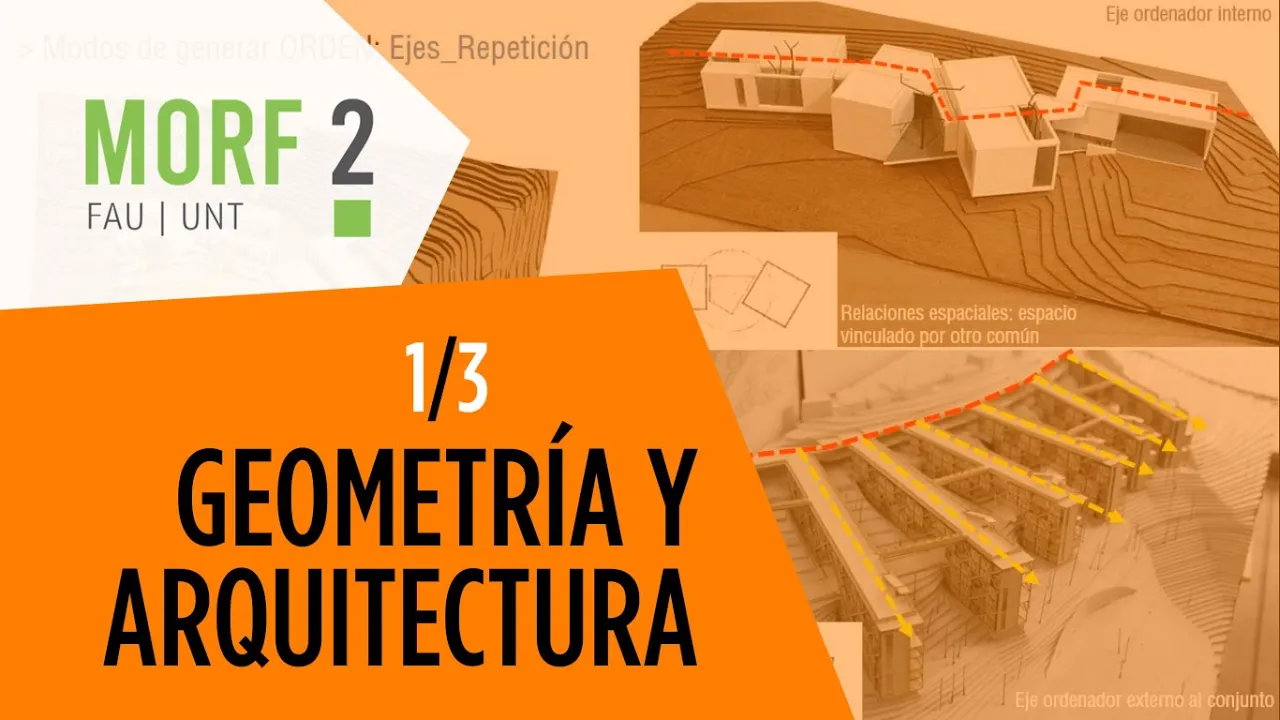
morf2 | geometria y arquitectura | parte 1 de 3
New Section
The architect María Inés Molt introduces the third theoretical block on geometry and architecture, outlining its three parts focusing on geometric concepts and their application in architecture.
Introduction to Geometry and Architecture
- María Inés Molt initiates the presentation, discussing the theoretical block on geometry and architecture.
- The presentation will consist of three parts: an introduction to geometry, a deep dive into Euclidean geometry by architect Rafael Board, and an exploration of symmetry as an analytical tool for form generation.
- Principles of order and Euclidean geometry are essential tools for organizing elements in architecture, establishing relationships between forms or spaces to refine architectural shapes.
- Internal structure defines the relationships within a form, while external conformation pertains to its visible appearance.
- Order refers to how things or events are arranged in space or time based on specific criteria, closely linked to the fundamental aspects of form and space-time in architecture.
New Section
Delving deeper into the concept of order in architecture, emphasizing its significance in information processing and decision-making processes.
Significance of Order in Architecture
- Order is crucial for organizing information effectively by extracting relevant details systematically.
- The concept of order is inherent in human nature, facilitating comprehension through organization, categorization, and prioritization.
- Working with order enhances efficiency by reducing errors and streamlining understanding processes across various domains.
New Section
Exploring spatial relationships and organizational principles within architectural design beyond geometric considerations.
Spatial Organization in Architectural Design
- Architectural studies involve analyzing spatial relations like interior spaces connected to adjacent areas using various organizational patterns such as central, linear, radial, grouped, or grid layouts.
- Apart from geometric rules for shaping forms and spaces, perceptual aspects like Gestalt laws play a vital role in design organization.
New Section
The section discusses different types of symmetry and the concept of rhythm in design.
Types of Symmetry
- Symmetry can be bilateral, involving balanced elements on opposite sides of an axis, or central, with balanced elements around multiple symmetry planes.
Rhythm in Design
- Rhythm is linked to movement through the modulation of regular or irregular elements, influencing how our eyes move through a space.
- Repetition is a key aspect of rhythm, emphasizing the importance of recurrence in design.
New Section
This part explores how different modes of organization apply at urban, architectural, and object scales.
Application of Organizational Modes
- Urban spaces like streets are structured around reinforced axes created by building facades.
- Architectural scales exhibit external axes for vehicular circulation and internal axes within housing complexes.
- Object scales showcase symmetrical duplication within individual volumes.
New Section
The discussion focuses on specific examples illustrating varied spatial organization principles.
Spatial Organization Examples
- Collective housing project emphasizes a ground-level pedestrian walkway for neighbor interaction.
- Kindergarten design features irregular exterior spaces tailored for children's activities and transitions.
New Section
This section discusses the design elements used in creating building openings, focusing on rhythm, repetition, and the interplay between filled and empty spaces within social housing structures.
Design Elements in Building Openings
- The use of rhythm and repetition allows for designing openings that resemble subtractions in a mass, creating a regular rhythm of filled and empty spaces. The filled spaces correspond to interior spaces shaped like Vs that house the beds in this social housing.
New Section
This part explores how irregular volumes in a house are structured using modular elements on the facade to introduce both regularity and order, forming a pattern that organizes different openings effectively.
Structuring Irregular Volumes
- Irregular volumes are organized through a modular structure on the facade, providing both regularity and order. This arrangement forms a kind of framework that orders and defines the measurements of various openings within the house.
New Section
The discussion here delves into how the perception of openings as filled and empty spaces influences privacy concerning neighboring houses, contrasting with the facade facing the lake where visual extensions beyond physical limits are achieved through contained openings.
Perception of Openings
- Reading openings as filled and empty spaces reveals an intimacy concept concerning neighboring houses. Contrasting this is the facade facing the lake where openings within planes visually extend interior spaces beyond their physical boundaries.
New Section
This segment focuses on urban space organization through pathways—straight or curved—that guide people's movement, distinguish primary from secondary areas with different uses, and complement city spaces with urban furniture designed based on principles like repetition and grouping by proximity or similarity.
Urban Space Organization
- Urban space organization involves pathways—straight or curved—that direct movement and help identify primary and secondary areas with distinct functions. Urban furniture complements city spaces as objects designed using principles such as repetition and grouping by proximity or similarity.
New Section
Here, various methods of generating order in urban settings are discussed, including creating zones with different activities by reinforcing ground plans using color exclusively or alternating elevated planes with base planes to establish distinct functional sectors while incorporating geometry, color, rhythm, repetition for spatial differentiation.
Generating Order in Urban Spaces
- Order in urban settings can be established by creating zones with diverse activities through techniques like reinforcing ground plans solely using color or alternating elevated planes with base planes. Designing ground plans involves combining geometry, color along with rhythm and repetition to delineate areas or sectors serving different functions.
New Section
This part concludes discussions on order related to perception and geometry by referencing Fútbol Argel's text emphasizing that without order there is confusion; however, any level of complexity can accommodate order—from simple sculptures like Easter Island's to intricate ones like Berlin's sculptures or structures found across various architectural contexts.
Concept of Order
- Emphasizing the importance of order regarding perception and geometry from Fútbol Argel's text highlights that without order comes confusion. Order is achievable at any complexity level—from simple sculptures like those on Easter Island to complex structures such as Berlin's sculptures or architectural designs by Borromini.
New Section
Closing remarks touch upon Le Corbusier's view defining architecture as a plastic fact embodying wise playfulness involving volumes under light—a manifestation reflecting mathematical order constituting pure theory leading architects towards understanding architecture not just as guidance but also embracing it transcendentally alongside concepts linking internal form structure externally shaping form relationships emphasizing geometrical significance within architectural practice.
Le Corbusier’s Perspective on Architecture
- Le Corbusier defines architecture as a plastic fact embodying wise playfulness involving volumes under light—a manifestation reflecting mathematical order constituting pure theory guiding architects towards understanding architecture not just as guidance but also embracing it transcendentally alongside concepts linking internal form structure externally shaping form relationships emphasizing geometrical significance within architectural practice.
Geometry Fundamentals
In this section, the speaker discusses the concept of lines and planes in architecture, emphasizing how they define three-dimensional volumes and spaces based on properties like size, shape, color, and texture.
Lines and Planes in Architecture
- Lines and planes define three-dimensional volumes by their length, width, form on surfaces.
- Volumes are created by extending a plane in a different direction to form a three-dimensional structure with length, width, and depth.
- Vertices are points where multiple planes meet; edges are lines where planes intersect; surfaces are boundaries of volumes defining their shape.
Classification of Geometric Bodies
This part introduces the classification of geometric bodies including regular polyhedra, irregular polyhedra, prisms, pyramids, cylinders, spheres, and cones.
Classification of Geometric Bodies
- Regular polyhedra include tetrahedron (4 faces), hexahedron/cube (6 faces), octahedron (8 faces), dodecahedron (12 faces), icosahedron (20 faces).
- Regular polygons can form prisms or pyramids; round bodies include cylinder, sphere, cone.
Importance of Geometry in Architecture
The significance of geometry in architecture is highlighted as a tool for defining and shaping spaces through mathematical systems.
Significance of Geometry
- Geometry is crucial for architects as it helps delineate and control forms and spaces within buildings.
Geometry and Space Exploration
In this section, the speaker delves into the concept of perpendicular circles and explores the idea of hyperbolic geometry, drawing connections to special relativity theory.
Perpendicular Circles and Hyperbolic Geometry
- Perpendicular circles are discussed in relation to finding a line and an external point to draw parallel lines.
- The possibility of living in a hyperbolic world is mentioned, with a reference to special relativity theory based on hyperbolic geometry.
Geometric Transformations and Spatial Representation
This part focuses on geometric transformations, spatial representation, and the characteristics of Euclidean geometry.
Geometric Transformations
- Euclidean geometry involves transformations like translation, rotation, reflection for symmetry, and extension or power.
- Symmetry through axial reflection is highlighted along with spatial representation using coordinates in a three-dimensional space model.
Spatial Representation
- The Euclidean space model is defined by coordinates enabling precise positioning in a 3D space with tools for designing shapes.
Architectural Geometry and Design Principles
This segment explores how architectural design incorporates geometric forms and principles for creating complex structures.
Architectural Design Elements
- Architecture utilizes simple and intricate geometric shapes like hexagonal plans seen in contemporary buildings such as museums.
- Examples include museums designed with dodecahedra arrangements or semispheres serving as landmarks or circulation references.
Incorporating Geometric Forms
- While round shapes are common in architecture, designs should prioritize incorporating them as subordinate elements within complex volumes.