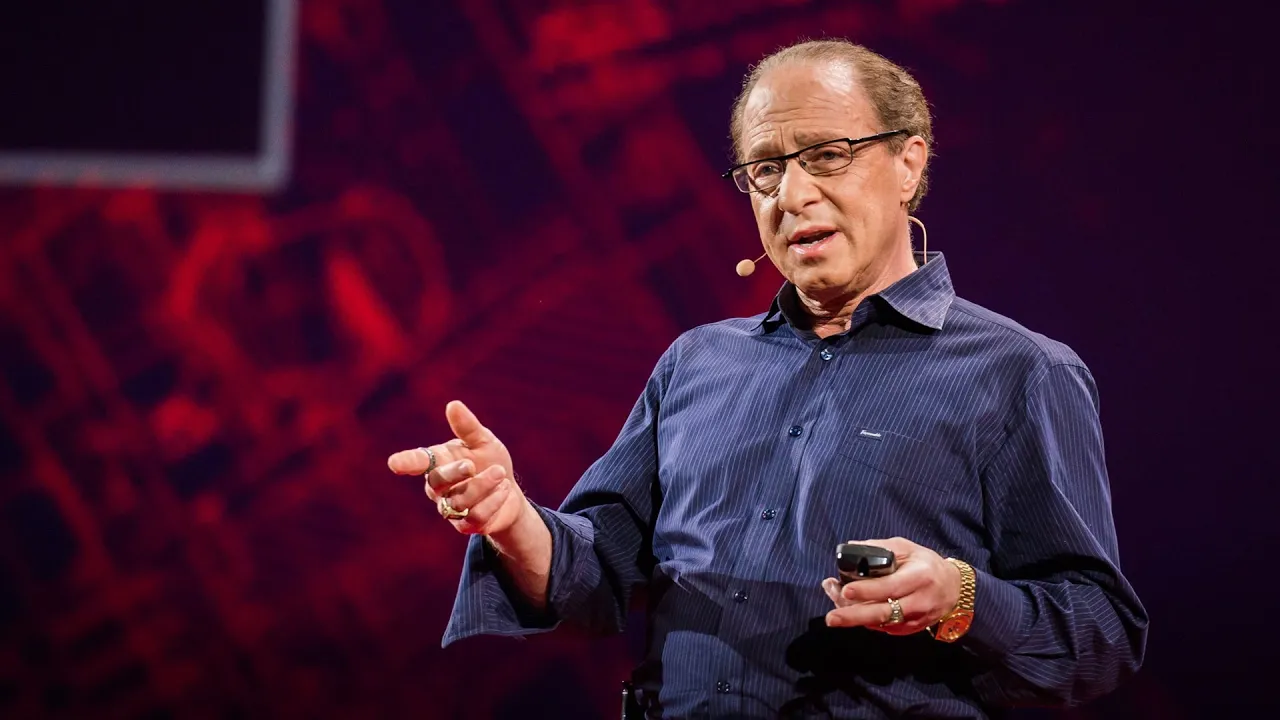
Ray Kurzweil: Get ready for hybrid thinking
The Story of the Neocortex
This section introduces the concept of the neocortex, a thin covering around the brain that allows mammals to engage in new types of thinking and invent new behaviors.
The Evolution of the Neocortex
- Mammals were the only creatures with a neocortex, which allowed them to have flexible behaviors and invent new solutions.
- Non-mammalian animals had fixed behaviors and could only learn new behaviors over thousands of lifetimes through evolution.
- The environment changed slowly until 65 million years ago when a sudden extinction event occurred, leading to mammals overtaking their ecological niche.
Growth and Functionality of the Neocortex
This section explores how the neocortex grew in size and complexity over time, becoming a significant part of human brains and influencing our thinking processes.
Development and Structure of the Neocortex
- Over time, mammals' brains grew bigger at an accelerated pace, with the neocortex developing distinctive ridges and folds to increase its surface area.
- The human neocortex is about the size of a table napkin but has numerous convolutions and ridges, making up 80% of our brain.
- The neocortex sublimates basic drives into more complex actions such as writing poetry or inventing apps.
Understanding Brain Modules
This section discusses how brain modules work together in hierarchies to process information and create thoughts. It also highlights advancements in neuroscience research.
Brain Module Hierarchy
- The brain consists of approximately 300 million modules organized in hierarchies.
- Each module specializes in recognizing specific patterns or concepts.
- Information flows both up and down within the hierarchy, allowing for pattern recognition and prediction.
Advancements in Brain Research
This section highlights the increasing amount of data and technological advancements in neuroscience research that enable us to understand how the brain works.
Technological Advances in Neuroscience
- The amount of data about the brain from neuroscience is doubling every year.
- Spatial resolution in brain scanning is also improving, allowing us to see individual interneural connections firing in real time.
- We can now observe how thoughts create changes in the brain and vice versa.
Example of Brain Module Functionality
This section provides a simple example to illustrate how brain modules recognize patterns and work together within hierarchies.
Recognizing Patterns
- Modules specialized in recognizing specific patterns, such as a crossbar to a capital A, get excited when they encounter their specific pattern.
- Information flows up through conceptual levels, becoming more abstract with each level.
- Information also flows down, allowing for predictions and adjusting recognition thresholds based on expectations.
Complexity of Brain Hierarchy
This section emphasizes that higher-level cognitive processes are built upon complex hierarchies within the brain.
Sophistication of Higher-Level Processes
- Higher-level processes, such as understanding irony or perceiving beauty, occur at higher levels of the hierarchy.
- However, the complexity lies beneath these higher-level processes where multiple senses converge to form perceptions.
- An example is given involving a girl who had brain surgery and conscious experiences related to different modules' activities.
The transcript ends abruptly after this point.
The Neocortex and Humor Detection
This section discusses the neocortex's role in detecting humor and how computers are beginning to master human language using similar techniques.
Neocortex and Humor Detection
- The neocortex has points that detect humor, causing a person to find everything hilarious when these points are stimulated.
- Computers are now using techniques similar to the neocortex to master human language.
- An algorithm called hierarchical hidden Markov model is described, which is used for natural language processing.
- Watson, an AI system, outperformed the best two players combined in the game show "Jeopardy" by correctly answering a query about a "meringue harangue."
- Computers can understand human language by reading sources like Wikipedia and encyclopedias.
Future of Search Engines
This section explores how search engines will evolve in the future to not only look for combinations of words and links but also understand and read billions of pages on the web and in books.
Evolution of Search Engines
- In five to ten years, search engines will be based on understanding rather than just word combinations and links.
- They will read for comprehension from billions of web pages and books.
- Users may receive personalized notifications from search engines based on their previous concerns or interests.
Nanobots and Brain Connectivity
This section discusses nanobots, their potential role in connecting our brain with synthetic neocortex in the cloud, and how this could enhance our thinking capabilities.
Nanobots and Brain Connectivity
- Nanobots can enter our brain through capillaries to connect our neocortex with a synthetic one in the cloud.
- Currently, we have access to additional computing power through cloud services. In the future, we will be able to access extra neocortex directly from our brain.
- This enhanced connectivity will allow for hybrid biological and non-biological thinking.
Expansion of Neocortex
This section explores the expansion of the neocortex throughout human evolution and how it has enabled qualitative leaps in language, art, science, technology, and innovation.
Expansion of Neocortex
- Two million years ago, humans developed larger foreheads due to an expansion of the neocortex.
- The additional quantity of thinking enabled qualitative leaps in language, art, science, technology, and innovation.
- Over the next few decades, humans are expected to experience another expansion of the neocortex.
Conclusion
This section concludes by emphasizing that humans are on the verge of another qualitative leap in thinking and innovation.
Another Qualitative Leap
- Humans have a unique ability to innovate due to their expanded neocortex.
- In the coming decades, humans will undergo another expansion in thinking capabilities.
- This expansion will lead to further advancements in language, art, science, technology, and innovation.
Turn any video into a summary like this
YouTube links, meetings, lectures. With transcripts, search, and chat.