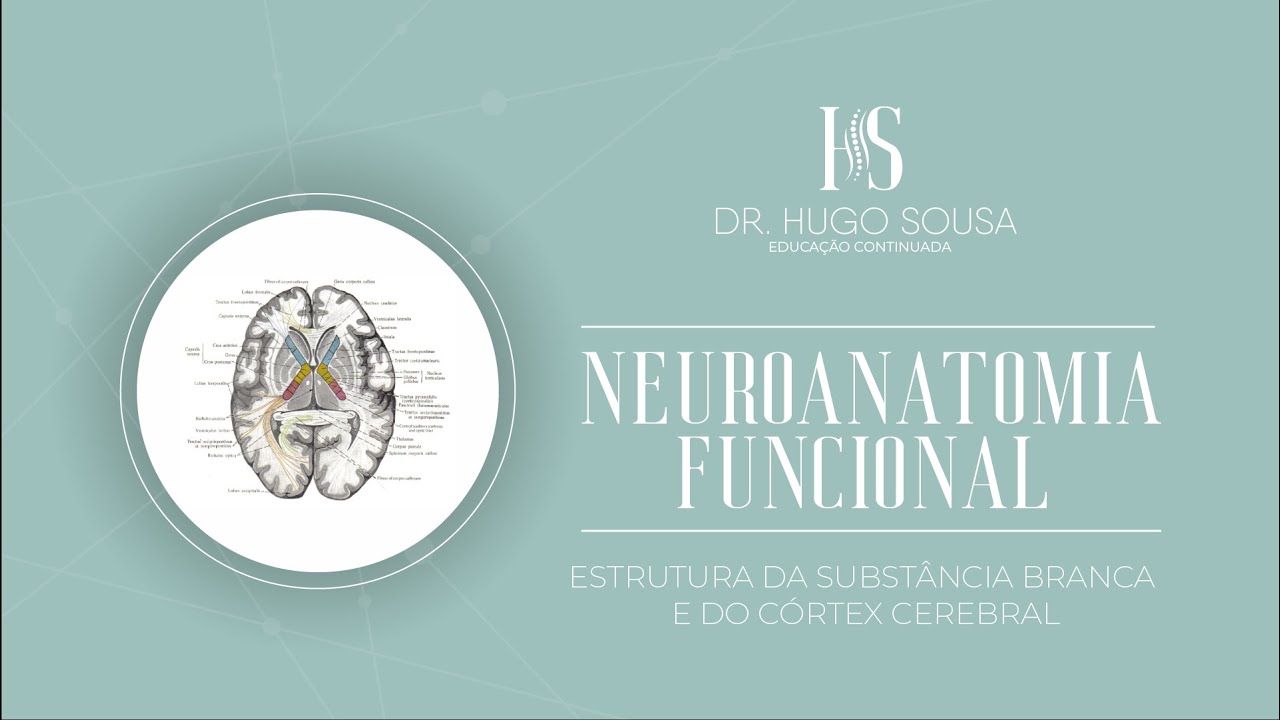
ESTRUTURA DA SUBSTÂNCIA BRANCA E DO CÓRTEX CEREBRAL - PARTE 2
Cerebral Cortex Structure and Function
Overview of the Cerebral Cortex
- The cerebral cortex is a thin layer of gray matter that covers the white matter of the brain, receiving sensory impulses that become conscious.
- It plays a crucial role in interpreting sensory information, highlighting its importance in processing and understanding stimuli.
Functions of the Cerebral Cortex
- The cortex initiates voluntary movements and is linked to psychic phenomena, indicating its multifaceted role in both physical and mental functions.
- Traumatic brain injuries can severely impact victims due to damage to the cortex, affecting either sensory or motor functions depending on the injury's location.
Layers of the Cerebral Cortex
- The cortex consists mainly of isocortex (90%), which has six distinct layers: molecular, external granular, external pyramidal, internal granular, internal pyramidal, and fusiform.
- Each layer has unique characteristics; for example, the molecular layer contains horizontal fibers for interconnecting different levels.
Neuronal Connections within Layers
- The external and internal granular layers connect with neighboring neurons through interneurons to enhance information interpretation.
- The external pyramidal layer primarily sends descending projections to white matter areas while also being involved in sensory reception.
Functional Classification of the Cortex
- The internal pyramidal layer projects towards critical areas like the brainstem and spinal cord; it plays a significant role in motor function.
- Anatomically, cortical classification relies on sulci (grooves) and gyri (ridges), aiding in locating cortical lesions effectively.
Important Sulci and Gyri
- Key anatomical features include major sulci such as the central sulcus (Rolando), which separates important gyri: precentral (motor control) and postcentral (sensory perception).
Neuroanatomy Overview
Key Structures of the Brain
- The discussion begins with an overview of the occipital, parietal, and temporal lobes, highlighting their anatomical features.
- The cingulate gyrus is identified as a significant structure located between the corpus callosum and other gyri, emphasizing its importance in brain function.
- The parieto-occipital sulcus is introduced, along with the calcarine sulcus which houses the primary visual area of the brain.
Lobes and Their Functions
- The frontal lobe is defined as being anterior to the central sulcus, with specific mention of its gyri: superior frontal gyrus, middle frontal gyrus, and inferior frontal gyrus.
- In relation to the parietal lobe, key structures such as the postcentral gyrus are discussed alongside superior and inferior parietal lobules.
Interactions Between Lobes
- The supramarginal gyrus is noted for its association with both parietal and temporal lobes; it plays a role in sensory integration.
- The angular gyrus is highlighted as another important structure within this region that contributes to various cognitive functions.
Temporal Lobe Features
- Three distinct gyri within the temporal lobe are mentioned: superior temporal gyrus, middle temporal gyrus, and inferior temporal gyrus.
- A deeper look into medial views reveals additional structures like the parahippocampal gyrus and uncus.
Structural Classification of Cortex
- Moving towards structural classification, distinctions between allocortex (primitive cortex with 3 to 5 layers) and isocortex (more complex cortex with 6 layers) are made clear.
- Allocortex relates to older evolutionary developments while isocortex represents more recent advancements in brain complexity.
Summary of Telencephalic Lobes
- An overview concludes by summarizing five telencephalic lobes: frontal (pink), parietal (blue), occipital (green), temporal (yellow), and insula located deep within lateral sulci.
Understanding the Brain's Cortical Areas
Mapping Designated Areas of the Cortex
- The speaker identifies 52 designated areas in the brain, referencing specific coordinates (e.g., area 1147 22/45 4486 41237), which are well-known in clinical and medical research contexts.
- Experiments involving stimulation of specific cortical areas have been conducted on dogs, monkeys, and humans, revealing that subjects report various experiences and feelings during stimulation.
- Specific movements can be elicited from certain regions of the cortex, indicating a direct relationship between cortical areas and motor functions.
Structural Classification of the Cortex
- The classification of cortical architecture includes isocortex and allocortex; isocortex is more recent evolutionarily and consists of six distinct layers.
- Within isocortex, there are heterotypic regions where individualization of layers varies; these can be granular or agranular based on neuron types present.
Neuronal Populations in Sensory Areas
- Sensory areas show a predominance of granular neurons to process incoming information effectively from subcortical centers.
- In contrast, motor regions exhibit a higher population of pyramidal cells compared to granular cells due to their role in motor projection.
Phylogenetic Development of the Cortex
- The cortex comprises three main parts: archicortex, paleocortex, and neocortex. Archicortex and paleocortex have fewer layers (3 to 5), representing more primitive structures.
- Neocortex occupies about 90% of the cerebral cortex area with six organized layers that facilitate complex processing.
Functional Classification of Cortical Areas
- Images illustrate locations such as paleocortex within the temporal lobe; specifically highlighting structures like the hippocampus which plays a crucial role in memory.
Understanding Cortical and Subcortical Connections
Overview of Cortical Projections
- The subcortical centers project to the cortex, indicating a bidirectional relationship between these areas.
- Secondary unimodal areas in the cortex interpret specific sensory and motor information from primary areas.
Auditory Information Processing
- Auditory information travels from the inner ear through the cochlear nerve (eighth cranial nerve) to nuclei in the brainstem known as cochlear nuclei.
- From the cochlear nuclei, fibers project to the inferior colliculus and then to the lateral geniculate body, ultimately reaching the primary auditory cortex.
Interpretation of Sound
- Distinguishing sound involves recognizing pitch, intensity, and tone; however, understanding its meaning requires additional cognitive processing.
- Secondary association areas are larger with more neuronal populations, enhancing memory formation related to sounds.
Unimodal vs. Supramodal Areas
- Each primary sensory area has a corresponding secondary unimodal area dedicated to that specific modality (e.g., auditory, olfactory).
- Tertiary association areas are supramodal; they integrate multiple sensory inputs for complex cognitive functions like planning and decision-making.
Complexity of Cognitive Processing
- These supramodal regions converge diverse sensory and motor information, contributing significantly to our behavior and internal perceptions.
Turn any video into a summary like this
YouTube links, meetings, lectures. With transcripts, search, and chat.