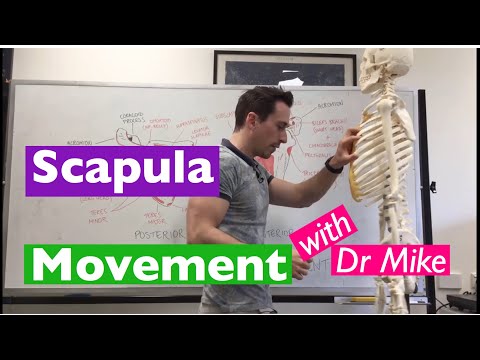
Scapula Movement | Functional Anatomy
Scapula Movement and Muscles Involved
In this video, Dr. Mikey discusses scapula movement and the muscles involved. He focuses on muscles that have direct attachments to the scapula and explains the different movements of the scapula.
Scapular Movements
- Elevation: The scapula moves upward.
- Depression: The scapula moves downward.
- Protraction: The scapula moves forward or away from the spine.
- Retraction: The scapula moves backward or towards the spine.
- Lateral Rotation (Upward Rotation): The glenohumeral joint raises or opens up.
- Medial Rotation: The glenohumeral joint lowers or brings down.
Muscles Involved in Scapular Movements
Elevation
- Levator Scapulae:
- Origin: First four cervical vertebrae.
- Insertion: Medial border of the scapula.
Depression
- Lower Fibers of Trapezius:
- Insertion: Along the spine of the scapula.
- Serratus Anterior (Lower Fibers):
- Origin: First eight ribs.
Protraction
- Serratus Anterior:
- Origin: First eight ribs.
- Insertion: Medial border of the scapula.
Retraction
- Rhomboids (Minor and Major):
- Important for retraction.
- Attachments on specific areas of the scapula.
- Horizontal and Inferior Fibers of Trapezius:
- Also important for retraction.
Lateral Rotation (Upward Rotation)
- Upper Fibers of Trapezius:
- Play a role in lateral rotation or upward rotation.
- Serratus Anterior:
- Also involved in lateral rotation or upward rotation.
Medial Rotation
- Rhomboids (Predominantly):
- Play an important role in medial rotation.
- Pectoralis Minor:
- Also involved in medial rotation.
Timestamps are provided for each section to easily navigate to the corresponding part of the video.