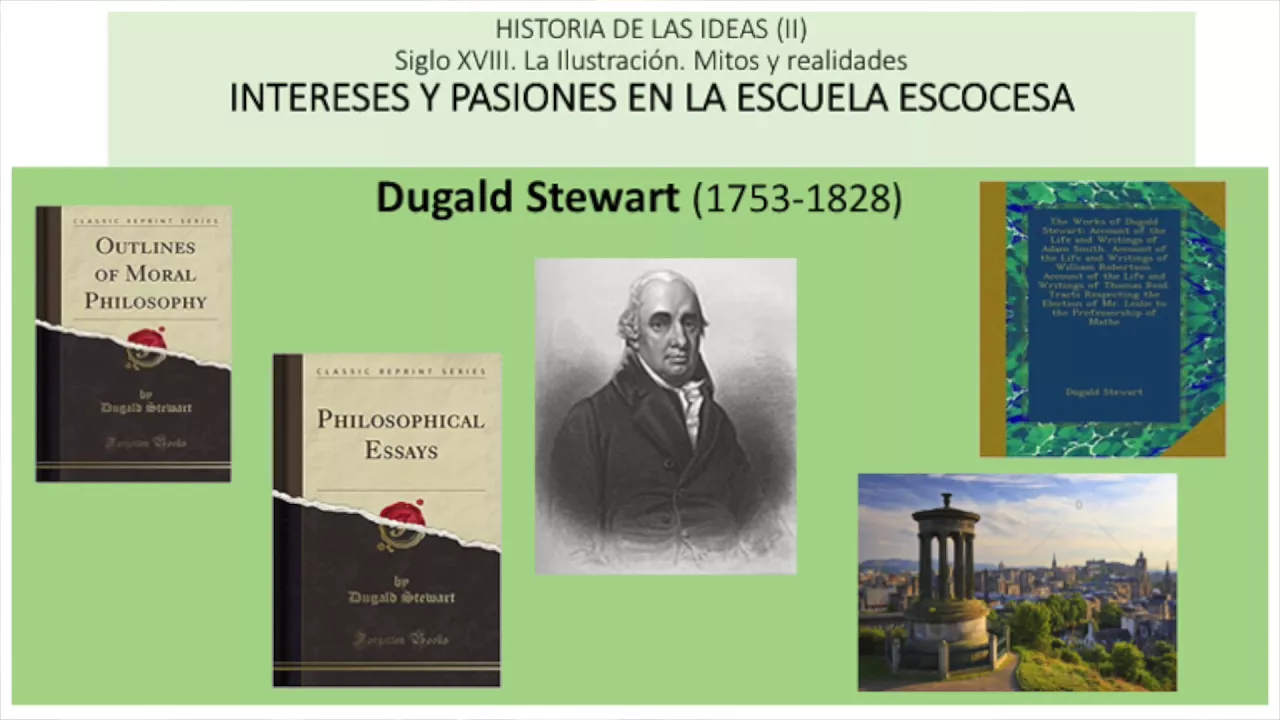
Conferencia: "Intereses y pasiones en la escuela escocesa"
Introduction to the Conference
Opening Remarks
- The speaker expresses gratitude for attendees at the third conference of the series, introducing Isabel Vences, a distinguished scholar known since her advanced student days.
- The speaker notes the lack of cultivation in the history of ideas in Spain and praises Vences for her brilliant work on a significant topic that will be discussed.
Background on Isabel Vences
- Isabel Vences is introduced as a professor at Carlos III University and an accomplished researcher with several important publications, including her doctoral thesis.
- The speaker highlights the challenges faced by university faculty today, emphasizing the need to teach beyond their specialized fields, which broadens their comparative understanding.
The Scottish Enlightenment: An Overview
Contextualizing the Discussion
- Vences acknowledges the cold weather but appreciates attendees' commitment to learning about the Scottish Enlightenment.
- She references Dr. Antonio Valdecantos’ previous comments about discussing enlightenment topics in front of experts like Carmen Iglesias, expressing her own apprehension.
Structure of Presentation
- Vences outlines her presentation structure: first discussing the importance of the Scottish school and then focusing on feelings, passions, and interests.
Significance of the Scottish Enlightenment
Intellectual Energy and Cultural Vitality
- The 18th century in Scotland is described as a period marked by remarkable intellectual energy and cultural vitality, leading to what is termed its "golden age."
- This era is characterized by an explosion of ideas that significantly impacted Western culture.
Defining Key Terms
- When referring to "Scottish Enlightenment," it encompasses not just literature but also broader cultural contributions from various intellectual figures during this time.
Characteristics of Literary Figures
Values and Principles
- Literary figures are defined as individuals who embody values such as humanism, scientific inquiry, critical thinking, respect for labor, rejection of inhuman treatment, and societal transformation aspirations.
Historical Context
- The 18th century represents a peak period for these literary figures in Scotland's intellectual prosperity between 1730 and 1780.
Notable Contributors to Scottish Enlightenment
Diverse Fields of Knowledge
- A range of influential personalities emerged during this period across various disciplines including architecture (e.g., John & Robert Adam), poetry (e.g., Robert Burns), historical novels (e.g., Walter Scott), painting (e.g., Robert Foulis), physics (the Gregory family), chemistry (Joseph Black), medicine (Colin), geology (Hutton), and engineering (James Watt).
The Scottish Enlightenment: Key Figures and Concepts
Influential Thinkers of the Scottish Enlightenment
- Francis Jochen is recognized as the father of the Scottish Enlightenment, alongside notable figures such as Henry Home, Thomas Reid, David Hume, and William Robertson.
- Adam Smith is highlighted for his contributions to moral philosophy through "The Theory of Moral Sentiments," in addition to his well-known work on economics, "The Wealth of Nations."
- Adam Ferguson's theories on social ranks are noted for their significant influence on later thought; Brugal Stewart contributed biographies of key figures like Adam Smith and William Robertson.
- The discussion includes lesser-known intellectuals such as Lord Monboddo, Blair, Campbell, Carlisle, Hume, and Beattie who were part of a cohesive intellectual elite in Scotland.
- These thinkers shared common affiliations with universities and the Church of Scotland (except Hume), indicating a strong network among scholars.
Cultural Revolution and Values
- The concept of culture is framed as a defining trait of the Enlightenment; it reflects a revolution in values that Paul Hazards describes as a crisis in European consciousness.
- This cultural shift encompasses philosophical, literary, scientific, economic, technological, social, and institutional changes that distinguish modern society from traditional structures.
- The Scottish Enlightenment is positioned within a broader European context while maintaining its unique characteristics shaped by local experiences.
- It emphasizes that while Enlightenment values were similar across Europe, local peculiarities led to distinct features within the Scottish context.
- The movement is characterized by its structured nature rooted in Scotland's national history and influenced by cultural heritage and institutional power.
Institutional Influence on the Scottish Enlightenment
- The Presbyterian Church played a crucial role during this period; legislation passed in 1712 allowed various religious groups to maintain their traditions amidst growing tolerance.
- Initially slow to manifest effects from this law of religious tolerance led to profound changes over time within Scottish religious life.
- A division emerged within the clergy between evangelical factions and moderates; moderates eventually gained control over church assemblies promoting more enlightened theological perspectives.
- Moderates fostered an intellectual current that significantly impacted the trajectory of the Scottish Enlightenment despite facing condemnation for their ideologies.
- Notable moderate ministers included figures like Alexander Carlyle who focused on ethical issues rather than doctrinal disputes.
Contributions from Key Figures
- Alexander Carlyle was educated at Edinburgh University under Francis Hutcheson; he authored numerous pamphlets addressing moral concerns.
- Jon Home also studied at Edinburgh University contributing significantly to literature during this era.
Edinburgh's Intellectual Legacy
Key Figures in Scottish Enlightenment
- Adam Ferguson, a prominent figure of the Scottish Enlightenment, served as a personal secretary and tutor to the Prince of Wales, and was also a historian of the Jacobite rebellion of 1745.
- William Robertson, another influential scholar from Edinburgh University, became a recognized rector and leader within the moderate faction of the Scottish Church by 1751.
The Role of Scottish Jurisprudence
- Despite the 1707 Act of Union between England and Scotland, Scotland maintained its own legal authority through institutions like the College of Justice, preserving its unique legal system.
- Scottish jurists played crucial roles in social and cultural development by contributing to philosophical studies on law's nature and its relationship with morality, custom, and economics.
Influence on Education and Legal Practice
- The revitalization of Scottish legislation by Enlightenment thinkers transformed it into an academic discipline that significantly impacted societal norms.
- Lawyers formed powerful communities due to their connections with aristocracy; they were central figures in discussions about Scots law and legal philosophy.
Interconnections with Continental Thought
- Many Scottish jurists engaged closely with contemporary philosophers, exemplified by Henry Young Lords Games who supported various intellectual pursuits during this period.
- Universities such as Edinburgh—often referred to as "the Athens of the North"—became vital centers for Enlightenment ideas while English universities experienced stagnation during the 18th century.
Societies Promoting Enlightenment Ideas
- The Philosophical Society of Edinburgh emerged as a key institution for advancing arts and sciences; other notable societies included Glasgow's Literary Society focusing on economic topics.
- Aberdeen’s philosophical society witnessed significant contributions from thinkers like Thomas Reid, marking it as a birthplace for common-sense philosophy.
Royal Society and Scottish Enlightenment
The Formation of the Royal Society
- The Royal Society, based in London, was established with contributions from several Scottish Enlightenment thinkers in the late 18th century. It is recognized as the oldest scientific society in Europe, focusing on science and culture, particularly medicine, anatomy, geometry, navigation, and mechanics.
Role and Recognition
- Today, the Royal Society functions similarly to a national academy of sciences in the UK and is a member of the British Scientific Council. In 2011, it received the Prince of Asturias Award for Communication and Humanities.
Diversity of Thought
- The existence of various societies and academies reflects an effort to create platforms for discussing societal concerns. The Scottish Enlightenment was not limited to one ideology but included diverse intellectual currents.
Schools of Thought
- Various labels have been applied to Scottish thinkers: political economy school, moralists' school, common sense philosophy school, historical school of social thought. A notable label discussed is "sentimental school," emphasizing their focus on emotions.
Interdisciplinary Connections
- Scottish Enlightenment thinkers were deeply engaged with social, moral, political, and economic issues. This engagement stemmed from a close relationship between history and social theory during the 18th century.
The Influence of Emotions
Sentimentalism vs Rationalism
- While many scholars link enlightenment with reason alone, it's crucial to recognize that Scottish Enlightenment thinkers emphasized emotions as significant determinants in human actions over pure rationality.
Study of Emotions
- These philosophers extensively studied how knowledge interacts with emotion and morality. They posited that understanding human behavior requires acknowledging emotional influences alongside rational thought.
Theories on Human Nature
Sensory Epistemology
- The study of the nervous system became central for these thinkers as it bridged mind-body interactions. They argued that sensory experiences are foundational for understanding human knowledge.
Social Connection through Feelings
- There was a transition from medical studies on the nervous system to philosophical theories about social connections based on feelings. This shift highlighted similarities between concepts of human nature and societal structures among Scottish philosophers.
Sympathy as a Concept
Understanding Sympathy
- Edinburgh physicians developed models linking bodily functions with human nature's sensitivity. They defined sympathy as communication between feelings across body organs—an essential concept reflecting interrelations within individuals' emotional experiences.
The Role of Sympathy in Human Interaction
Historical Perspectives on Sympathy
- The concept of sympathy was first articulated by Robert Witt, a prominent neuropsychologist, who believed that sympathetic action permeates the entire nervous system.
- Philosophers like Thomas Reid and Scottish literati such as John Gregory emphasized sympathy as a fundamental principle linking humanity through affection.
- Alexander Monroe Priestly, founder of the Edinburgh Medical School, also referenced the principle of sympathy in his medical writings, highlighting its significance in human interactions.
- Adam Ferguson acknowledged emotions as motivators for actions and stressed the importance of love for society and public affection in understanding human nature.
Sympathy's Influence on Social Bonds
- Davis and Adam Smith explored social connections based on sympathy, which they regarded as a powerful mental principle transcending mere psychological study to become foundational for ethical theory.
- They posited that sympathy is essential for moral judgments and interpersonal relationships, acting as an innate inclination to share others' feelings.
Moral Implications of Sympathy
- Sympathy plays a crucial role in morality by influencing approval or disapproval based on shared emotional experiences; it connects deeply with moral sentiments.
- David Hume viewed sympathy as an effective mechanism for social interaction and a cornerstone for socialization within communities.
Mechanisms of Emotional Exchange
- Sympathetic communication facilitates the sharing of thoughts and opinions between individuals, fostering similar behaviors through emotional resonance.
- The sympathetic mechanism operates regardless of whether feelings are pleasurable or painful; it explains why we seek to alleviate unpleasant feelings while promoting positive ones.
Hume's Perspective on Reason and Emotion
- Hume argued that reason serves merely as an auxiliary role in human conduct; true motivation stems from passions rather than rational thought alone.
- He asserted that moral decisions arise from feelings rather than intellectual reasoning, advocating for a sentiment-based approach to morality over rationality.
The Foundation of Social Cohesion
- According to Hume, societal benefits stem from the propensity towards sympathy rather than rational decision-making; moral approval underpins justice within society.
Understanding Adam Smith's Moral Philosophy
The Role of Sympathy in Human Interaction
- Adam Smith, influenced by a moderate liberalism, emphasizes the psychological dimension of sympathy as a basis for human intercommunication.
- Schmidt highlights the importance of understanding the chain of causes behind passions and feelings, focusing on motives and their proportional reactions.
- Unlike Hume, Smith views morality through sentiment; he believes moral feelings arise from an instinctive sympathy towards others' emotions.
- Smith stresses the relationship between feeling and its cause, examining not just emotional responses but also the motivations behind them.
- The distinction lies in recognizing both the emotion felt by another and the situation that triggers it, emphasizing social context in moral judgment.
Social Reflection and Self-Awareness
- Society acts as a mirror for individuals to reflect on their behavior, allowing them to gauge how others perceive their actions.
- Contrary to views that see humans as inherently selfish, Smith argues that there are natural principles within us that foster concern for others' well-being.
- While acknowledging societal perceptions of egoism, Schmidt points out inherent altruistic traits in human nature that drive empathy towards others’ happiness or suffering.
Altruism vs. Egoism in Moral Actions
- Actions motivated by self-love often have social references; individual behavior is primarily driven by self-interest but moderated by moral sentiments and social norms.
- According to Smith, this interplay results in beneficial conduct for both individuals and society at large despite underlying egoistic tendencies.
- Scholars note that Smith’s concept of sympathy transcends mere egoism or altruism; it encompasses a blend of emotional connections with others’ experiences.
Benevolence as a Foundation for Social Interaction
- In Adam Ferguson's view, benevolence is central to social interaction; it contrasts with purely mercenary exchanges proposed by other Enlightenment thinkers.
- Ferguson acknowledges self-preservation instincts but insists they must be balanced with considerations for societal welfare and collective interests.
The Historical Context of Moral Philosophy
- Despite rising interest-based philosophies during his time, Ferguson maintains that benevolence should prevail over self-interest in guiding human actions.
Analysis of Ferguson's Views on Human Nature and Society
The Role of Self-Interest in Society
- Ferguson acknowledges that self-interest drives human behavior within commercial society, yet he argues that this does not negate the capacity for mutual affection and social bonds.
- Despite recognizing self-interest, Ferguson maintains an optimistic view of human nature, prioritizing altruistic feelings over egoism in his hierarchical ordering of human attributes.
Social Passions vs. Egoism
- Ferguson critiques Bernard Mandeville’s perspective that private vices lead to public benefits, emphasizing instead the importance of social passions and benevolence as foundational to moral behavior.
- He suggests that acting with kindness ultimately serves one's own interests, as promoting the welfare of others also enhances personal well-being.
The Impact of Passions on Progress
- For Ferguson, passions are essential drivers of progress and prosperity; they are not mere byproducts but rather independent variables influencing social order and change.
- He contrasts 18th-century theories which often overlooked emotions with a more nuanced understanding that incorporates feelings into explanations for societal development.
Stages of Civilization and Human Development
- Ferguson outlines a progression through various stages of civilization—from savage societies to commercial ones—where emotional states evolve alongside societal complexity.
- He posits that humanity develops through interconnected stages akin to individual maturation, though different societies may exist at varying historical levels simultaneously.
Characteristics of Early Societies
- In early "savage" stages, passions are tumultuous; behaviors driven by love, ambition, greed, and violence dominate interactions among individuals.
- As societies advance to more complex forms characterized by rivalry and conflict, these violent passions remain influential despite moments of peace or idleness.
Transformation in Civilized Societies
- While civilized societies experience a refinement in their tumultuous passions over time, some negative traits can emerge if unchecked—leading to stagnation or despotism.
The Role of Passion and Commerce in Human Society
The Nature of Human Passions
- The text discusses how no one can oppose the impulse of passion unless there is a contrary impulse, highlighting that passions undergo modifications during the process of perfection.
- It emphasizes that while human nature allows for the improvement of habits, it also retains qualities such as love for society, friendship, eloquence, and courage alongside vices like animosity.
- The impact of civilization is noted to be not just about inspiring tenderness but also about mitigating potential abuses stemming from strong passions.
Commerce as a Civilizing Agent
- Enlightenment thinkers celebrate the transition from barbarism to internal peace and political stability, suggesting that rough customs require transformation.
- The idea emerges that commerce serves as a powerful civilizing agent capable of fostering progress, prosperity, and security through managing human passions.
Insights from Historical Thinkers
- Montesquieu's assertion is cited: where there are gentle manners, there is commerce; conversely, where commerce exists, gentle manners thrive.
- William Robertson notes that commerce refines human behavior rapidly as arts advance within commercial contexts.
Characteristics of a Civilized Society
- A commercial society is viewed as a moralizing force providing social and political benefits beyond mere material gains.
- Key virtues associated with this society include diligence, temperance, punctuality, honesty, and predictability—essential for its functioning.
Leadership Dynamics in Commercial Societies
- In thriving commercial environments, leadership emerges where stronger individuals motivate weaker ones; this dynamic fosters societal cohesion.
- Ferguson argues that while passionate rivalries exist in commercial societies, they indirectly enhance social cohesion and political efficacy by protecting rights.
Conflict and Social Progress
- Animosity can lead to positive social outcomes; conflict between factions preserves freedoms and provides outlets for group disputes.
- Ferguson posits that animosity drives actions towards beneficial social consequences on both individual and collective levels.
Complexity of Human Emotions
- The text suggests that loyalty stems not only from benevolence but also from discord; political conflicts can highlight admirable qualities like generosity and bravery.
- Despite seeming contradictions between love/compassion versus jealousy/envy in human motivations, both can coexist to produce enthusiasm and joy in life experiences.
Active Nature of Humanity
- Humans are inherently active beings who resist idleness; prolonged inactivity may lead to lethargy or despotism according to Enlightenment thought.
The Role of Commerce in Civilization
The Impact of Commerce on Society
- The arrival of commerce transforms societies, moving them away from ignorance and laziness towards industriousness and knowledge.
- Engaging in conversation and contributing to society enhances humanity, suggesting that public affairs should be prioritized over mere personal pleasure.
- Capitalism faced challenges from pre-capitalist mentalities rooted in feudal times, as noted by Hillman.
- Commerce is seen as a civilizing force that fosters diligence, knowledge, and humanity while transforming harmful passions into constructive ones.
- Scottish Enlightenment thinkers distinguished between different passions, arguing some could be beneficial rather than destructive.
Evolution of Economic Thought
- In the 18th century, passions were re-evaluated as essential to life’s creative potential; however, this perspective began to undermine moral foundations by the 19th century.
- Later thinkers criticized the notion of "gentle commerce," highlighting historical violence associated with commercial expansion.
Reflections on Scottish Enlightenment
- A discussion emerges about the vibrant intellectual culture during Scotland's Enlightenment period compared to other European centers like Athens or Florence.
- The flourishing of Scottish universities was contrasted with Oxford and Cambridge due to their internal criticisms and adherence to outdated scholastic teachings.
Societal Context and Development
- The importance of elite societal structures is emphasized; these cycles are crucial for reviving overlooked illustrations from history.
- Understanding Scottish Enlightenment requires recognizing its unique characteristics influenced by local institutions such as churches and universities.
Historical Perspectives on Civilization
- Enlightened thinkers believed they had reached a civilized commercial society while viewing others still in barbarism; this view has been challenged historically.
Consequences of Actions and Emotions in Human Nature
The Role of Emotions and Intuition
- Discussion on the unintended consequences of actions, highlighting the significance of feelings and emotions in human behavior.
- Reference to cognitive sciences, emphasizing how brain scientists study emotions linked to physical sensations, as noted by Piaget.
Scottish Enlightenment Insights
- Exploration of the connection between medical understanding and sensory experiences during the Scottish Enlightenment, showcasing advanced insights into human nature.
- Mention of an idealized society where political order could channel human passions towards positive outcomes, despite inherent challenges.
Critique of Optimism in Human Nature
- Acknowledgment that while empathy is scientifically validated, there exists a darker side to human nature that was not fully addressed by Enlightenment thinkers.
- Recognition that the optimistic view of humanity faced criticism in subsequent centuries for underestimating negative aspects like violence and tumultuous passions.
Contemporary Relevance of Enlightenment Ideas
- Current advancements in neuroscience affirm many 18th-century Scottish intuitions about emotions influencing moral choices.
- Importance placed on understanding that emotions are integral to our moral decision-making processes, linking back to Enlightenment philosophy.
The Need for Reason alongside Emotion
- Assertion that while reason is crucial for avoiding barbarism, it must be balanced with emotional understanding as proposed by Enlightenment thinkers.
Biographical Dictionary Launch Announcement
Introduction to New Resource
- Brief mention about an upcoming Spanish biographical dictionary set to launch online with over 50,000 biographies available for public access.
Comparison with Historical Dictionaries
- Comparison made between this new resource and historical dictionaries from Scotland and Oxford, emphasizing its significance for educational purposes.
Accessibility for Youth