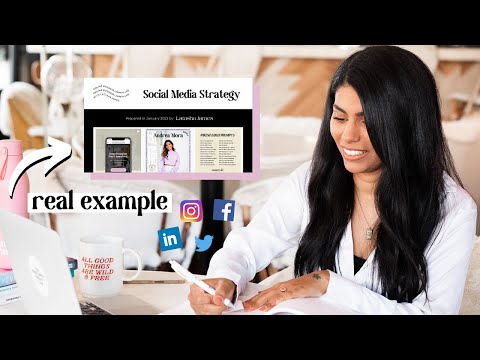
Real Social Media Strategy Example and Walkthrough
Social Media Strategy Presentation
In this video, the presenter shares a social media strategy for an online education business called Online Business Launch Lab. The strategy is designed to drive core sales, establish OBL brand authority, and generate leads for pros and their directory.
Goals
- The primary goal is to drive core sales and revenue.
- Establish OBL brand authority by building trust with students and the online business community.
- Generate leads for pros and their directory.
Website Audit
- Conducted a mini audit of the website to identify areas that need improvement.
- Identified issues with page speed, mobile responsiveness, and user experience.
- Recommended solutions such as optimizing images, improving site structure, and adding call-to-actions.
Content Strategy
- Created a content calendar to plan out posts in advance.
- Focused on creating educational content that provides value to the audience.
- Used a mix of formats such as blog posts, videos, infographics, and webinars.
- Tailored content to each platform's unique features and audience preferences.
Engagement Strategy
- Engaged with followers by responding to comments and messages promptly.
- Used hashtags strategically to increase reach and visibility.
- Collaborated with influencers in the industry to expand reach and credibility.
Advertising Strategy
- Utilized Facebook Ads Manager to create targeted ads based on audience demographics, interests, behaviors, etc.
- Set clear objectives for each ad campaign such as increasing website traffic, generating leads, or promoting a specific product.
- Monitored ad performance regularly and made adjustments as needed to optimize results.
Analytics and Reporting
- Used analytics tools such as Google Analytics and social media platform insights to track performance metrics.
- Created monthly reports to share with the client that highlight key metrics such as engagement rate, reach, impressions, conversions, etc.
- Used data insights to inform future strategy decisions and make improvements.
Recommendations for Website and Social Media
In this section, the speaker provides recommendations for improving the website and social media presence of a client.
Website Recommendations
- Add social media icons in the header or footer of the website.
- Install Google Analytics and Facebook Pixel to enable better analytics and retargeting.
- Consider adding a blog to drive organic traffic through Google.
Social Media Recommendations
- Increase posting frequency on Instagram to a minimum of three times per week.
- Repurpose Instagram content onto Facebook to have a presence on the platform.
- Consider repurposing content into LinkedIn.
- Leverage user-generated content and stories to highlight brand authority.
- Focus on courses and alumni to shift focus away from being solely about the lead instructor.
Full Web and Social Audit
In this section, the speaker discusses conducting a full web and social audit for clients that already have an online presence.
Full Web Audit
- List out all pages on the website, identifying areas for improvement such as misspellings or menu items that need condensing.
Full Social Audit
- List out all social media platforms used by the client, identifying areas for improvement such as posting frequency or lack of use of certain features.
Social Media Management Plan
In this section, the speaker discusses a social media management plan for her clients and outlines key priorities.
Priorities
- Not everyone is fully immersed in the world of social media. Clients need to be educated on what an Instagram story or ad means.
- Focus on top priorities such as adding new stories, highlights, updating stories daily, creating alumni features and highlighting course reviews regularly.
- Get on a consistent posting schedule ideally five times per week.
- Create a courses highlight and an alumni highlight because there is no menu of all the courses that are created.
Hashtag Library
- The speaker recommends building a hashtag library based on Instagram with 10 different hashtags added to each bucket.
- Adding 10 hashtags allows for mixing up and creating your own hashtag sets.
Prioritizing Social Media Platforms
In this section, the speaker discusses how to prioritize social media platforms for a brand and shares some quick wins for LinkedIn and Facebook.
LinkedIn Priorities
- Share podcast clips on the OBL L page.
- Encourage alumni interaction by tagging the OBL elec instead of personal accounts.
- Announce the directory via personal profiles.
Facebook Priorities
- Repurpose existing content from Instagram.
- Consider creating an alumni-only Facebook group.
- Test an advertising strategy with retargeting for abandoned carts.
Content Pillars
In this section, the speaker discusses content pillars and focuses on three main areas for this brand's social media strategy.
Sustainably Self-Employed
- Focus on being sustainably self-employed as a content pillar.
Learning & Development
- Focus on learning and development as a content pillar.
Freelancing Tips & Tricks
- Focus on freelancing tips and tricks as a content pillar.
Building an Online Business for the Long Haul
Natasha shares her approach to building a sustainable online business and introduces the three pillars of her program.
Three Pillars of the Program
- The first pillar is building an organic, sustainable business that is in it for the long haul.
- Slow and steady wins the race.
- Focus on building strong foundations.
- The second pillar is learning from the best by providing university-level education from pros who are doing it big.
- Modeled after university-level classes with weekly lectures, homework assignments, small groups for collaboration and networking.
- Immersive, high level, and challenging education experience.
- The third pillar is being at your service by positioning OBL Al as not just an education hub but also as a hub for building an online business in other ways including outsourcing.
- Directory of resources available to help build your online business.
Examples of Pillars in Action
- Sustainably Self-Employed: Make it easy to pay you
- Carousel with tips on how to make it easy to pay you such as using ACE and invoicing on time
- Alumni Quotes: Pricing Tips
- Freelance Friday Club members and course alumni provide pricing tips
- Content Ideas:
- Tips and tricks carousels with different topics such as pricing, getting paid, finding clients
- Saveable motivation posts that make people want to save or share in their stories
Introduction
In this section, the speaker introduces herself and explains that she will be discussing how to create a content strategy for a new brand. She also mentions that she will provide examples of what she means by this.
- The speaker introduces herself and explains the topic of discussion.
- Examples will be provided to help understand the concept better.
Pillars of Content Strategy
In this section, the speaker discusses the four pillars of content strategy: consistency, learn from the best, at your service, and community building.
Consistency
- The importance of consistency in branding is discussed.
- Examples are given on how to maintain consistency in branding.
Learn from the Best
- The importance of learning from successful brands is discussed.
- Examples are given on how to learn from successful brands.
At Your Service
- The importance of providing value to customers is discussed.
- Examples are given on how to provide value through customer service.
Community Building
- The importance of building a community around a brand is discussed.
- Examples are given on how to build a community around a brand.
CEO or Leadership Involvement
In this section, the speaker emphasizes the importance of having CEO or leadership involvement in today's business world.
- Having CEO or leadership involvement is important for running a business successfully.
- Personal branding alongside company branding is important for CEOs and leaders.
Content Ideas
In this section, various content ideas are presented for creating an effective content strategy.
Directory Highlights
- Highlighting directory members weekly can be an easy way to start creating content immediately.
Alumni Interview Clips
- Sharing highlights and stories about alumni can help close loops and show what is possible.
Growth Tips and Stories
- Sharing growth tips and stories can help people understand how to build a successful online business.
Leveraging UGC
- User-generated content can be used to create effective content for a brand.
Social Media Strategy Call Overview
In this section, the speaker discusses a social media strategy call and what a social media strategy document would look like.
Key Points
- The speaker emphasizes the importance of using satisfied customers as marketers.
- The speaker suggests doing Instagram takeovers with alumni to showcase their achievements and share behind-the-scenes glimpses of their lives.
- A quick win would be adding an Instagram highlight for alumni tags.
- Encouraging students to tag on LinkedIn and Instagram after completing a course can help increase engagement.
- After discussing ideas, the speaker outlines next steps, including making profile edits, repurposing content, and creating new content.
Importance of Human-to-Human Conversation in Social Media Strategy Calls
In this section, the speaker highlights the importance of having human-to-human conversations during social media strategy calls.
Key Points
- The speaker notes that it's important to talk to clients about their ideas because they might have insights that you didn't think of.
- Having an hour-long conversation with clients can help you understand their needs better.
- The speaker encourages viewers to subscribe to her channel for more information on social media strategy, online business ownership, course creation, and independent professional life.
I understand the instructions. Let's get started!