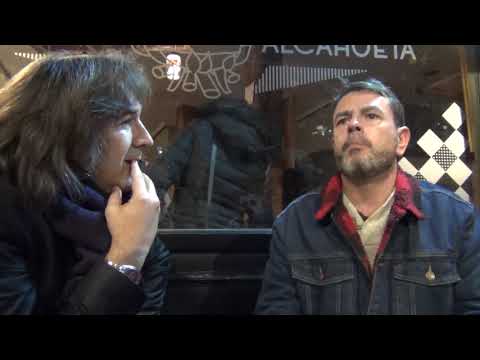
EL EGO TRASCENDENTAL SEGÚN ÍÑIGO ONGAY. ENTREVISTADO POR MIGUEL ÁNGEL CASTRO.
Understanding the Transcendental Ego
Introduction to the Transcendental Ego
- The discussion begins with a question posed to Pedro Insúa regarding the concept of the transcendental ego and its significance in philosophical materialism.
- Insúa reflects on a previous conference, emphasizing how he prepared his work by integrating linguistics, psychoanalysis, and behaviorism into his exposition.
Importance of the Transcendental Ego
- The need for clarification is highlighted; Insúa aims to explain what the transcendental ego is and why it holds importance in philosophical materialism and business ethics.
- A reference is made to a prior publication in "El Basilisco," indicating that this topic has been explored before but requires further elaboration.
Philosophical Context
- Insúa critiques positions held by figures like Ricardo Sánchez, who argue that ideas related to materialism are merely idealistic residues. He defends the transcendental ego as a fundamental concept.
- He asserts that the transcendental ego serves as a crucial link between reality and thought, countering interpretations that diminish its role.
Distinction Between Fields of Knowledge
- Insúa discusses how different fields (mathematics, biology, engineering) have their own domains of knowledge which do not overlap with philosophy's unique inquiries.
- He emphasizes that philosophy addresses fundamental questions about existence itself, distinguishing it from other disciplines.
The Nature of Philosophy as a Field
- Philosophy is described as lacking clear boundaries compared to scientific fields; it encompasses all aspects of inquiry without an external limit.
- The metaphor of 'fields' is used to illustrate how various disciplines operate within defined parameters while philosophy remains expansive and inclusive.
Mapping Reality Through the Transcendental Ego
- Insúa posits that understanding reality requires creating a 'map,' which can only be constructed through an overarching perspective provided by the transcendental ego.
- He argues that individual egos cannot fully encapsulate or label reality since they are limited; thus, there must be a collective or universal aspect to effectively engage with existence.
Conclusion: The Role of the Transcendental Ego
- The discussion culminates in recognizing that while individuals perceive reality differently, there exists an underlying totality represented by the transcendental ego.
- This totality transcends personal experiences and limitations, suggesting that true understanding comes from acknowledging this broader perspective.
The Role of Ego and Mythology in Art
The Concept of Ego in Relation to Mythology
- The discussion begins with the idea that the only true cartographer is not a new normal but rather a "super ego," linking this concept to mythology, particularly referencing figures like Christ holding a world map.
- The speaker critiques the notion of geometric art as being unjustly labeled; they argue that both Christian and Muslim art share similar geometric elements, challenging preconceived notions about their differences.
Fragmentation of Reality
- The speaker posits that the ego serves as a theological echo, suggesting that historical figures like Alexander and Caesar claimed divine status (Zeus), reflecting on how empires shape perceptions.
- They emphasize that while these powerful figures can convince others through their narratives, reality itself remains fragmented and cannot be fully contained within any singular ideology or belief system.
Plurality and Incommensurability
- A critical point made is that the world consists of diverse elements that are internally fragmented; no single perspective can encompass all aspects due to their incongruity.
- This leads to an exploration of ontology, where materiality is discussed as being complex and heterogeneous, resisting reduction into simpler forms or categories.
Perception Filters
- The conclusion drawn is that our understanding of the world is shaped by human and animal perceptual filters; without these filters, fundamental concepts such as rocks would lose meaning.
- It’s argued that our perception creates a spectacle out of reality, which is inherently infinite but limited by our sensory capabilities.
Implications for Understanding Reality
- The speaker asserts that reality should not be viewed as a self-contained totality but rather as a contradictory whole composed of disconnected pluralities.
- Finally, they highlight how human perception plays a crucial role in shaping our experience of reality, emphasizing its significance in understanding both material existence and abstract concepts.