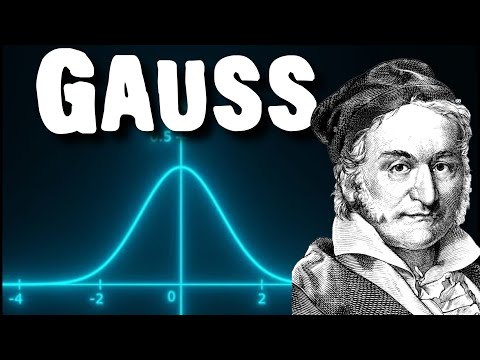
La Historia del Matemático MÁS GRANDE de Todos los TIEMPOS
Introduction and Question
The video starts with a question about adding numbers from 1 to 100, which was asked to a 3-year-old child in 1780. This question was posed by a teacher who used to punish the child for being hyperactive.
Can you add numbers from 1 to 100?
- The video begins with a question about whether one can add numbers from 1 to 100.
- This question was asked to a 3-year-old child back in 1780 by a teacher who used to punish the child for being hyperactive.
Introduction of Carl Frederick Gauss
The video introduces Carl Frederick Gauss, a legendary mathematician known as the "Prince of Mathematics." It discusses his biography, contributions, and important theorems.
Carl Frederick Gauss - Biography and Contributions
- Carl Frederick Gauss, also known as Johann Carl Friedrich Gauss, was born on April 30, 1777, in Brunswick, Germany.
- Despite his father's lack of formal education, he noticed his son's mathematical abilities and encouraged him to study mathematics.
- At the age of 7, Gauss started attending a local school where he demonstrated exceptional skills in arithmetic and geometry.
- At the age of 10, Gauss discovered the formula for summing the first 100 integers, impressing his teachers and becoming recognized as a mathematical prodigy.
- In 1799, Gauss published his first book called "Disquisitiones Arithmeticae," which focused on number theory and included his fundamental theorem of algebra.
- He became a professor at the University of Göttingen in 1801 and made significant contributions not only in mathematics but also in physics and astronomy.
- Some of his notable contributions include formulating important theorems in various fields, such as number theory, statistics, and differential geometry.
- Gauss's work in mathematics, physics, and astronomy remains influential and relevant to this day.
Curiosities about Carl Frederick Gauss
This section highlights some interesting facts about Carl Frederick Gauss, showcasing his exceptional mathematical abilities and personal characteristics.
Curiosities about Carl Frederick Gauss
- From a young age, Gauss demonstrated his mathematical prowess by calculating the sum of numbers from 1 to 100 at the age of 3 and discovering a formula for summing arithmetic series at the age of 10.
- Despite his genius, Gauss remained humble and reserved. He avoided seeking recognition or receiving awards for his work.
- In addition to mathematics, Gauss was interested in cartography and geodesy. He proposed using triangulation to measure large areas accurately and developed the method of least squares for calculating measurements in triangulation.
- While known for being modest and reserved, Gauss had friendly rivalries with other mathematicians of his time, such as Pierre-Simon Laplace and Adrien-Marie Legendre.
Conclusion
Carl Frederick Gauss was an extraordinary mathematician who made significant contributions to various fields. His early achievements as a child prodigy set the stage for a remarkable career filled with groundbreaking discoveries. Despite his brilliance, he remained humble and focused on his work rather than seeking fame or accolades. Today, Gauss's legacy continues to influence mathematics and science as a whole.
Gauss: The Prince of Mathematics
This section provides an introduction to Carl Friedrich Gauss, highlighting his obsession with prime numbers, his contributions to astronomy and geodesy, and his exceptional memory.
Gauss's Life and Abilities
- Gauss was a mathematician who had a fascination with prime numbers.
- He spent a significant portion of his life studying prime numbers and made several conjectures and theorems related to them.
- Gauss had exceptional abilities in languages. He was fluent in German, Latin, Ancient Greek, French, Italian, English, and Russian.
- He had an extraordinary memory and could remember names, dates, quotes, and mathematical formulas without the need for notes.
Contributions to Astronomy
- In addition to mathematics, Gauss also made contributions to astronomy.
- He studied the orbits of celestial bodies such as the dwarf planet Ceres.
- Gauss proposed the theory of gravitational fields and made advancements in understanding planetary motion.
Teaching Style
- Although known for being modest and humble, Gauss was an demanding teacher who set high standards for his students.
- He expected his students to meet the same elevated standards he held for himself but also provided support and guidance when needed.
Family Life
- Gauss had six children - three sons (Joseph Eugene and William) and three daughters (Teresa Joana and Dorotea).
Gauss's Important Contributions
This section highlights some of Carl Friedrich Gauss's most significant contributions in mathematics, astronomy, physics.
Theorem of Gaussian Markov
- The theorem states that under certain conditions, the ordinary least squares estimator is the best linear unbiased estimator for a linear regression model.
- Conditions include linearly related explanatory variables with the response variable,
- Errors having zero mean and constant variance,
- Non-correlation between errors,
- Errors following a normal distribution.
Gauss-Bonnet Theorem
- This theorem is fundamental in differential geometry, which forms the basis for understanding the universe.
- It relates the curvature of a surface to its topology.
- The integral of Gaussian curvature over a closed surface depends only on the surface's topology.
Fundamental Theorem of Algebra
- Gauss's first publication established that any polynomial of degree n has n roots in the complex numbers.
- This theorem is foundational and widely used in mathematics.
Gauss's Laws
- Gauss formulated laws related to electric and magnetic fields.
- The law for electric fields (Gauss's Law) establishes a relationship between electric flux and electric charge within a region of space.
- The law for magnetic fields (Gauss's Law for Magnetism) states that the total magnetic flux through any closed surface is always zero, indicating no sources or sinks of magnetic field lines.
Importance of Gauss's Contributions
This section emphasizes the significance and impact of Carl Friedrich Gauss's contributions in various fields.
Statistical Estimation
- Gauss's theorem on Gaussian Markov provides a foundation for statistical estimation techniques, particularly in linear regression models.
- It helps determine the best estimator with minimal bias when certain conditions are met.
Differential Geometry and Topology
- The Gauss-Bonnet theorem plays a crucial role in differential geometry, which is essential for understanding complex surfaces and their properties.
- It relates geometric properties such as curvature to topological characteristics like holes or handles.
Fundamental Theorem of Algebra
- Gauss's theorem on polynomials laid the groundwork for many mathematical developments.
- It guarantees that every polynomial equation has solutions in complex numbers, enabling further exploration and analysis.
Laws of Electromagnetism
- Gauss's laws for electric and magnetic fields provide fundamental principles governing these phenomena.
- They allow us to calculate field strengths based on known charge or current distributions, aiding in the understanding and application of electromagnetism.
The transcript provided was a mix of English and Spanish. I have translated the content into English for clarity and consistency.
Important Contributions of Carl Friedrich Gauss in Mathematics and Science
This section discusses the significant contributions of Carl Friedrich Gauss in mathematics and science.
Contributions to Number Theory
- Gauss dedicated much of his work to number theory, making significant contributions.
- He developed the theory of quadratic residues and Legendre symbols, which establish a relationship between quadratic residues and prime numbers.
- This theorem is crucial in cryptography and data encoding.
Contributions to Vector Calculus
- Gauss also made important contributions to vector calculus.
- The Gauss-Ostrogradsky theorem, also known as the divergence theorem, relates the flow of a vector field through a closed surface to the divergence of the field within that surface.
- This theorem has applications in physics and engineering, helping understand the behavior of vector fields in various situations.
Contributions to Linear Algebra
- Gauss's name is associated with the Gaussian elimination method or Gaussian Jordan elimination.
- This algorithm is used to solve systems of linear equations by applying elementary row operations to an augmented matrix.
- The goal is to transform the matrix into its reduced row echelon form, also known as the canonical form.
Summary of Contributions
- Gauss's contributions spanned various areas such as mathematics, statistics, differential geometry, physics, and astronomy.
- His theorems and formulas remain relevant and influential today.
- He is considered one of the greatest mathematicians of all time.
Timestamps are provided for each section.