Reflexión de la LUZ
Reflection of Light
Introduction to Light and Reflection
- The session begins with an introduction to the concept of light reflection, emphasizing that light travels in a straight line at a speed of 300,000 kilometers per second in a vacuum, which is considered the maximum speed in the known universe.
- It is clarified that while reflection does not change the speed of light, refraction does; this distinction will be explored in future classes.
Speed of Light and Its Implications
- The speaker illustrates the vastness of light's speed by stating it could circle Earth approximately eight times in one second if it traveled in circular paths instead of straight lines.
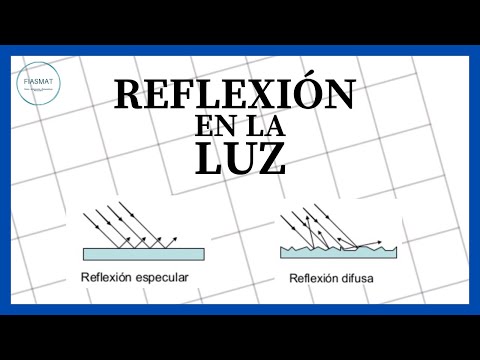
- Upon reaching a surface, light reflects. The discussion focuses on two types of reflection: diffuse and specular.
Types of Reflection
Diffuse vs. Specular Reflection
- The class will concentrate on understanding diffuse and specular reflections, noting that absorption also occurs when surfaces absorb certain frequencies while reflecting others.
Laws of Reflection
- Understanding the laws governing reflection is crucial. Two main laws are introduced:
- First Law: The incident ray and reflected ray form equal angles with respect to the normal (the imaginary line perpendicular to the surface).
- Second Law: Both rays lie within the same plane.
Detailed Explanation of Reflection Laws
- The first law emphasizes that both rays must maintain equal angles relative to the normal line drawn at 90 degrees from the surface.
- This normal line serves as a reference for measuring angles; thus, any angle given for incidence refers back to this imaginary line.
Specular Reflection Explained
- Specular reflection occurs when parallel rays hit a smooth surface; they reflect off as parallel rays due to adherence to reflection laws.
- An example provided is looking into a mirror where all incoming rays reflect orderly because they follow these established rules.
Diffuse Reflection Characteristics
- In contrast, diffuse reflection happens on rough surfaces where reflected rays scatter in multiple directions due to varying normals across different points on the surface.
Reflection in Physics: Understanding Specular and Diffuse Reflection
The Nature of Reflection
- Reflection occurs according to the law of reflection, where the angle of incidence equals the angle of reflection. However, when surfaces are irregular (e.g., "chueca"), the normals differ across points, leading to varied angles for incident and reflected rays.
- Two types of reflection are discussed: specular and diffuse. Specular reflection is exemplified by a calm lake acting like a mirror, while diffuse reflection occurs in irregular surfaces such as a river with ripples that obscure clear reflections.
Importance of Studying Reflection